The late Lubavitcher Rebbe Menachem Mendel Schneerson zt"l had no successor as the rebbe of Chabad-Lubavitch. Why is this? Was it simply because he had no children? If so, why was nobody else appointed to be the rebbe?
Asked
Active
Viewed 1.8k times
22


-
3Would you want to follow that act? (The impersonal you) – HodofHod Apr 29 '13 at 20:37
-
16@HodofHod Yehoshua did. – Double AA Apr 29 '13 at 20:38
-
1@DoubleAA cute. But, in our situation there was nothing to follow. I'm not Chabad but have tremendous admiration for the Lubavitcher Rebbe. There truly was no one like him in the last few generations. Period. Not only his love for Klal Yisrael but also his greatness in learning. – Yehoshua Apr 29 '13 at 20:41
-
6@Yehoshua, and you don't think you could say that about Moshe Rabeinu? – Daniel Apr 29 '13 at 20:43
-
1@DoubleAA Chosen by G-d and his predecessor, I'm not sure he had much choice. Nor worries about whether Moshe's followers would accept him. – HodofHod Apr 29 '13 at 20:43
-
2@Yehoshua I didn't mean you :) Moshe said it's important to have a leader even though he knew he was the ultimate prophet. That's why he asked for Yehoshua – Double AA Apr 29 '13 at 20:43
-
@HodofHod Your last sentence is now getting to an answer. – Double AA Apr 29 '13 at 20:44
-
@Daniel the reason for succession then (whatever HaShem's reasoning) we can't compare to that of today or understand. It was part of a plan. This is also part of a plan but since we're dealing not with a Navi or Nasi, etc then we can began to understand more – Yehoshua Apr 29 '13 at 20:44
-
1@HodofHod Btw God's initial speech to Yehoshua does make it seem like he is reassuring Yehoshua that the people will follow him. Even with Moshe's appointment it seems Yehoshua had some doubts about following that act. – Double AA Apr 29 '13 at 20:47
-
@DoubleAA 1) A corollary of following a hard act, nothing more. 2) Exactly. Even Yehoshua needed G-d's personal reassurances. – HodofHod Apr 29 '13 at 20:48
-
1@HodofHod A very important part of it. The reason (possibly) is not that no one wanted to "sit in his seat" so to speak out of kavod, but that they didn't feel that they would be accepted. Two very different aspects of following a hard act. The former, I think, is not well founded in Jewish tradition. The show must go on. We must have another leader, as Moshe showed in his request for Yehoshua. – Double AA Apr 29 '13 at 20:50
-
@DoubleAA Not necessarily. Many of our greatest leaders were unwilling to accept their mantle, due to feelings of unworthiness, until it was thrust upon them by G-d and/or the Jewish people (which also takes care of the issue of acceptance). The Rebbe himself is such an example. The show must indeed go on, but not wanting to be the Director is also a Jewish tradition. – HodofHod Apr 30 '13 at 03:46
-
1@HodofHod There's a big difference between not wanting to accept temporarily and leaving your community to איש כל הישר בעיניו יעשה. – Double AA Apr 30 '13 at 13:10
-
@DoubleAA But is volunteering for a job one feels they are unqualified/unready for, and may not be accepted as, the solution? I don't think there is much of a difference. If G-d hadn't pushed Yehoshua, or Shmuel, or Shaul, and the Chassidim hadn't pushed the BeSh'T, or the Alter Rebbe, or the Rebbe, do you really suppose they all would have eventually just stepped up? – HodofHod May 01 '13 at 00:10
-
2Is this on topic? – Double AA Jun 13 '14 at 14:37
-
2@DoubleAA re your last comment: yes, it's about Jewish-spiritual leadership of a group of Jews. (That's enough on its own; as added on-topicness, the group is, I think, even defined in Judaism terms.) – msh210 Jul 23 '15 at 16:29
-
This is not the first chasidic group to have the rebbe die without a successor. Rebbe Nachman of Breslov also never had a successor and the group continues. – sabbahillel Feb 28 '19 at 00:37
-
The answer isn't will the answer is when? When will Moshiach come. He prepared Klal Yisrael to bring Moshiach, not need more Rebbes. Maybe that's the problem with Chabad, they want a Rebbe. We already have one. – Brian Mar 14 '24 at 20:33
8 Answers
18
There are, perhaps, several factors to consider:
In Chabad thought, the rebbe is more than just a leader, Torah teacher, spiritual guide, etc. All of these roles, and many more, are outgrowths and expressions of his being the נשמה כללית, the "all-encompassing soul" of the Jewish people (see Tanya, ch. 2).
Now, of course, barring an explicit statement by Chabad rebbe A that potential successor B has a נשמה כללית, there's really no way to know who's the bearer of one. But by and large throughout Chabad history, the successor was essentially "voted in" - often against his will - by consensus of the elder chassidim, which in retrospect means that they had Divine assistance in determining who that person should be. If, then, there has been no movement in that direction, then that may well indicate that there simply is no one suitable. (What deeper reasons there might be for Hashem to cause things to be this way? Perhaps the one indicated in Josh's answer, or perhaps others; אין לי עסק בנסתרות - I have no business with hidden matters.)
On a more down-to-earth level, the dynastic principle is very strongly embedded in Chabad history: in the "main line" of succession, every rebbe since R. Schneur Zalman has been his predecessor's son or son-in-law. (This is also true of the Chabad dynasties that branched off from the Tzemach Tzedek's second through fourth sons.) The groups that instead followed a disciple from outside the family (R. Aharon of Strashelye, R. Avraham Dovber Levine) were, then as now, considered schismatic. Practically speaking, then, with the Rebbe having been childless and his other brothers-in-law (the Previous Rebbe had no sons) having passed away before him, there is no one who would meet that criterion.
To address Shalom's point about plans and foresight: במחילת כבודו, that I think the premise of his answer is a bit mistaken. There were actually very few cases where the Lubavitcher rebbeim designated their successors (even when there were multiple possible candidates); in fact I don't believe any of them ever explicitly said, "X should be the next rebbe." The closest are the Tzemach Tzedek directing the Maharash to start delivering original maamarim (winter 5626, a few months before his own passing), and the Rashab similarly directing the Rayatz in his will to say Chassidus publicly. (The latter case was during the upheaval following the Russian revolution, which obviously was a situation where no uncertainty could be tolerated - and even then the Rayatz was reluctant to fully accept the position until, as in point 1, he was pressed into it by the chassidim. As for the Tzemach Tzedek, that his directive wasn't seen as necessarily designating a successor is proven by the simple fact that three of his other sons also accepted positions as Chabad rebbeim, albeit in other towns.)
Of course, each of the rebbeim can be seen in retrospect to have groomed their successors for the position, but much of that was by assigning them responsibilities - which they did to their other sons, sons-in-law and other people close to them as well, so that's hardly dispositive. [Consider the Previous Rebbe: he appointed his oldest son-in-law the Rashag as director of Tomchei Tmimim, and his second son-in-law the Ramash (the Rebbe) as director of Merkos, Machaneh Yisroel and Kehot (his third son-in-law R. Mendel Horenstein was killed in the Holocaust) - but in addition there were responsibilities parceled out to many others as well, such as R. Nissan Mindel, R. Chaim Mordechai Aizik Hodakov, etc. When the Previous Rebbe passed away, then, there was a minority of chassidim who held out for the Rashag, a majority for the Ramash, and so far as I know no one considered anyone else as even a possibility.]


-
12
-
Re 2: is that standard among other Chassidic circles or is that particular to Chabad? If the latter, do you know why that is? – Double AA May 02 '13 at 05:07
-
3Thanks! Can't promise I'll be around much, because since last summer I'm extremely busy, but maybe once in a while I'll pop in. – Alex May 02 '13 at 05:17
-
Re your second comment: Ger would be another example - every Gerrer rebbe has been his predecessor's son, grandson or brother. There are probably other examples too. – Alex May 02 '13 at 05:21
-
2
-
2@Alex, I'd love to know: How many inbox notifications did you have when you returned? – HodofHod May 02 '13 at 05:35
-
Re: 2 I think that the Rebbe Rashab appointed the Frierdicker Rebbe as Rebbe in his will (which is why the Frierdicker Rebbe didn't have a period similar to 5710-5711) – ertert3terte May 02 '13 at 05:48
-
Although re. @DoubleAA 's point, it started to happen in most chassidusim after some time (see famous Tshuva of the Tzanzer regarding Yerushas of Rebbes). By us it happened earlier (by 2nd generation from Maggid, in contrast to Maggid->Choze of Lublin->R' Bunim of Psichsa->the Kotzker->R' Yitzchak Meir of Ger) – ertert3terte May 02 '13 at 06:10
-
@ShmuelBrin (first comment): not entirely. The Rashab's will directs the Rayatz to say and explain Chassidus, to give himself over to the good of the chassidim, and to run Tomchei Tmimim. Reading between the lines - and חסידים זיינען קלוג - this indeed amounts to appointing him as rebbe, but the fact is (as described by R. Folye Kahan in his Shmuos Vesipurim) that the Rayatz resisted fully accepting the nesius in other regards - such as accepting pa"nim - for several months. – Alex May 02 '13 at 17:02
-
And @ShmuelBrin (second comment): I also don't get the impression that in most other branches of Chassidus they find this centrifugal tendency to be objectionable, whereas in Lubavitch - very likely related to the נשמה כללית idea - there is the feeling that there is supposed to be strictly דבר אחד לדור ולא שני דברים לדור, no matter how great the rebbe's other sons, sons-in-law and talmidim might be. – Alex May 02 '13 at 17:08
-
3
-
Welcome back, Alex. To clarify #1: Are you saying that only a Chabad rebbe (for the past 200+ years) is the נשמה כללית for a given generation? – Fred May 02 '13 at 19:17
-
@Fred: thanks. I know that the Lubavitcher Rebbe zt"l referred many times to his predecessor as the נשמה כללית of the generation, and also to the Baal Shem Tov as such. (Tanya, Iggeres Hakodesh 29, also notes that a Jewish king is כללות כל ישראל and that therefore his fulfillment of his mitzvos is credited to them all.) I guess that by implication the same is true of the other Chabad rebbes, but I don't know for certain. (In any case, of course, that is not ח"ו to disparage any other leader, chassidic or not; even if one particular person is the "head," we still need a "heart," etc.) – Alex May 06 '13 at 17:40
-
-
8
(I suspect this will get some downvotes or be seen as disrespectful by some. It's important to say nonetheless.)
That's a million-dollar question. No, make that a billion-dollar question.
It appears that as Rabbi Schneurson had no children there was no heir-apparent; in his last years after he suffered a stroke he was probably unable himself to choose a successor, and prior to that -- well I don't know what plans were made. Rumor has it that some believed it had been decreed long ago that there would only be seven grand rabbis of Lubavitch, and hopes were high that the Messiah would come at that point. But critics will tell you that succession planning could have been done a lot better -- it's actually a lesson for all of us to think about our wills and life insurance, unpleasant as it may be.
Rabbi Menachem Mendel Schneurson zt'l was an incredibly great man in all sorts of ways, and he left some very large shoes to fill. (Critics would tell you that exaggerated language about his greatness only makes the transition after his death even more difficult.) Not to mention there is a division within Lubavitch regarding how to view Rabbi Schneurson's messianic potential after his death, this makes choosing a new rebbe harder still.
(Some have floated the name of Rabbi Adin Steinzaltz shlit'a as a possible eighth Lubavitcher Rebbe; besides the above difficulties, Rabbi Steinzaltz's background is seen as somewhat of an outsider's [his parents were not religiously affiliated], and his role as a quiet intellectual (of colossal stature, may I add) would be a great departure from his predecessor's public figure.)
The Talmud gives thanks that human corpses rot; Rashi explains that this forces us to bury them. Otherwise we'd leave the remains of our loved ones around all the time, and never cope with their loss. We take the memories of the dead with us, but then we move on. Candid friends of Chabad-Lubavitch wonder if they would have done better had they planned for a post-Schneurson existence.

Shalom
- 132,602
- 8
- 193
- 489
-
So what's the answer? They just didn't prepare well enough ahead of time, and now they find themselves unable to replace him? – Daniel Apr 29 '13 at 20:56
-
3Are the "critics" you quote suggesting that Rabbi Schneerson, a man whose huge success is due in large part to his organizational skills, forgot to plan a succession? (Don't say "stroke" - he was in his 90's at the time, it's not as if it was a huge surprise. Don't say "could have been done better" - that would imply that there were succession plans and that they just didn't work out.) Remember, we're talking about a man who was himself groomed from birth by his predecessor. – HodofHod Apr 29 '13 at 21:03
-
@Daniel and some believe he's coming back, so they shouldn't replace him. And there are now two factions you'd have to reunite. – Shalom Apr 29 '13 at 21:03
-
3Messianism is irrelevant to succession plans. If he had left plans (publicly) there never would have been the faction split in the first place. – HodofHod Apr 29 '13 at 21:04
-
2@HodofHod it's relevant to those who want to plan now for succession. – Double AA Apr 29 '13 at 21:08
-
1@HodofHod I don't know that they explain why he didn't plan effectively. Perhaps he tried, but he was evidently unsuccessful. It's not a blame game. He certainly wouldn't be the first to not have arranged a transition successfully. – Double AA Apr 29 '13 at 21:09
-
2@DoubleAA 1) True. 2) That's just it, there's no evidence that I know of that he even tried. – HodofHod Apr 29 '13 at 21:13
-
3It's also been suggested that he couldn't tell his followers "no I'm not the Messiah" as there were points in time where he couldn't definitively state that's NOT how history would go. – Shalom Apr 29 '13 at 22:22
-
1@Shalom there were clear points in time when the Rebbe did tell people just about that. (He didn't say ""I'm not Moshiach" but he did tell people off hard for saying it) – ertert3terte Apr 30 '13 at 03:31
-
The fact that Adin Steinzaltz is a quiet intellectual doesn't change anything (The Rebbe before he took on the Nesius was also fairly quiet and not much of a public figure). I just don't think he has what it takes (or he's hiding himself well). – ertert3terte Apr 30 '13 at 04:43
-
1Stam to point out 1. He did write a will 2. He did answer questions even after the stroke. – ertert3terte Apr 30 '13 at 05:50
-
@Shalom, even if his followers were pretty sure he was, until moshiach actually shows up nobody knows. We make contingency plans all the time -- "chupah will be in Yerushalayim, or, if moshiach hasn't come yet, New York". So that wouldn't be a reason not to do just-in-case succession planning. (I'm not expressing an opinion on the question, just the implied logic here.) – Monica Cellio Apr 30 '13 at 13:02
-
6It is worth noting that the Rebbe did start a campaign in the mid-80s of עשה לך רב, "make for yourself a leader" (mashpia, in Chabad jargon). I think that even at the time, and certainly in retrospect, this was understood to mean that Chabad will continue in a more "decentralized" model. Indeed, in a sichah many years earlier the Rebbe foreshadowed this by quoting a story where the Tzemach Tzedek said, "There are my children [to succeed me]; further, the achdus of chassidim will bring them to Moshiach" - on which the Rebbe commented that the first option is gone, and all we have is the second. – Alex May 02 '13 at 17:16
4
The Lubavitcher Rebbe perhaps did not have anyone one person to proceed him on purpose perhaps becasue he has more then 5000 Shluchim emissarys worldwide who have proceeded him and followed his mandate of 'Uforatzto, Yomo Vokedmo, Vetzofono Vonegbo', bringing a thirst of yiddishkiet to all corners of the world. What other leader do you know of charged so many of his chassidm with leadership ones who are committed there for a lifetime till the coming of Moshiach.

Double AA
- 98,894
- 6
- 250
- 713

Pintele Yid
- 77
- 1
-
1Are you the same person as http://judaism.stackexchange.com/users/1232/pinteleyid ? If so, you might want to consider attempting to merge the two accounts. If not, welcome to Mi Yodeya! – Isaac Moses May 03 '13 at 18:19
-
1Pintele Yid, welcome to Mi Yodeya (or welcome back, perhaps)! If I understand you correctly, you are saying the Lubavitcher Rebbe decided not to have a successor because he has emissaries instead. Do you have a source to support this claim? Perhaps a statement he made, or a letter that was written somewhere? – Seth J May 03 '13 at 18:57
-
@seth pretty much every talk he ever gave, especially the ones about "shlooychoy shell awduhm kimoysoy" and later when he said he's giving the job off to "3 or 3 people" to end the exile, but not limited to that, but even that – B''H Bi'ezras -- Boruch Hashem Feb 24 '21 at 22:31
3
From the outset, the Rebbe was to be the seventh and final Lubavitcher Rebbe. It is an important part of Chabad theology. See here:
However, by Rabbi Yosef Yitzchak Schneersohn's reign there had been seven generations of Hasidic Rebbes who had followed the Ba'al Shem Tov, and six generations of Lubavitcher Rebbes. As early as 1926, Yosef Yitzchak emphasized the importance of a midrashic statement that "all sevens are dear to God." In the 1940s, after experiencing the depredations of Communist rule and seeing some of his family and much of his world destroyed by the Nazis, he coined the slogan le-alter le-teshuvah, le-alter le-geulah ("repentance now, redemption now").
Rabbi Yosef Yitzchak's last work was entitled Basi Legani, or "I have come into my garden," after the biblical verse, "I have come into my garden, my sister, my bride" (Song of Songs 5:1), understood as a poetic allegory of the consummation of the love between God and Israel, and also that between God and his exiled (feminine) presence, the Shekhina. It was delivered posthumously by Schneerson on the anniversary of his father-in-law's passing, in what was to become his first address as Rebbe. Schneerson consoled his father-in-law's Hasidim and himself by emphasizing that "the seventh is cherished." Just as Moses and his generation had followed Abraham by seven generations, so too this generation was now the seventh Hasidic generation, whose task was to complete the process of drawing down the Shekhina. The end of the address is worth quoting at some length.

josh waxman
- 20,700
- 44
- 86
-
2Won't disagree with your first sentence, but I will disagree with the author you quote. The Rebbe did not deliver his father-in-law's work as his first address- he quoted a paragraph and then expounded on it. As he did every year following that on its anniversary. – HodofHod Apr 30 '13 at 03:36
-
2The way he writes about Chabad's writing style - I wonder if he's as derisive of Torah's or Gemara's. Layers of meaning are wrapped in a single sentence, as anyone who's well versed in the subject can unfold (some more, some less), but the "style" bothers him. A real mayven. He just casually tosses in "[The] fervent devotion to the previous Rebbe seems perilously close to crowding out other religious motivations" at the end. On what basis? He doesn't say. – HodofHod Apr 30 '13 at 03:37
-
What does he mean by "seven generations of Hasidic Rebbes who had followed the Ba'al Shem Tov"? There have been substantially more than that; does he mean seven up until a point? Which point? Certainly not up until the Baal haTanya. – Shimon bM Apr 30 '13 at 03:50
-
@ShimonbM it should be 8 since the Baal Shem Tov (6 Chabad + Maggid + Baal Shem Tov). I've seen people writing about the Rebbe Rashab that he was 7 (since the Baal Shem Tov). – ertert3terte Apr 30 '13 at 04:46
-
@ShmuelBrin, That seems a strange way of counting generations, but if this is how some hasidim count them, then okay. Also, doesn't anybody take the Kapuster hasidim into account? I mean, they weren't "Lubavitch", but they were Chabad... – Shimon bM Apr 30 '13 at 05:07
-
@HodofHod Seriously? You think anyone would describe the Gemara's writing style as "flowing, clear, and lucid"? – Double AA Apr 30 '13 at 14:45
-
@DoubleAA I would hope not, but simultaneously, I would hope they recognize that the writing style is that way for a reason. We learn many things out from a turn of phrase, or even an omission, in a Mishna/Gemara, and an expert can do the same in a maamar/sicha (I've seen it - it's breathtaking). If one wrote about the Gemara's style that way without looking for its redeeming qualities, I'd be similarly dismissive. – HodofHod Apr 30 '13 at 15:56
-
@HodofHod He's not being dismissive. He says Person X read through all the Rebbe's writings, which is not an easy task as the work is difficult to read and understand. I could easily imagine the exact same sentence with Rav Ashi replaced for the Rebbe. One day I'll say it about you :) – Double AA Apr 30 '13 at 17:16
-
@DoubleAA If one writes a paragraph on the writing style of Rav Ashi, one might use words like "concise" or even "cryptic" or "difficult". Using words like "rebarbative" or "paradox[ical]" would tell me that that person doesn't have an appreciation for Gemara's layers of meaning. (I'm not disagreeing that learning Chassidus can be difficult, even exceedingly so for some of it, just that he clearly has the wrong outlook on the matter. It probably wouldn't matter to me as much if it was an isolated error.) – HodofHod Apr 30 '13 at 17:47
2
I accidentally came across this site and wish to give a different perspective. First it's important to realise that the Rebbe was a unique person and that his legacy lives on in those who follow him and that no one could fill his shoes.
Sadly though there are those who were capable of guiding the Rebbe's Chassidim just as Breslov Chassidim have, for Breslover's there only was one Rebbe, Rav Nachman but they have Rabbonim who guide them and crucially they are involved with other Chassidus and the wider Orthodox Jewish world.
Unfortunately what happened in Chabad is that a sizable number believed and some even declared the Rebbe the Moshiach, the Messiah, this is not the place to go into detail but there are explicit sources to prove that the Moshiach has to be conceived and be born in the Holy Land as well as uniting the Jewish people and when explicitly asked the Rebbe responded that he was not the Moshiach and that he had tried everything that he could do to bring the Moshiach, a direction that many of his contemporary Rebbes and Roshei Yeshivot considered incorrect.
This 'Moshiach' group of people have made it almost impossible for Lubavitch to integrate in the way that Breslov Chassidim have done and their beliefs which have no source or foundation to them can even place them in a Jewish Law in a category of people who are actually non-observant even though they keep the entire rest of the Torah a bit like Jews for Jesus. Imagine a Jew who observes all the mitzvoth but belives that Jesus is the Messiah - this person has placed themselves outside the Orthodox camp and has strange alien beliefs.
In truth Chabad do not need another Rebbe but what they do need is for those who do not believe the Rebbe to be the Moshiach to split from those who do belive this but this could be very acrimonious and so the status quo has been accepted even though it has isolated Lubavitcher's from the rest of the Orthodox world. A tragic story given that they do much good and help many people but true non the less.

Shimon
- 47
- 1
-
-
@ShmuelBrin "This 'Moshiach' group of people have made it almost impossible for Lubavitch to integrate" Sounds like an answer to the question. (I'm not commenting on the value of the answer.) – Double AA Jan 14 '14 at 00:53
-
@DoubleAA we're not discussing why Lubavitch has few friends in the outside, we're discussing why there is no successor, and it's not because of the Moshiach group. They don't have enough power. – ertert3terte Jan 14 '14 at 01:42
-
1@ShmuelBrin So downvote if you think it's a wrong answer. That's not what mods delete for. – Double AA Jan 14 '14 at 01:46
-
-
@ShmuelBrin "we're discussing why there is no successor, and it's not because of the Moshiach group. They don't have enough power". According to Rabbi David Berger, they may well be a majority in Chabad - if you include the ones who believe the Rebbe was moshiach, but we aren't supposed to go around saying it. I could hear that would make it impossible to look for a successor. – MichoelR Feb 24 '21 at 23:23
1
Because that would make the meshichist angry, because the meshichist, who, mind you, control 770 and believe that the last rebbe is moshiach and that nobody will proceed him. They aren't gonna accept anybody else. And plus, the non meshichist just say that since he could be moshiach, they will not choose another rebbe. The non meshichists are fine with or without a new rebbe anyways.
In short, it's because some still believe the last rebbe is moshiach.

itai ifraim
- 608
- 5
- 11
-
1
-
My (orthodox, of course) friend told me this. And also, it's pretty obvious, the meshichist are waiting for the rebbe to come back and be the "new" rebbe – itai ifraim Aug 02 '16 at 04:13
0
In addition to many things that have been said here, there is a tradition amongst older chassidim in Russia that that there will be 7 rebbes and no rebbe before moshiach comes. I heard this directly from Eliyahu Touger(his name is all over chabad edition translations into english) who said it was a "known thing". I then promptly asked Uri Kaploun (also a known chabad editor) who said that a vintage Chosid R' Mottel Kozliner(he knew him personally) said this at a fabrengen in Nachlas Har Chabad years ago. In a sefer from R' Sholom Dovber Volpo, he brings that this ultimately came from the Rebbe Rashab himself.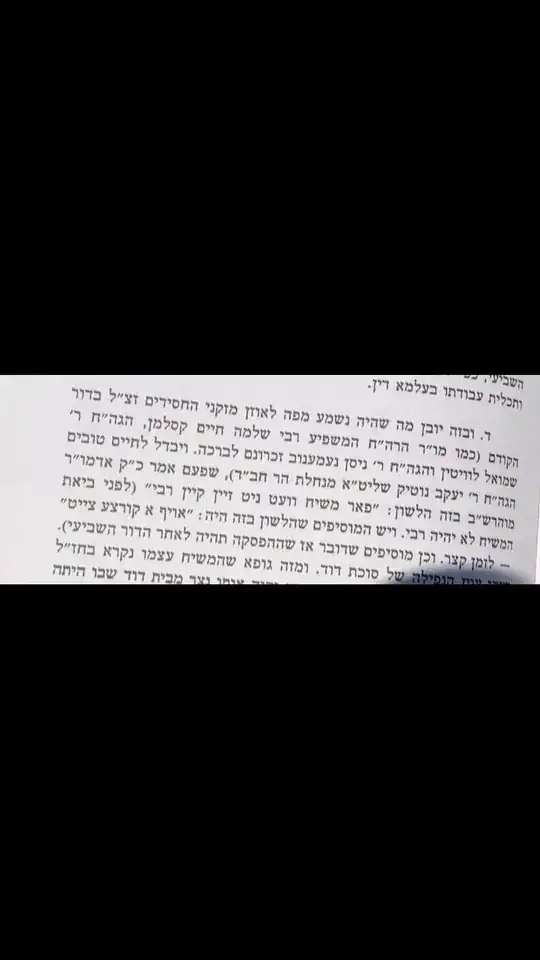

Eliyahu770
- 67
- 6
-
-
1I certainly heard it, more or less ("7 rebbes and then moshiach!") from the Chabad rabbi in Berkeley, back in the '80s. – MichoelR Feb 24 '21 at 23:15
-
1@MichoelR ok but did you hear "there will be 7 rebbes and no rebbe before moshiach comes" – Double AA Feb 24 '21 at 23:30
-
I see what you mean. Of course not. That whole line of thought didn't exist till the Rebbe died. – MichoelR Feb 25 '21 at 00:00
-
“The whole line of thought didn’t exist..” That’s precisely what’s under discussion isn’t it. To say that is only to assume I’m wrong but I already told u I heard this from Eliyahu Touger, Uri Kaploun, and this is written in a book by R Volpo in the name of the alter chassidim. He said some said no rebbe and some have the tradition of no rebbe for a “short time”. They may have thought we could merit it not happen that way and didn’t want to have it in mind, but that doesn’t mean this wasn’t said. – Eliyahu770 Feb 25 '21 at 03:03
-
You can say it all you want, but I'm asking you to document that someone said it before 1993. Show me something published, written or recorded before then. Not something from after then claiming to have known it or seen it or heard it before 1993 too. This shouldn't be too difficult if it's as well known as you say and would pretty definitively improve the value of this answer. – Double AA Feb 25 '21 at 03:11
-
If Uri Kaploun and Eliyahu Touger swear by it especially in the name of the alter chassidim it’s essentially chabad canon. You don’t realize who you are being skeptical of.
You just heard from someone that this was said in the 80’s. The “no rebbe” part isn’t relevant to the posters question. What was confirmed is that it says 7 rebbes. Not 8. That’s all that’s needed.
It’s an oral tradition that the alter Chassidim from russia knew about. And they probably hoped we would merit the “no rebbe” part not happen. It was not a tradition so emphasized until it needed to be.
-
It’s well known that when the previous rebbe came out with “immediate teshuva immediate geulah” that Chassidim published that he would be moshiach. You think they would dwell on an oral tradition that essentially said their rebbe wouldn’t be moshiach? They, again, likely hoped it wouldn’t need to happen that way. It’s simply not reasonable to expect they spread this thing in books. It might very well be recorded somewhere, but ur expectations are out of line with the nature of what we are talking about – Eliyahu770 Feb 25 '21 at 21:53
-4
You are all wrong. Rabbi Shaul Shimon Deutsch is the 8th Rebbe.
The Rebbe: The Life and Afterlife of Menachem Mendel Schneerson By Samuel Heilman, Menachem Friedman

Kfir
- 1,274
- 5
- 15
-
2
-
The Rebbe: The Life and Afterlife of Menachem Mendel Schneerson By Samuel Heilman, Menachem Friedman. I think Heilman mentions him here and there. He wears a kolpek – Kfir Feb 27 '19 at 03:51
-
1If that book is your source you should [edit] it into the answer. Note that R. Deutsch's Wikipedia page claims that he is the Liozna Rebbe (which would seem to make him not the Lubvitcher Rebbe). – Alex Feb 27 '19 at 03:55
-
Well, 1000's of people followed him. I would think that would make it res ipso facto. – Kfir Feb 27 '19 at 04:01
-
Do the 1000s of people follow him specifically as the eighth Lubavitcher Rebbe? – Alex Feb 27 '19 at 04:02
-
Also, chabad lubavitch is from liozhna. He took over after the lack of leadership to return chabad to its roots. He has a 2 volume book set called Larger Than Life which seems to make the Rebbe more of just the 7th Rebbe and not an eternal rebbe. – Kfir Feb 27 '19 at 04:05
-
But that sounds more like he started an offshoot of Lubavitch and declared himself the Rebbe. – Alex Feb 27 '19 at 04:06
-
No, the Malach is an offshoot. He follows different teachings based on HaMalach - Shaarei Hasagot : Rabbi Chaim Avraham Dov Ber Levin HaCohen. Rabbi Carlebach started an offshoot based on different Rebbe's. Nobody else took over chabad so he's at the helm, running incumbent, based only on the rebbe's teachings. – Kfir Feb 27 '19 at 04:14
-
1
-