The acidic blood of the Xenomorph is well within the boundaries of conventional science as far as powerful acids are concerned. As for the biology of such an acid and how it would be used in the Xenomorph metabolic process, that is beyond my ability to judge.
"Strongest" Acid Known
"Molecular acid" is a tautology. All acids are made from molecular compounds or groups of various active molecules, so the phrase was the sign of a writer too busy or too lazy to give it a name. With that said, there are acids we know about today which make hydrochloric or hydrosulfuric acids seem like pancake syrup by comparison in terms of their ability to interact with matter.

One of many carborane molecules: Colour scheme: hydrogen − white, chlorine − green, boron − pink, carbon − black.
These highly active molecular compounds are called carboranes and considered to be superacids. They do not break down while dissolving other materials, so their potency is both everlasting and millions of times more effective than conventional acids.
A carborane is a cluster composed of boron and carbon atoms. Like many of the related boranes, these clusters are polyhedra and are similarly classified as closo-, nido-, arachno-, hypho-, etc. based on whether they represent a complete (closo-) polyhedron, or a polyhedron that is missing one (nido-), two (arachno-), or more vertices.
Carboranes have been used to make solid superacids. Solid superacid catalysts alleviate the need to dispose of spent acids, thus providing a significant environmental advantage over dissolved acids. The carborane superacid H(C-H-B11-Cl11) is one million times stronger than sulfuric acid. -- Wikipedia
Acid strength however can be independent of an acid's corrosive nature. Carboranes, while potent, are considered strong-but-gentle because they can be held within laboratory test tubes without special glass. An acid's ability to eat through materials depends on the reaction of the acid in question. For years Fluorosulfonic acid and trifluoromethanesulfonic acid were some of the world's reigning champions, so powerful they could barely be contained. They would cause a reaction with the silicon in glass and dissolve it.
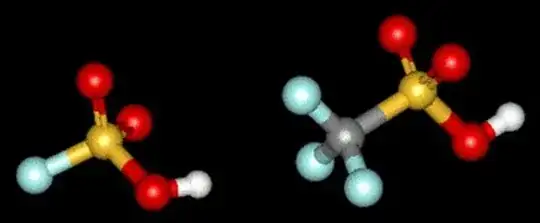
These acids are the strongest acid as single isolable compound, meaning they are acids without the addition of other compounds.
Highly Corrosive Acids
There are even stronger acids than these when mixing two compounds together. An example would be a mixture of Antimony pentafluoride (SbF5) and fluorosulfonic acid which is even stronger than any single isolable compound. While fluorosulfuric and pentafluorides are strong acids, both degrade with reactions, leaving acid wastes making them less desirable for certain chemical reactions.

Antimony pentafluoride molecule
Classic but deadly
Aqua regia first appeared in the work of medieval European alchemist Pseudo-Geber, dating from the 14th century. Antoine Lavoisier called it nitro-muriatic acid in 1789. Aqua regia (lit. "royal water"), aqua regis (lit. "king's water"), or nitro-hydrochloric acid is a highly corrosive mixture of acids, a fuming yellow or red solution. The mixture is formed by freshly mixing concentrated nitric acid and hydrochloric acid, usually in a volume ratio of 1:3. It was named so because it can dissolve the so-called royal or noble metals, gold and platinum. However, titanium, iridium, ruthenium, tantalum, osmium, rhodium and a few other metals are capable of withstanding its corrosive properties. - Wikipedia
Out of Universe:
In a recent article published on the thirtieth anniversary of the movie "Alien" it was revealed:
To create an acid/smoke effect, Richardson said they combined titanium tetrachloride, cyclohexylamine and acetic acid, along with yellow dye.
Titanium tetrachloride is the inorganic compound with the formula TiCl4. It is an important intermediate in the production of titanium metal and the pigment titanium dioxide. TiCl4 is an unusual example of a metal halide that is highly volatile. Upon contact with humid air, it forms spectacular opaque clouds of titanium dioxide (TiO2) and hydrogen chloride (HCl). Both of these byproducts are extremely toxic and may have made the filming quite difficult.


