16

I've done a bit of research here, but I still have some questions.

To start with, for anyone who isn't familiar with this, we can't say the brucha for lulav & etrog after completing the mitzvah, and the mitzvah is completed as soon as we gather the 4 species together and they are all right-side up, so we first pick up the Etrog upside-down, say the brucha and then turn it right-side up.

For the Etrog, The Shulchan Aruch says right-side-up is the way it grows: pitom-up, (and we should first pick it up pitom-down). And I remember being taught as a kid the Etrog first grows pitom-up and then turns pitom-down.

On the other hand,"The Second Jewish Book of Why" (page 266-267) says, etrogs grow pitom-down and growing pitom-up is a misconception that dates back to "the German Authority Jacob ben Moses Mollin (1360-1427)" who described the procedure in "Minhagay Maharil", and that it is an error in the Shulchan Aruch as well. It also cites that Rabbi Yechiel Epstein and Rabbi Israel Ben Meir Hakohen were aware that Etrogs grew pitom-down, but ruled it is a minhag (custom) now.
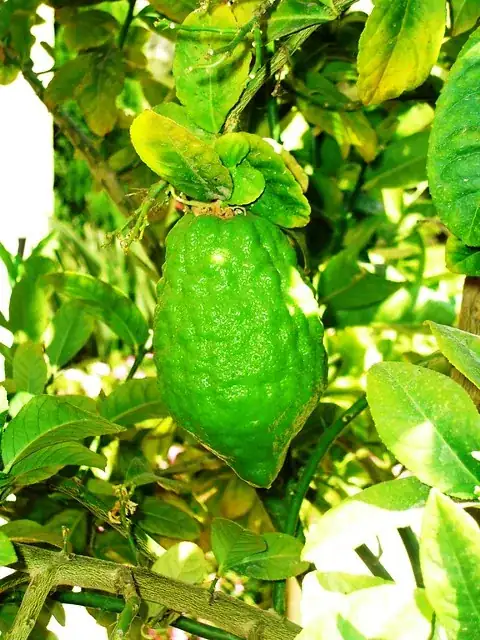
adult etrog

However, when I look at photos of etrogs, the young etrog-buds do grow pitom-up first, as opposed to how a kiwi immediately hangs down.

  • Do Rabbi Yechiel Epstein (Aruch ha-Shulchan) and Rabbi Israel Ben Meir Hakohen (the Chafetz Chaim?) actually agree they don't grow this way?

  • Does it matter at what growth-point the etrog is considered a fruit (unripe fruits are ha'adama, not ha'eitz)? or what growth-point is an etrog kosher for use? Can an etrog be too small?

  • Are there other cases where we need to know the orientation of a fruit? -note: Willow branches grow facing down but we consider the "top" of the branch to be the the end of branch pointing towards the ground. Do we consider willow branches to also grow upwards first?

zaq
  • 8,864
  • 30
  • 65
  • You're asking too many questions. I think the question of whether an Ethrog can be too small is a distinct question, whose answer, I assume, is that it must be a mature fruit. As for apples, I think it's irrelevant. Willow ('Aravah) may be relevant, but we do, in fact, hold it stem-down ("top"-up), just as we do with the myrtle (Hadas) and the date-palm (Lulav). Again, too many questions. – Seth J Jul 27 '11 at 19:27
  • Also, can you cite a specific page or chapter in the "Second Jewish Book of Why"? And does that book cite specific sources for those opinions quoted? – Seth J Jul 27 '11 at 19:28
  • 1
    I think they're all (except the apple) directly related to whether the pitom grows up or down. How would we define a mature fruit? I remember reading a fruit is considered a fruit when it is recognizable as a fruit, but I'm not sure exactly where it says this. Willow - right, but what we call "top" grows towards the ground, so why is the end that we call "top" not the bottom - is there somewhere that says it also grows up-wards first? – zaq Jul 27 '11 at 19:40
  • page 266-267, and no specific sources. – zaq Jul 27 '11 at 19:42
  • The Chafetz Chaim was "Yisrael Meir". Was that your misprint, or was the book referring to someone else? – YDK Aug 01 '11 at 04:55
  • Did R' YM Epstein or R' YM haKohen Kagan ever travel to climates which can produce esrogim? How authentic is this book? – YDK Aug 01 '11 at 04:57
  • PS Nice pictures! – YDK Aug 01 '11 at 04:58
  • That's the name the book says. I suppose it could mean someone else, as they refer to the Chafez Chaim as Rabbi Yisrael Meir ben Aryeh Hakohen on p.322, but who'se Rabbi Israel Ben Meir Hakohen then? - I'm not positive how accurate this book is, but it appears to give pretty solid answers. - Thanks. I wish I could find more of photos of Etrogim growing upwards.
  • – zaq Aug 01 '11 at 13:41
  • It looks like some of your pictures have died. – Double AA Sep 30 '12 at 03:55
  • :( those took me a long time to find. Maybe I saved them somewhere. – zaq Sep 30 '12 at 15:17
  • 1
    When I went to נאות קדומים, I saw plenty of mature esrogim growing with pitom facing up, though a lot of the esrogim were also facing pitom down or to the side or at some other angle. – Fred Sep 10 '13 at 20:28