5

Just curious.

I read about Nathan Hanavi and Gad Hachozeh here.

Are those the same job?

Harel13
  • 25,676
  • 4
  • 58
  • 136
user4951
  • 4,343
  • 4
  • 34
  • 56
  • 1
    I thought we had this question already, but I don't see it. Anyway, one avenue for investigation is (IIRC) Tora T'mima or maybe it was N'tziv on "vatelech lidrosh es Hashem" at the beginning of Tol'dos. – msh210 Feb 27 '17 at 13:18
  • The Malbim in Shmuel 1 provides an explination, if I get a chance I'll put it up – TrustMeI'mARabbi Feb 27 '17 at 17:54

3 Answers3

4

The Targum Yonason on Shmuel 9:9 seems to equate the term Chozeh with Roeh.

Based on that understanding, the Malbim on Shmuel 9:9 eloquently explains the difference between a Navi and a Roeh as such (See full text there):

(Source provided from Sefaria.org)

אומר כי יש הבדל בין הנביא בדור אחרון ובין הרואה לפנים, שהנביא נקרא שמו על שם דברותיו ותוכחותיו (מלשון ניב שפתים) על כי ה' דבר בו וישלחהו להגיד לעם פשעם ולבית יעקב חטאתם, ולא שלחהו במלאכות ה' רק לצורך עניני הכלל והגוי כולו ולא חל רוח הקודש עליו להראותו דברים פרטיים הנוגעים אל היחידים, אבל הרואה נקרא בשמו על שם שהיה צופה ברוח הקודש השורה עליו כל הדברים ההויים והעתידים וגם עניני היחידים ופרטיהם, ועל כן היו בורחים מן הנביא אשר היה תמיד מגיד פשע ומוכיח עלי עון, ורדפום אחר הרואה באשר כל אחד השיג ממנו מבוקשו על הגניבה ועל האבידה ועל החולה ועל האשה והבנים, והיו נותנים לו תשורה ומתן בעבור שהתבודד לעיין על עניניהם,

(The verse is) saying that there is a difference between a Navi in the later generation and the Roeh of old, for the Navi is called a "Navi" because of his words and rebukes (from the term "uttering of the lips) for G-d spoke to him and sent him to tell the people their sins and the house of Jacob what they were guilty of, and was not sent with the the work of G-d, rather for the needs of the general population and the nation as a whole. Ruach HaKodesh did not rest upon (the Navi) to show him specific matters pertaining to individuals. However a "Roeh" is called such because he would see with Ruach HaKodesh and matters of the future as well as matters of individuals and their details would rest on him. Therefore (the people) would run from the Navi who would always tell them of their sin and rebuke their transgression, and pursue the Roeh in that everyone would inquire of his and ask regarding their stolen and lost items, about their maladies and about their wives and children and would give a offering and gift because of because he (the Roeh) would set himself to look into these matters

Hope this is helpful

TrustMeI'mARabbi
  • 4,245
  • 13
  • 39
  • Do we know that hozeh and roeh are identical? – mevaqesh Feb 27 '17 at 21:04
  • what do you mean? – TrustMeI'mARabbi Feb 27 '17 at 21:31
  • The question was about a hozeh not a roeh – mevaqesh Feb 27 '17 at 21:46
  • noted. deleting now. – TrustMeI'mARabbi Feb 27 '17 at 21:49
  • Just saw in the Targum that the terms are equated. – TrustMeI'mARabbi Feb 28 '17 at 15:50
  • Will update when I get a chance – TrustMeI'mARabbi Feb 28 '17 at 15:50
  • 1
    @TrustMeI'mARabbi I am not taking issue with the Malbim in any way. I'm asking you about how you are understanding his usage as compared to the Targum. It states clearly that the prophecy in Isaiah is 'chazone', meaning from a 'Chozeh'. Isaiah is after Shmuel, although not as late as the minor prophets. In Shmuel 2 24:11, Gad is referred to as both a Navi and a Chozeh. In Habakkuk 1:1 it says that his type of prophecy is 'Chazone' (חזה) and Habakkuk is clearly a later prophet. In the case of Elisha and the Shunamite, Elisha's visions clearly relate to her future as an individual. – Yaacov Deane Feb 28 '17 at 19:47
  • I see no evidence whatsoever that the Aramaic word that the Targum chooses to employ is identical in technical usage, to the similar sounding Hebrew word. Nor do I see any evidence that Malbim attempts to equate this either, and therefore, I see no evidence that any of this is proof for the question that was asked. – mevaqesh Feb 28 '17 at 19:50
  • A quick look at wikipedia seems to demonstrate that Gad demonstrated these qualities as described by the Malbim. https://en.wikipedia.org/wiki/Gad_(prophet) I don't think the malbim needs to equate it but it seems like a strong assumption used. (I will appreciate it if you do not quote and criticize my reply) – TrustMeI'mARabbi Mar 01 '17 at 01:43
  • So to say that it is not so seems like Gad "played on both fields" bringing Nevuah for the public and for the individual. – TrustMeI'mARabbi Mar 01 '17 at 01:45
2

HALOT suggests this etymology for נָבִיא:

to be associated with the Akkadian verb nabû to name, call; from which is derived נָבִיא, which may have an active sense “speaker, herald, preacher” or (more probably) a passive sense “one who has been called”

While it notes that חֹזֶה is the participle of חזה, which has the meaning of "to see, behold". Some of the examples it gives are:

God sees Ps 11:4 17:2 Sir 15:18, is watching over with עַל cj. Jb 3429 (Ehrlich);
man sees God Ex 24:11 Jb 19:26f חָזָה מַחֲזֶה to see a vision Nu 24:4.16 Ezk 13:7
to see as a seer Am 1:1
‏חָזָה לוֹ‎ to select for oneself Ex 18:21 ‏ח׳ בְ‎ to see with pleasure, satisfaction (→ ראה 10) Mi 4:11 Ps 27:4 (= experience) Jb 36:25 Song 7:1

The connection between the two words is obvious: prophets and seers were (or falsely claimed to have been) given visions of the future by God.

But actually this is only a small part of the role of a prophet. Visions of the far future are rare in the scriptures. Instead most of their messages from God implored the people to repent of their sin and turn back to him in faith. When the prophets foretold judgement it wasn't necessarily because they were given a vision of the future, but because Israel's covenant with YHWH promised curses on the sinful (Deuteronomy 27-28). They didn't need visions to know that God would judge the unrepentant. They were called prophets because they obeyed God's call to them to speak boldly to the nation.

But although the term "seer" may more strongly imply that the person has been given visions than a "prophet" implies (who might receive only a message rather than a vision), it seems to me that the two terms are pretty synonymous in the scriptures.

  1. Particular people are consistently called one title, such as Nathan the prophet and Gad the seer, even though their roles were very similar. Gad's speech in 2 Samuel 24:11-13/1 Chron. 21:9-12 did not involve a vision, and neither did Jehu the son of Hanani the seer in 2 Chronicles 19:2-3.

  2. In Amos 7:12 the seer Amos is instructed to prophesy.

  3. חֹזֶה is very commonly used in parallel with other terms without clear differences:

    • with נְּבִיאִ֛ים (prophets) in Isaiah 29:10
    • with רֹאִים֙ (another word for seers) in Isaiah 30:10
    • with קֹּ֣סְמִ֔ים (diviners) in Micah 3:7
  4. In Chronicles, after it has finished telling a king's story, it often refers the reader to go to the writings of both a prophet and a seer:

    • Now the acts of King David, from first to last, are written in the Chronicles of Samuel the seer, and in the Chronicles of Nathan the prophet, and in the Chronicles of Gad the seer (1 Chron 29:29)
    • Now the rest of the acts of Solomon, from first to last, are they not written in the history of Nathan the prophet, and in the prophecy of Ahijah the Shilonite, and in the visions of Iddo the seer concerning Jeroboam the son of Nebat? (2 Chron 9:29)
    • Now the acts of Rehoboam, from first to last, are they not written in the chronicles of Shemaiah the prophet and of Iddo the seer? There were continual wars between Rehoboam and Jeroboam. (2 Chron 12:15)
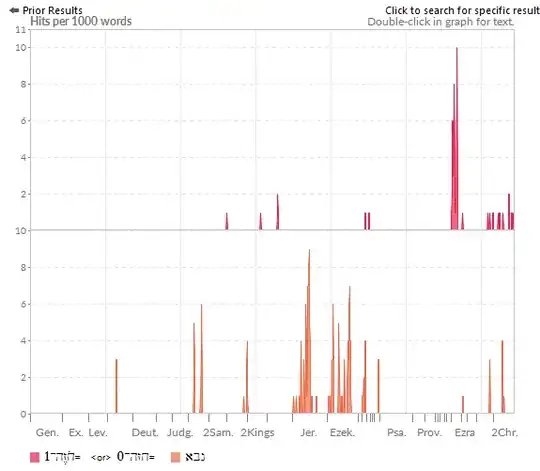
  5. Aside from these parallels, the words are largely complementary - most authors only use one of the words. A graph showing the hits per 1000 words for 'prophet' and 'seer'
curiousdannii
  • 590
  • 3
  • 15
  • `The connection between the two words is obvious: prophets and seers were (or falsely claimed to have been) given visions of the future by God.

    But actually this is only a small part of the role of a prophet. Visions of the far future are rare in the scriptures. Instead most of their messages from God implored the people to repent of their sin and turn back to him in faith.` You seem to be drawing a false dichotomy between prophecy consisting of exhortations towards repentance, and "visions".

    – mevaqesh Feb 27 '17 at 14:20
  • They were called prophets because they obeyed God's call to them to speak boldly to the nation. Is this your own idea? While the prophets may have initiated their own castigation, there are certainly instances of prophetic revelation consisting of ethical guidance to the nation; e.g. Jeremiah 9:22. – mevaqesh Feb 27 '17 at 14:22
  • 1
    @mevaqesh Not really, I'm trying to correct the pop culture view of prophets which many readers will have. The prophets neither exclusively spoke about the future nor did they never speak about the future. They sometimes did, but they predominantly spoke about the present and what the past (the covenant promises) means for the present. The pop culture view of a prophet is the same as a seer, but we can't assume they are because they have different word roots. But ironically, after examining the textual evidence I think they are close to synonymous in fact. – curiousdannii Feb 27 '17 at 14:26
  • Gad's speech in 2 Samuel 24:11-13/1 Chron. 21:9-12 did not involve a vision You can't state that absolutely. More accurately, we are not informed through which medium God conveyed this information to Gad; whether through an audio experience, a visual one, or something else. Furthermore, isolated cases where a "seer" isn't explicitly described as having a vision, is hardly evidence that the term חזה doesn't carry a connotation distinct from נבא – mevaqesh Feb 27 '17 at 14:26
  • @mevaqesh I think it does have distinct connotations, but the roles as presented overlap to a huge extent. The explicit text often has prophets retelling their visions and seers speaking a message. We start with etymology to get an idea of what the base sense of each word is derived from, but then we consider how they are used to refine our understanding. That's what my answer tries to do: base our understanding on a Hebrew dictionary not a pop culture definition of prophecy, but then dig deeper into the text to see how strong the distinction really is. – curiousdannii Feb 27 '17 at 14:33
  • My answer: individuals are consistently labelled, but the terms, which started as distinct senses, are by the time of the Tanakh generally interchangeable. – curiousdannii Feb 27 '17 at 14:34
  • I understand what you are saying. I am pointing out that you draw a false dichotomy between visions and ethical exhortation, and that your evidence (or at least that which I examined and commented on) is not compelling. | The only reason I am not downvoting, is that the other answer is almost certainly worse and contains seemingly deliberate misinformation, and no indication of any evidence for an answer. – mevaqesh Feb 27 '17 at 14:39
  • @mevaqesh I'm not drawing a false dichotomy... I'll try to edit it to be clearer tomorrow. – curiousdannii Feb 27 '17 at 14:42
  • I explained why it is a false dichotomy. You are welcome to your opinion, but unless you respond with something more substantial, you will probably do little to convince others. – mevaqesh Feb 27 '17 at 14:42
  • @mevaqesh a false dichotomy says there are no alternatives or no overlap, which I never said nor implied. Obviously, for the purpose of the visions is always to draw people back to God. One purpose, two overlapping forms of speech (quoting the Law and visions). – curiousdannii Feb 27 '17 at 14:48
  • "most authors only use one of the words" "Particular people are consistently called one title" This strongly supports that the words are not synonymous. Why do you cite it as evidence?? – Double AA Feb 27 '17 at 14:57
  • @DoubleAA Rabbi and Teacher are essentially synonymous but many people are by convention called by only one. The same as Pastor and Minister in Christianity. Gad was clearly a prophet, but his title was Seer. – curiousdannii Feb 27 '17 at 15:00
  • @curiousdannii That's possible and I didn't say it proves they aren't synonymous. But it doesn't support that! It supports that there is a reason for the distinction. The reason could be convention (what did Gad like being called) or it could be something more fundamental. – Double AA Feb 27 '17 at 15:01
  • The cases of Amos and Shmuel who get different verbs should be discussed in more detail. – Double AA Feb 27 '17 at 15:02
  • @DoubleAA I need to improve this answer to more clearly mark out the distinct goals it is attempting to address, but I also need to sleep, so I'll do that tomorrow :) I'll also try to more clearly distinguish between what is the clear textual evidence and what is my conclusions based on that. – curiousdannii Feb 27 '17 at 15:03
  • Just one question here. Does it strike anyone else as odd that this answer is attempting to explain the concept of prophecy as found in Jewish tradition from a dictionary of the "Old Testament"? HALOT stands for the "Hebrew And Aramaic Lexicon of the Old Testament". That sounds like Christian teachings, not Jewish. I haven't heard many traditional Jews referring to the Torah as the "Old Testament". Considering the spin that Christian scholars put on the Dead Sea scrolls for decades trying to say it was evidence of the foundation of Christianity, is this source something to rely upon? – Yaacov Deane Feb 27 '17 at 18:28
  • 2
    @YaacovDeane I don't find referencing dictionaries to be odd nor considering their suggested etymologies. "Old Testament" is just a convention used in English speaking academics. Even if originally it had certain theological connotations, it doesn't need to still have them now in all uses. – Double AA Feb 27 '17 at 19:03
1

The term Navi is a generic term for one to whom G-d speaks. It is taken from the expression ניב שפתים (Isaiah 57:19) which is the idea of the lips drooling. When a Prophet on a level lower than Moshe experiences prophecy, they lose control of many of their bodily functions including drooling. The expression Navuah is the process of communication.

Chozeh is referring to a prophet who receives a specific level of prophecy on the level of vision (See Zohar, parshat Pekudai, 248:a, chapter 533-536 for details). This is also found at the end of tikkun 39 in Tikkunei Zohar, 79b.

ועוד ויאמר אלקים יהי אור. דא נבואה במראה דאתמר בה (במדבר יב) במראה אליו אתודע ואיהי חזון

That is the level of Chazone, like Isaiah 1:1. This expression is also used in connection with the level of Moshe Rabbeinu's prophecy like is found in Tehillim 58:11.

יִשְׂמַח צַדִּיק כִּי חָזָה נָקָם פְּעָמָיו יִרְחַץ בְּדַם הָרָשָׁע:

In this example, Moshe's prophecy is expressed with the phrase of chazah, like in a vision. In chapter 533 from the Zohar cited, this is described by the phrase Zeh.

מאתר דא, ינקי כל אינון מאריהון דחכמתא, דקיימן למנדע במראה, או ברזא דחלמא

This phrase is described as being able to look at something clearly and say, This is the thing. A good discussion of the concept of Moshe's level of prophecy can be found here.

The lower levels of prophecy come from the level of hearing and are called Bat Kol and Ruach HaKodesh among many other names. In contrast to the level of Zeh, this lower level is described by the phrase Koh (כֹּה אָמַר ה')*

This is discussed in the commentary of Rabbeinu Bechai on the Torah (Devarim 33:8) and in Sha'ar Ruach HaKodesh (Drush 1) of Rabbi Chaim Vital.

The different terminology is only distinguishing between the level from which the prophet receives, meaning the source of their prophecy or the level of his reception, meaning the prophets ability to contain and absorb the message. In general, prophets serve the purpose of helping the people to return to the service of G-d. That may be directed to the Jewish people or to the nations at large.

Yaacov Deane
  • 14,809
  • 22
  • 64
  • 1
    Rabbenu Bahya does not seem to answer the OP's question. He does not discuss the term חזה at all. – mevaqesh Feb 27 '17 at 13:55
  • 1
    I am not seeing an answer to the OP's question in Zohar, parshat Pekudai, 248:a. I might be missing it. Mind quoting some of the relevant text? – mevaqesh Feb 27 '17 at 15:24
  • 1
    You discuss two words (Navi and Chozeh) and two levels of prophecy (Zeh and Koh) but I don't see anything here that explicitly defines those in terms of each other (mevaqesh noted that none of your sources appear to mention the root חזה). What source explicitly defines Chozeh with Zeh, and defines Navi as the generic term? Is that just your own idea? – Double AA Feb 27 '17 at 19:05
  • @DoubleAA The Zohar cited defines it that way and explicitly. It explains that this higher level of prophecy described as 'Zeh' is related to the aspect of vision and in Moshe's case is emphasized with the term 'Ispaklariah HaMeirah'. Other prophets who receive on that level but lower than Moshe are described with the term 'Chozeh'. To help you, I have also included the quotation from the Tikkunei Zohar which says that "Nevuah via vision" is "Chazon". – Yaacov Deane Feb 27 '17 at 19:43
  • The problem with this last answer is in this week's Parsha of Bshalach when Miriam is called a Nivea in respect to the singing and drum playing that she did at the shores of the yams suf. Banging on drums in a rhythmic pattern and inspiring others and off the cuff spontaneous composition of a Shira that really is a song that requires music and a beat does not happen with someone who loses control of function of their body but retains heightened control of their mind and body. It seems to me that we cannot determine the exact parameters for the term Nevuah. – user18564 Jan 16 '19 at 13:57