7

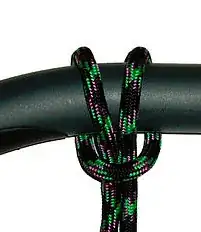
Would it be permitted to attach tzitziyot using a cow hitch (a way of attaching a rope or lead without use of a knot - pictured below), in order to be able to remove them before washing a garment so that they do not become untied or unraveled?

Is it permissble to attach them this way according halakhic tradition? https://upload.wikimedia.org/wikipedia/commons/thumb/6/66/T%C3%AAte_d%27alouette.jpg/226px-T%C3%AAte_d%27alouette.jpg

https://en.wikipedia.org/wiki/Cow_hitch

NOTE: In the picture above, the bar represents the corner of the garment, while the rope represents the loop at the top of the tzitziyot.

Thanks.

Ulrikhe Lukoie
  • 317
  • 1
  • 7
  • 1
    Welcome back to Mi Yodeya! Please [edit] in more information about what a cow hitch is. – Isaac Moses Jul 07 '15 at 16:53
  • I see the concern. This is an interesting device, although, from the pic, it looks huge! At any rate, AFAIK, the requirement of having loose tzitzit applies only when you are wearing it. While I don't thin you can intentionally destroy the existing knots (why would you want to?) I don't think there is any problem doing anything else you want with the strings including making an extra temporary knot, if that helps. In this case, it seems that your intention is "meritorious" as you are trying to preserve their shape. Offhand, I don't think there's a problem. Have to find supporting source. – DanF Jul 07 '15 at 17:16
  • To clarify further, where the bar is in the picture, you would put the corner of the garment, with the top of the bar corresponding to the inside of the hole in the garment. Is that right? If so, @DanF, this mechanism is in place of the standard method of tying to the garment, which involves putting all of the strings through the hole and then tying them together with a square not. – Isaac Moses Jul 07 '15 at 17:58
  • 3
    This would either be passul as not being a kesher only an aniva, or if you would consider it a kesher, it would be taaseh v'lo min ha'asui. – user6591 Jul 07 '15 at 18:03
  • @user6591 that plus explaining your terms and sourcing your assertions of law, and you've got an answer. – Isaac Moses Jul 07 '15 at 18:36
  • @IsaacMoses Aren't the restrictions of tying, etc. only applicable while you are wearing them? – DanF Jul 07 '15 at 19:02
  • @Isaac I've already got an answer. If I did all that then this site would have an answer. – user6591 Jul 07 '15 at 19:23
  • 1
    From the Mishna Brurah 11:64 at the end of the seif he writes...ודע דמש"כ קשר אחד ר"ל מהה' קשרים שרגילין לעשות אבל הוא היה ב"פ זה על גב זה כדלקמן דבלא"ה לא מיקרי קשר שאינו מתקיים: that a knot on a knot(double knot) is considered a knot since it won't open anything else isn't called a knot – sam Jul 07 '15 at 20:34
  • To keep this open, you might want to make it sound like you're not actually asking for a practical ruling. Also, how does this make things any quicker/easier? – Loewian Jul 07 '15 at 22:04
  • @user6591, why is it min ha'asui if you tie it directly on the hole and it is a knot? Do any and all knots have to be taaseh, or only the main knot? – Yishai Jul 07 '15 at 23:07
  • @Yishai while it's true that only the first knot is mideoraisa, that really means a double knot. Also, I don't know why taaseh shouldn't apply to all the rest of the loops and knots, even if they are not mideoraisa. – user6591 Jul 07 '15 at 23:15
  • @user6591, right, it is not a knot. But if it were a knot, I don't know whether or not taaseh applies to all knots or only the main one, so I was asking. – Yishai Jul 07 '15 at 23:31
  • Dear querent: Please see also the post which discusses the best way to wash a tallit katan without ruining the strings. – unforgettableidSupportsMonica Jul 08 '15 at 04:22
  • @Yishai - I think that the issue is that according to the lashon of the halakhah, a ssissith IS PART of the garment itself, thus the language of "tefirah" ("sewing"). Also, generally the strings that constitute the "lavan" portion of the ssissith are supposed to be of the same material and the same color of the garment itself - this is because IT IS PART of the garment. But I think the real question is whether a garment reverts back to its original state after the ssissiyyoth are removed from it, thus require a re-tying and not just a re-attaching... –  Jul 09 '15 at 06:06
  • ...This, I think, is the implication of min ha-'asui. So, from the aspect of tefirah" and the ssissith* being intended to be a permanent part of the garment itself (even taking on it's material and color), a "cow hitch" does not fit that necessity. And since the questioner is stating his reasons for using a "cow hitch" (i.e. that the ssissith may be removed and re-attached at will), we must conclude based on the principle of `osim min ha-'asui that it is not permitted. Kol tuv. –  Jul 09 '15 at 06:09

1 Answers1

4

Great question.

The halakhah actually discusses the idea of having "ready-made" ssissiyyoth which are then attached to the corner of a garment. This concept is called `oseh min ha-'asui (essentially, "attempting to fulfill the misswah [of ssissith] from something already made beforehand"), and it is not permissible.

The Rambam (Hilkhoth Ssissith 1:12-13) says the following:

wa-ssissith shen-na`asath min he-'asui miq-qodhem pasulah. kessadh? hevi kanaf shey-yesh bo ssissith uthfarah 'al hab-beghedh afilu yesh be-othah hak-kanaf ammah 'al ammah pesulah, shen-ne'emar "wa-'asu lahem ssissith" wa-lo min he-'asui she-hareizeh domeh le-mi shen-na'asath me-eleyha. Umuttar le-hattir ssissith mib-beghedh zeh wa-lithlothah be-veghedh ahher - ben lavan ben tekheleth.

Translation:

"And [when the misswah of ssissith is] performed using [ssissiyyoth] that were already made, it is invalid. What is a practical example? Someone brought a [severed] corner of a garment on which there is [already a] ssissith, and sews it onto another garment - even if that corner has a square ammah of cloth still attached (i.e. the smallest possible area of a garment that is still subject to the laws of ssissith) - it is invalid. As it is said, 'wa-`asu lahem ssissith - And they shall make for themselves ssissith' (Bamidbar 15:38) [in order to perform the misswah] and they should not attempt to perform it [using ssissiyoth] that were already made, for this is like a garment that became messuyyesseth ("tassled") on its own. But it is permissible to untie ssissiyyoth from one garment and [re-]tie them onto another garment - whether they contain tekheleth or whether they are completely white."

[See also 1:14-16 for cases involving this concept.]

And although it should be obvious, the transferring of ssissiyyoth from one garment to another mentioned in the closing statement this halakhah does NOT mean that one may take whole/tied ssissiyyoth from one garment and simply attached them - with a cow's hitch or by any other means - to another garment. To do so would violate the first statement of the halakhah. Rather, it means to completely untie the ssissiyyoth on one garment, thread the strings into the corner of another garment and re-tie them.

As it says in the new edition of the Mishneh Torah with explanatory notes by HaRav Yohai Maqbili (יצ"ו) and jointly published by yeshivoth "Or Wiyeshua`" and "Torath Hhayyim":

להתיר ציצית... ולתלותה - שאינו מעביר את הציצית בשלמותה מבגד לבגד אלא מתיר את החוטים ועושה מהם ציצית חדשה

(Translation: "To untie ssissiyyoth...and to hang them" - Not that one is transferring the ssissith while it is still fully-tied. Rather, he is completely untying the strings and from them making a new ssissith.")

In short, ssissiyyoth that are put onto any garment while already fully-tied are invalid without exception. Thus, attaching them impermanently with a "cow hitch" to the corners of your garment so that you may remove them and easily re-attach them is not permissible.

Hope this helps. Kol tuv.
  • http://judaism.stackexchange.com/questions/60969/is-it-allowed-to-tie-tzitzit-using-a-cow-hitch#comment165539_60969 – Double AA Jul 08 '15 at 14:42
  • @DoubleAA - Not sure of the exact reason for the linkage, but I hope I did justice by my comments there above. Let me know if you think anything else needs to be done. Kol tuv. –  Jul 09 '15 at 06:11