1

After reading some questions posted on here I found my self reviewing Hilkhoth Tefilah, mainly the halakha of the amidah. While reading i noticed something that I have read countless times yet never popped out at me. After one prays the amidah we are instructed to preform hishtahhawayah (full body prostration) while saying tehhinoth (private supplications). In this part the halakha states that ones face must be flat on the ground and only turned to the side if one “is as righteous as Joshua”:

“ וְאֵין אָדָם חָשׁוּב רַשָּׁאי לִפֹּל עַל פָּנָיו, אֵלָא אִם כֵּן הוּא יוֹדֵעַ בְּעַצְמוֹ שְׁהוּא צַדִּיק כִּיהוֹשׁוּעַ; אֲבָל מַטֶּה הוּא פָּנָיו מְעַט, וְאֵינוּ כּוֹבֵשׁ אוֹתוֹ בַּקַּרְקָע." M"T Hilkoth Tefilah 5:14

“An important person is not permitted to fall on his face unless he is certain that he is as righteous as Yehoshua. Rather, he should tilt his face slightly, but not press it to the ground.” M"T Hilkoth Tefilah 5:14

So what exactly does this mean? Why Yehoshua Ben-Nun and why is his righteousness used for this particular halakha as a bench mark? Is there something in our mesora that links these two concepts?

EDIT: It was brought to my attention that most contributing members to Mi Yodeya hold by the S”A (of various editions) and most likely do not perform our more ancient practices of tefilah. So here are some pictures to help clarify my question.

Face flat on the ground (as the majority of yehudhim are supposed to do) picture of a man in talis and tefillin, laying flat on the ground, with his arms stretched out in front of him

Face off to the side ( I couldn’t find an exact picture of this, since no one does this now a days, but you can see how the mans head is tilted in compared to the boys. Just imagine his body fully stretched out)
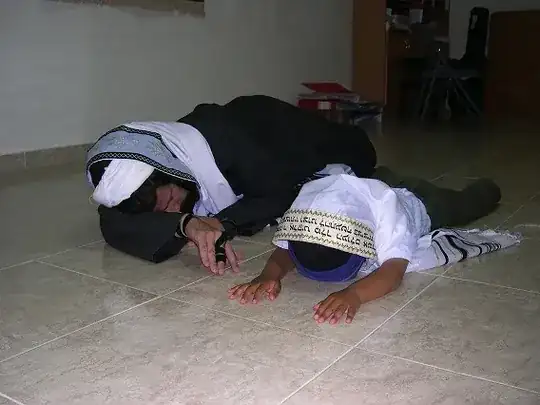
A man and a boy laying on the floor next to each other, wearing talleisim. The boy is lying as the man in the last picture is, while the man in this picture is lying down with his head resting, tilted to the left, on his right arm.

** They are on ceramic tiles NOT stone **

MTL
  • 19,073
  • 4
  • 51
  • 161
Qoheleth
  • 641
  • 6
  • 13
  • 1
    Your quote and your summary of the Halachah state the opposite to one another. One of them is incorrect. – Seth J Sep 24 '12 at 01:06
  • related http://judaism.stackexchange.com/q/9285/759 – Double AA Sep 24 '12 at 01:27
  • @SethJ What do you mean? – Double AA Sep 24 '12 at 01:31
  • I can't explain on mobile. If I get a chance when I'm at a real computer tomorrow, I'll explain, unless it's fixed by then. Read it and it should be evident. – Seth J Sep 24 '12 at 03:26
  • @SethJ Sorry could you clarify your first statemented? – Qoheleth Sep 24 '12 at 19:49
  • @Qoheleth, your summary says that one should not put his face to the side if he is unsure he is worthy. But the cited Halachah states that one should put his face to the side unless he is worthy. In other words, the Halachah states that a person on par with Joshua should put his face down; others should put their faces to the side. The last sentence in your first paragraph says the opposite. – Seth J Sep 24 '12 at 19:55
  • @SethJ i understand what you are saying, but i dont see where you are getting that from the cited halakha. Note that it says "an important person" not "A person" so its saying that's in relation to a specific person of a certain stature should not do it where as the masses do. Does that address the issue you have? – Qoheleth Sep 24 '12 at 19:59
  • @Qoheleth, no. I was trying to speak with brevity. The Halachah in the RaMBa"M is that a regular person puts his face down on the floor. The Halachah for an important person is that he only does this if he is righteous like Joshua. Your statement still says the opposite. "In this part the halakha states that ones face must be flat on the ground and only turned to the side if one “is as righteous as Joshua”:" – Seth J Sep 24 '12 at 20:35
  • @SethJ oh yes yes. I see what you mean. i was just trying to get to the direct question i had. – Qoheleth Sep 24 '12 at 21:05

2 Answers2

6

The source of the Rambam's ruling is Taanis 14b:

אמר ר' אלעזר אין אדם חשוב רשאי ליפול על פניו אלא אם כן נענה כיהושע בן נון שנאמר (יהושע ז, י) ויאמר ה' אל יהושע קום לך למה זה אתה נופל על פניך

R. Elazar said: A important person should not fall upon his face unless he is confident that he will be answered like Yehoshua, as it is written, And the Lord said unto Joshua. ‘Get up; why do you fall on your face?’

Since the law is expounded from a narative regarding Yehoshua, the Rambam brings him as an example.

Michoel
  • 18,944
  • 1
  • 57
  • 91
5

The Rambam is referencing a Gemara (Megillah 22b) which says:

אמר רבי אלעזר, אין אדם חשוב רשאי ליפול על פניו אלא אם כן נענה כיהושע בן נון, דכתיב +יהושע ז:י+ ויאמר ה' אל יהושע קם לך [למה זה אתה נפל על פניך]‏

Rabbi Elazar said: An important person is not allowed to fall on his face unless he is [sure to be] answered like Yehoshua bin Nun, as it says (Joshua 7:10): And the LORD said unto Joshua: 'Get thee up; wherefore, now, art thou fallen upon thy face?

Double AA
  • 98,894
  • 6
  • 250
  • 713