0

Before the shofar blowing, usually there's an announcement not to make a hefsek until after the last tekios post-Musaf.

Is there something similar for lulav? Should you not talk between the bracha and hoshanos? I've never heard an announcement.

(Kind of related Why do shuls not announced which order of direction to shake the lulav?)

Heshy
  • 9,136
  • 1
  • 16
  • 35
  • You shouldn't talk during Hallel anyway, so the only chiddush here is not talking between taking the lulav and Hallel so your bracha goes on the real naanuim. I wish I could say that's not a concern but alas. – Double AA Oct 03 '23 at 19:11
  • @DoubleAA unless you do hoshanos after Musaf. I was kind of taking lulav-hallel for granted but as you say, alas maybe I shouldn't – Heshy Oct 03 '23 at 19:12
  • Oh I see your point. Hoshanot is just a minhag so there's no real halachic chashash that it should need a bracha, unlike tekiot dmeumad. But anyway in those shuls virtually everyone puts down their lulav for musaf so I think we have bigger concerns than talking if you want to try to mitzaref the bracha. – Double AA Oct 03 '23 at 19:15
  • @DoubleAA Yeah I guess so but the tekios after Musaf are also a minhag, and the announcement always includes them – Heshy Oct 03 '23 at 19:16
  • shhh the rabbi usually gets away with keeping decorum a bit longer – Double AA Oct 03 '23 at 19:16
  • Seemingly this shouldn’t be different than talking between putting on a Tallis and the beginning of Davening - they are both passive, as apposed to Shofar – שלום Oct 03 '23 at 20:13
  • @שלום A tallis has nothing to do with davening so I don't know what you're proving. – Double AA Oct 03 '23 at 21:01
  • @DoubleAA, but it is still a Minhag to wear it throughout the duration of Davening the same way it is a Minhag to hold the Lulav during Hosha’anos – שלום Oct 03 '23 at 21:03
  • @שלום So you're just saying the same thing as I did above, that minhagim don't get brachot? – Double AA Oct 03 '23 at 21:04
  • @DoubleAA, exactly! – שלום Oct 03 '23 at 21:05
  • Which bracha are we talking about? – shmosel Oct 03 '23 at 22:17
  • @shmosel על נטילת לולב – Double AA Oct 04 '23 at 00:03
  • I'm not sure it's meant to cover hallel and hoshaanos at all. Chabad does it in the morning, before davening. – shmosel Oct 04 '23 at 03:10
  • @shmo It is meant to cover the naanuim in halel which are part of the mitzva (some rishonim say explicitly thats why you can bless after picking it up). Chabad [if so] is not following classical halacha. The Arizal apparently thought there's something special to taking the Lulav in the Sukkah, but for all we know he davened then too. (The naanuim some people do when they first pick up the lulav are not mentioned explicitly in the gemara. Probably they are pointless, but they don't hurt and some rishonim from lands where lulavim were scarce thought it better to have everyone at least wave once) – Double AA Oct 04 '23 at 14:26
  • @DoubleAA Interesting. I wonder if it's a workaround to allow eating before davening. It's not done with shofar, but maybe that's just less practical. – shmosel Oct 04 '23 at 15:04
  • @DoubleAA Where is this "classical halacha"? Those Rishonim (such as Tosafos) who hold that those are the main naanuim say nothing about the berachah needing to cover them as well, and in fact they call it מכשירי מצוה, quite different than the shofar-blowing during Musaf which is indeed the primary place of the mitzvah. – Meir Oct 04 '23 at 17:06
  • @Meir That's not true. Tosafos does say the bracha is (or at least can be) on the naanuim (sukka 39 הואיל והמצוה לא נגמר עדיין לגמרי דבעי ניענוע מברך). – Double AA Oct 04 '23 at 17:17
  • @DoubleAA But then they're not saying that the only naanuim that count for that purpose are the ones during Hallel. Conceivably, if a person were to make the berachah and pick up the minim and not wave them, then indeed he shouldn't speak until he does so during Hallel; but where's the evidence that the same applies if he did wave them right after the berachah? – Meir Oct 04 '23 at 17:23
  • @Meir That's a different question than you wrote above. As mentioned, there is no explicit source in the gemara for any waving outside of hallel. The mishna and gemara just say "where do you wave? In hallel". Tosfot earlier (37b) says as much. The default is thus that everyone is talking about the one thing we know of: waving during hallel. Tosfot there suggests waving on its own could be a halachic thing because a mishna elsewhere says "if you have to run you can read megila or shake the lulav before sunrise" without mentioning hallel, but it's just as or more plausible that hallel is assumed – Double AA Oct 04 '23 at 17:30
  • @Meir If you fully accept tosfot's proof (who even knows if tosfot fully did) and see no value at all for being strict for all the other opinions who take the gemara kipshuto, then indeed you have a question of there is no source for how to value waving in halel if you waved already. But even then it's just we have no source (probably because the question shouldn't start) and it's fully plausible waving in halel is still significant enough to get the bracha even for tosfot since that is literally how the gemara says to do the mitzva. Tosfot just posited an additional waving not a replacement – Double AA Oct 04 '23 at 17:32
  • @DoubleAA All right, but with all those pshetlach there's no "classical halacha" - at best, there's maybe a diyuk - that says that the berachah has to cover the naanuim in Hallel as well. Hence your above crack about a community of shomrei Torah umitzvos "not following classical halacha" is out of place. – Meir Oct 04 '23 at 18:29
  • @Meir You can't just call straight reading of gemara and rishonim "pshetlach" and expect people to ignore its value. If you don't like the term "classical halacha" pick something else, but it's clear there's something they aren't doing. Classically everyone till pretty recently took the lulav with hallel and for good halachic reason. Chabad [apparently] doesn't do what classically halacha prescribed. – Double AA Oct 04 '23 at 18:42
  • 2
    Turns out it's a psak from the Alter Rebbe's siddur. He says it's best to do the mitzvah inside the sukkah, so it should be done earlier to avoid leaving during davening. – shmosel Oct 04 '23 at 18:59
  • @shmosel Davening itself is not a hefsek (as proven by the first few paragraphs of hallel). The questionable thing is allowing random talking and/or putting down the lulav before hallel. He doesn't say explicitly either of those things are permitted. For someone who is convinced neither of those is a problem then you indeed have nothing to lose. If you aren't, then it's a clear case of compromising on halacha to fulfill a purely kabbalistic idea. Just to think how many tzdadim there are to say these people have never fulfilled waving a lulav in their life. Oy! – Double AA Oct 04 '23 at 19:06
  • @DoubleAA The Arizal (cited in Shaloh, https://www.sefaria.org/Shenei_Luchot_HaBerit%2C_Aseret_HaDibrot%2C_Sukkah%2C_Ner_Mitzva.32) states pretty clearly יותר טוב לברך תחלה קודם התפלה בהיותך בביתך בסוכה עצמה, ואחר כך שאר הניענועים וההקפות יהיו בבית הכנסת. So much for your idea upthread that "for all we know he davened then too." Seems pretty clear that neither the Arizal nor the Shaloh nor the Baal Hatanya - all of who followed classical halacha - don't read Tosafos the way you do. – Meir Oct 04 '23 at 19:23
  • @Meir On the contrary that source (from an anonymous student of the ari, and you can cite better than I all the caution with which one must take such reports) states that you can also wave later on by continually focusing on the lulav (even if he prefers doing it before, probably for kabbalistic reasons). Everyone agrees blessing in your sukkah 11.5 hours before hallel is totally halachically fine if there is no hefsek. That was the minhag of anshei yerushalayim!! The question is do regular (if any) people actually maintain no hefsek when doing this today. – Double AA Oct 04 '23 at 19:31
  • @DoubleAA I wasn't addressing the supposed hefsek issue, just clarifying Chabad's minhag. FWIW, it's customary to also eat mezonos afterwards in order to make the bracha לישב; not sure if you'd consider that more or less of a hefsek. As to whether it's purely kabbalistic, the Rebbe (לקו"ש חי"ד 124) argues that it's based in nigleh too, as hinted by the deliberate rephrasing in the siddur (מצוה מן המובחר vs. יותר טוב). See here for further discussion. – shmosel Oct 04 '23 at 19:32
  • @shmosel Classically, halacha clearly categorically prohibits mezonos before prayer. And there's no need to make a leshev in the morning when waking up in the sukkah since the one from before sleeping carries through while asleep. – Double AA Oct 04 '23 at 19:35
  • @Meir Shaar Hakavanot says it a bit differently "והנה טוב הוא שאחר עלות השחר שהוא כבר יום קודם שתתפלל תטול הלולב בתוך הסוכה ותברך עליו ואח"כ הד' נענועים של הלל יהיו בבית הכנסת ומה טוב היה אם היית מתפלל בסוכה כדי שתתפלל ותטול הלולב בברכתו בשעה הראוי' אליו שהוא אחר תפלת שחרית קודם ההלל" so it seems more likely as I said the Ari did just pray in the sukkah and only later in your "anonymous student" do we find people actually preferring praying later on. – Double AA Oct 04 '23 at 20:07
  • What exact definition of hefsek did the Ari use? We don't know but I wouldn't put it past him to be dead silent for hours if needed. We can only follow halacha as we know it and it's safe to say popularizing this "inyan" without any caveats or instructions is machshil rabbim and that's why generally no one was doing it for centuries. Mayseh shehaya I know someone (with some sort of smicha) who woke up one sukkot morning and, due to rain, shook the lulav in his living room before going to shul. That is pashut insane! – Double AA Oct 04 '23 at 20:08
  • Surely he was careful not to make a hefsek. – shmosel Oct 04 '23 at 20:12
  • @DoubleAA First of all, everything we have from the Arizal is via his students, because he didn't write his own teachings. Evidently the Shaloh considered this report reliable enough. Next, the part about "continuously focusing" is the Shaloh's own statement, not part of the report from the Arizal; reread the paragraph. (And the naanuim referred to are after Hallel, not during it!) Next, in Shaar Hakavanos בתוך הסוכה vs. בבית הכנסת is pretty clearly טוב, just that מה טוב would be to daven in the sukkah - but there's not a word about the former being against "classical halacha." – Meir Oct 04 '23 at 20:53
  • 1
    As for your last point, that no caveats or instructions are given is pretty clear evidence that none are needed, because the Arizal and his students aren't to be suspected of being machshil es harabbim. – Meir Oct 04 '23 at 20:53
  • @Meir Oh as if the Ari intended anyone but the most expert educated rabbis to be reading his notes and reforming their practices. I see you are still upset at the term "classical halacha" and ignoring the substantive problems with the position. I don't like playing word games with people. Just admit this is a repeated argument from authority of questionable inferences in a particular few acharonim against the clear implication of the overwhelming majority of early sources matching many years of continuous uniform Jewish practice. – Double AA Oct 04 '23 at 21:05
  • @DoubleAA Oh, as if the talmid of the Arizal who publicized the matter, or the Shaloh who did so further, could assume that everyone would realize some chiddush that somehow remained unremarked on until 5784. You have yet to show that anyone, Tosafos included, says that the berachah has to cover the naanuim during Hallel, when as I've quoted before they say quite clearly דניענוע אינו אלא מכשירי מצוה בעלמא. – Meir Oct 05 '23 at 18:29
  • See also Aruch Hashulchan 651:14: ואין לומר: הא כיון דתקינו רבנן לנענע בשעת הלל, למה לא יברכו עליו קודם הלל, אף שבירך בבוקר? דיש לומר: דלא תקנו חכמים ברכה בשביל הניענועים האלו. ועוד: שהרי כבר ניענע בשעת ברכה. Why, how simple it would be for him to take a moment to point about that if בירך בבוקר he shouldn't speak until after Hallel, and yet not a breath of anything about that! Let me guess, the Aruch Hashulchan too isn't following "classical halacha," if by "classical" you mean "something I just came up with in order to bashmutz others." – Meir Oct 05 '23 at 18:30
  • @Meir I don't think you get how little I care about the word game stuff since you keep harping on it. But don't start ad hominem attacking: if I argue for a position it's because I believe it's תורת אמת not because I want to bashumtz (?) anyone. I don't need to repeat here from above what else Tosfot says that shows the bracha goes on the naanuim, and how many questionable assumptions have to go into making the conclusion you keep trying to draw. I didn't make this stuff up. Jews have a very long mesorah about how to do this and I am happy to defend that against anyone who wants to change it. – Double AA Oct 05 '23 at 19:06
  • Incidentally, Sukkah 4:4 came up today earlier and on the face of it is another good indication no one was taking their lulav specifically in the sukkah. – Double AA Oct 05 '23 at 19:16
  • @DoubleAA And I've shown you that the Aruch Hashulchan, in a place where he might be expected to make such a point, does not do so. Nor does any other posek. Which shows that Tosafos' "the naanuim in Hallel help complete the mitzvah" is not at all the same as your "the naanuim in Hallel have to be covered by the berachah." Simple honesty might have you say, at most, that based on this Tosafos it could be a hiddur to not speak between them, or something like that, but not to falsely claim that doing otherwise is "machshil es harabbim" or "not following classical halacha" or the like. – Meir Oct 06 '23 at 19:00

1 Answers1

0

There is a Shulchan Aruch (O''C 392:3) that one may not speak between Tekios. I did not see such a ruling between Lulav and Hoshanos (within S''A).

(ג) לֹא יָשִׂיחַ, לֹא הַתּוֹקֵעַ וְלֹא הַצִּבּוּר, בֵּין תְּקִיעוֹת שֶׁמְיֻשָּׁב לִתְקִיעַת שֶׁמְעֻמָּד {מִיהוּ בְּעִנְיָן הַתְּקִיעוֹת וְהַתְּפִלּוֹת אֵין הֶפְסֵק (מָרְדְּכַי וּמַהֲרִי״ל), וְאִם סָח דְּבָרִים בְּטֵלִים אֵין צָרִיךְ לַחֲזֹר וּלְבָרֵךְ (טוּר);} וְאֵין צָרִיךְ לוֹמַר שֶׁלֹּא יָשִׂיחוּ בֵּין בְּרָכָה לַתְּקִיעוֹת, אִם לֹא בְּעִנְיַן הַתְּקִיעוֹת.

Here is a possible explanation why:

Igros Moshe OC volume II, chapter 36
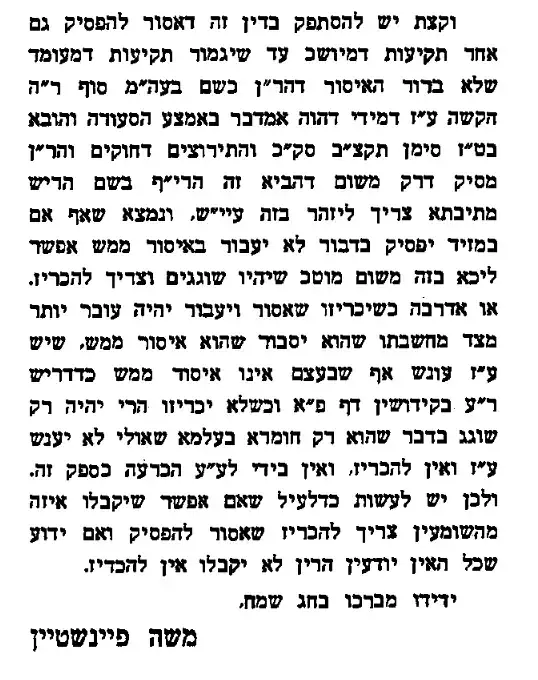
enter image description here

There is what to wonder if it is prohibited to interrupt after the sitting blasts until the standing blasts. It is unclear the prohibition. See Ra''n at end of R''H on Baal Hamaor... See Taz 592:2 and the answers are forced. The Ran concludes since the Rif says this in the name of the Reish Mesivta we must be careful with this.

Rav Moshe continues: It appears even if someone intentionally speaks it is not a prohibition literally - however, once it is announced it might be come one, since the listener thinks there is a prohibition.

See Taz quoted there:

(ב) לא ישיח לא התוקע כו׳ – בטור כתוב א״צ לחזור ולברך ומיהו יש לגעור במי שמסיח כו׳ וכ״כ הר״ן בשם ריש מתיבת׳ שראוי לגעור ותמה הר״ן שהרי אין בשיחה זו הפסק מידי דהוי אמדבר באמצע הסעוד׳ דא״צ לחזור ולברך המוציא. ולעד״נ לתרץ דזה הוי כמי שלא התחיל עדיין במצו׳ וכגון שלא אכל עדיין כלל דהא בשעת הברכה מתכוין על עיקר קיום המצו׳ שהיא על סדר הברכות כמ״ש סי׳ תקע״ה למה תוקעין כשהן יושבין וחוזרים ותוקעין בשעת מוסף כדי לערבב השטן פי׳ בתקיע׳ הראשונ׳ מתערבב קודם התפל׳ כדי שלא יקטרג בשעת התפלה כו׳ הרי שעיקר התקיעה של מצוה היא על סדר הברכות אלא שהתקיעות שמיושב לערבב השטן בעת קיום המצוה שהיא אח״כ ונהי שא״צ לחזור ולברך כיון שעכ״פ התחיל בעשיית מצוה והצורך לה מ״מ כ״ז שהוא לא קיים עדיין העיקר אינו יכול להפסיק ולא עוד אלא שבכל מצוה שהוא עוסק ואינו רשאי להפרד משם עד שיקיי׳ כולה איסור יש בהפסקתו ובבדיק׳ חמץ מצינו ג״כ איסור כמ״ש סי׳ תל״ב. ואין זה דומה למדבר באמצע הסעוד׳ או בישיבתו בסוכ׳ דשם אי בעי פסיק והולך לו משא״כ במקום שלא גמר עדיין המצו׳ וכמו הכא שעיקר המצוה עדיין לפניו פשוט שיש איסור להשיח ומה לי שיחה שבין התקיעות עצמן של מיושב דודאי יש איסור שם להפסיק בשיחה ומה לי אחריהם כל שלא קיים עדיין מה ששייך להמצוה הזאת ובסי׳ תל״ב כתבתי עוד מזה ע״ש כנלע״ד דיש איסור בהפסק׳ זו בשיח׳ מדינא ודוגמא לזה מצינו בפ׳ ע״פ דף ק״כ לענין ברכת מצה וז״ל ואפי׳ אם עיקר המצו׳ באחרונה אין זה תימה אם מברכין על הראשונה כדי לפטור האחרונה כו׳ עכ״ל ואע״ג דהתם שרי להשיח בין אכילה ראשונ׳ לאחרונ׳ התם חד ענין הם אלא שא׳ מהם עיקר משא״כ כאן ראשונה ואחרונה כל א׳ מצוה מיוחדת.

Here he incidentally deals with your issue. The Beracha is intended on all of the Shofar. The first set is different then the second set, the main focus is the second set, which the beracha is primarily for. Unlike Succah, a person can stop and leave any time. Matzah which even if the beracha focuses on the latter Matzah is the same unlike the blasts.

Imo here are a number of additional reasons upon my own logic:

  1. Talking does not only interrupt the Beracha, but also ruins the Mitzvah by not being able to hear.

    a. This might interfere with the Mitzvah of you or another, practically. Unlike Lulav, all can shake while someone else is speaking.

    b. Since this is not just an interruption between Bracha and action but in fact counter to the Mitzvah it might be considered more than an interruption, almost like a decision to separate one's self (ie: deciding to be done eating after making a beracha would require a new Bracha). Placing the lulav down one could argue - since like Tallis you have in mind to pick it up again etc.... I personally assume the Mitzvah has been completed when it comes to picking up or shaking the Lulav once; otherwise, there would be similar issues like Tallis.

    c. Perhaps the Baal Tokeah only has in mind those listening in his Beracha and you might separate yourself from his intention/berahca when you speak.

  2. Similarly, at the very least an announcement must be made to not interrupt for Shofar blasts since due to the variations, the Mitzvah is not completed on one blast, or even one set, but in fact after a number of variations. It is simple to announce to not interrupt at all, especially if one of the set might have a problem and one needs to redo them etc....

msj121
  • 979
  • 1
  • 9