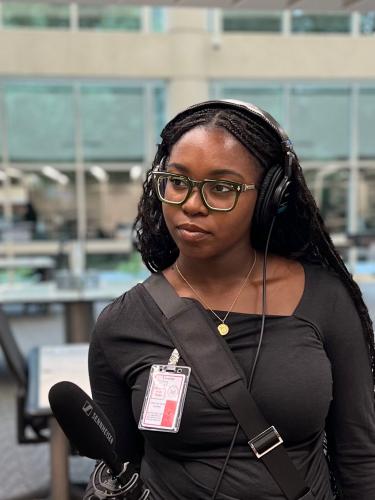
Lena DoDoo recording an interview for the Sidedoor podcast at the National Archives at College Park, Maryland.
Over the last few years, podcasts have become an extremely compelling medium for storytelling, education, and entertainment. There’s a podcast for everything, as they give storytellers a unique and intimate way to connect with audiences. This past summer, I had the incredible opportunity to intern with Sidedoor, the Smithsonian Institution’s flagship podcast, through which I discovered what it takes to produce engaging audio content, from start to finish. Guided by the dynamic duo behind Sidedoor, Lizzie Peabody and James Morrison, I was introduced to the art of podcasting. And if there's one key lesson I've learned, it's that when the front doors of the Smithsonian close, a Sidedoor always opens.
As part of the Because of Her Story internship program, I had the opportunity to curate a Sidedoor episode that highlights an underrepresented woman in American history. One of the first challenges I faced was selecting the most appealing story. I spent a long time exploring various topics including the Smithsonian's efforts to repatriate the Benin Bronzes, the Native American Code Talkers during the World Wars, and even the case of the Great New England Vampire Panic. Each story was fascinating, but I would often find myself at a dead end, whether it be because of a lack of research available or because there was no expert to speak to on the subject.
After much exploration, I settled on a story about Sojourner Truth and her meeting with President Abraham Lincoln. I was inspired by a photograph of this monumental meeting, intrigued by the idea that these two significant figures were active at the same time. I named the episode "Emancipation Conversations" and began diving deep into research.

“Abraham Lincoln showing Sojourner Truth the Bible presented by colored people of Baltimore, Executive Mansion, Washington, DC,” 1864. Image courtesy of the Library of Congress.
My research involved reading everything I could find about this meeting, sending emails to historians, exploring the National Portrait Gallery, and speaking to curators. At first, the information I found hardly seemed groundbreaking. That was until my supervisor, James, directed me to a website called the Sojourner Truth Project.
The Sojourner Truth Project revealed a surprising fact: Sojourner Truth, well known American abolitionist and activist, never actually said the famous words "Ain’t I a Woman." This revelation pushed me deeper into my research, leading me to discover more about her life and the misconceptions surrounding her. I connected with Dr. Nell Irvin Painter, a leading historian who had published extensively on Sojourner Truth. Her insights were invaluable and helped shape the narrative of our episode.
With a clearer angle, I began to structure the episode. Dr. Painter's interview provided a rich foundation for our story, and we decided to explore how art and commercial representations of Truth have altered our understanding of her legacy. Misattributing these words to Sojourner Truth contributes to the simplification of Truth’s multifaced legacy by misrepresenting her voice and identity. In reality, it was white feminist Francis Dana Barker Gage who fabricated these words twelve years after Truth gave her original speech. Further discussions with Ashleigh Coren from the Smithsonian Women’s History Initiative added another layer of depth to my understanding, as she explained how this misattributed quote contorts Sojourner Truth into a one-dimensional heroic figure, which, while inspiring, fails to capture the complexity of her life and activism. It became clear that our episode was aligning very closely with the pillars of the Smithsonian’s Reckoning With Our Racial Past Project, which encourages an informed public to appreciate our country’s complex history and, in the case of Sojourner Truth, strive for a more comprehensive understanding of the past.
The final steps involved scheduling an official recorded interview with Dr. Painter, outlining the episode, and crafting questions. After watching my supervisors Lizzie Peabody and James Morrison at work, I’ve learned that podcasters craft interview questions like gardeners tend a vibrant garden. They start with thorough research, planting seeds of open-ended questions to nurture deep, reflective responses. By attentively listening and following interesting tangents, they allow the conversation to bloom naturally. This balance of preparation and spontaneity ensures an engaging narrative where the most authentic and memorable stories flourish. With this in mind, I formulated questions for Dr. Painter to ensure Sojourner Truth's story was conveyed compellingly.
After weeks of meticulous research and planning, the episode was coming together! Producing a podcast episode is no small feat, but this experience at Sidedoor was incredibly rewarding. By uncovering Sojourner Truth's multifaceted legacy, we can offer listeners a richer understanding of this remarkable figure. I'm excited to share this episode, hoping it sparks curiosity and reflection. I’ve learned the importance of perseverance in research, the power of asking the right questions, and the intricacies of crafting a compelling podcast episode. I’m incredibly grateful to my supervisors and the entire Because of Her Story team for this invaluable experience!
You can find this and all previous episodes of Sidedoor: A Podcast from the Smithsonian here.