This seems like an argument that often comes up against plant-based diets: "you eat insert plant and it destroys rainforests". Are there any studies on which activity causes more harm to forests?
Asked
Active
Viewed 530 times
17

Nic
- 7,148
- 2
- 23
- 64

Ramon Melo
- 1,912
- 1
- 12
- 30
-
1Maybe we can exclude the case of palm oil, since it has already been covered in this question? – Turion Feb 06 '17 at 13:54
-
1@Turion I'm looking at agriculture as a whole vs animal husbandry as a whole, not individual cultures (it would be too broad). Oil palm is certainly a strong factor of deforestation, but is it the strongest? – Ramon Melo Feb 06 '17 at 13:56
-
4I guess my answer here is relevant What can be said when people argue that "plants suffer too"? – Zanna Feb 06 '17 at 14:41
-
1@Zanna It is, and you should post it as an answer. :) – Ramon Melo Feb 06 '17 at 15:01
-
1Tell them "planted one of these in a rainforest and came back later, it didn't harm the rainforest at all" :) – rackandboneman Apr 07 '17 at 11:02
4 Answers
15
A relevant point is that raising animals for food requires feeding them plants. Since only around 10% of the energy input (the percentage used for growth) at one trophic level of a food chain can be passed onto the next, it is more efficient to have a shorter food chain.
In practice, this means that, generally speaking, you need a lot more crops to feed to animals to feed to people than you need crops to feed to people directly, so raising animals is far less efficient in terms of producing energy per unit of land than raising crops, thinking purely about feeding humans.
It is sometimes argued that animals can be allowed to graze on land that is too poor for crop-raising, and to some extent this is true, and complicates the picture. Animals may also be fed on kitchen waste products and other energy sources that are not considered fit for human consumption, and may or may not overlap with human food sources or the capacity of land to produce them. However, while I do not have accurate statistics to hand, I believe the principle holds generally. [citation needed]
Where forest is cleared for agricultural purposes then, larger land areas will be needed to produce the same amount of food (in terms of energy) by livestock raising than for crop raising. Rainforest land is cleared to grow soya, and vegans are often reminded of our complicity in this: we eat soya, so we are contributing to deforestation. However, the great majority of this soya is produced to feed animals who will be killed for their meat. [citation needed]
I would argue however that forest should not be cleared for either purpose. There should certainly be enough arable land to feed everyone already without deforestation. Large areas of farmland are not used, or are used to grow biofuel crops, or are used inefficiently, for complex, bad economic reasons (corporate landowners exploiting regulations, food speculation and other globalisation factors)[explanation needed].
Forests regulate rainfall and water tables, and thus exercise protective effects on agricultural lands in the same geographic area. In former rainforest areas, the soil may be too poor to support nutrient removal via crop growing, and loss of the water retained by forest means that land will be too dry. In the long term, at least in tropical areas, it is more economic to leave forests intact and harvest food products such as roots and fruits from them, because of the rapid soil erosion that occurs, making the land unusable after a few crop cycles. Removing forest in these areas is highly unsustainable, whatever purpose the land is put to afterwards.

Zanna
- 11,878
- 2
- 38
- 78
-
2Great answer! We should also bear in mind the damage caused to fields, and consequent necessity of more fields, by soil erosion/flooding, chemicals/salt, and manure/sewage. Bad agricultural and industrial practices play heavily into the demand for deforestation. – amagnasco Feb 06 '17 at 16:58
-
- 1 "A relevant point is that raising animals for food requires feeding them plants". This!
– henning Apr 06 '17 at 12:32 -
@Zanna "10% of the energy input...can be passed onto the next" Do you have a good scientific source for the oft-cited 90% loss-of-energy with an additional hop in the food chain length? – Michael Altfield Jun 01 '23 at 16:35
6
There are two sides to your question: economics, and ecological impact. As Zanna explained the latter very well, and my experience is with the former, I'll focus on that.
As a political economist, I'd say deforestation isn't implemented specifically for either crop or husbandry, but rather for whatever is the most lucrative option in that particular time and place.
Given that at every scale, international markets as well as domestic (and even insular markets like Cuba!) are currently flooded with cheap, low-quality meat, most new fields are destined for always-in-demand cash-crops such as soy (South America for China); corn (North America for US); poppy (Afghanistan for Russia); fruits, coca, & cannabis (South/Central America for US).
This would likely change if: demand shifted to ethically-raised meats, or US laws were to ban factory-raised meat; if demand for cocaine, opium/heroin, or marijuana were to diminish; if another crop became lucrative; if the US stopped putting corn syrup in everything; if Monsanto were to get sucked into a black hole; or if war, natural disaster, or genocide were to wipe out or otherwise engage a big chunk of the world population.
The cost-benefit analyses have to include factors such as cost to produce, tariffs and taxes, and the international market for the product. You also have to consider the suitability of the species to the environment, and how you're going to need to compensate for the inevitable differences. Of course, raising factory meat that's never seen the light of day is always going to be much cheaper than grass-feeding, and the same goes (on a much smaller scale) for the greenhouse or indoor herb production that's taking off in urban areas.
Example 1: Argentina, an agrarian nation traditionally producing major quantities of both beef and grain for Europe and the US, now bases most of its production on soy for the Chinese market. Deforestation there seems to mostly go towards soy fields now, where before it could go either way. Compared to soy, production of meat, grapes/wine, wheat, maize, mate, etc are almost insignificant.
Example 2: In the rain-forest areas of Ecuador & Colombia, deforestation is usually heavily tied to the US market in ways that are not very pretty. Significant examples are fruit plantations (wikipedia "Banana Massacre"), rubber plantations, and now, in cartel-controlled areas, drug crops and illegal mining. Another well-known cash-crop is poppy (opium, heroin) in Afghanistan and Burma, or the growing demand for Ethiopian coffee.

amagnasco
- 105
- 5
-
fantastic answer, many thanks for contributing and welcome to the site :) – Zanna Feb 06 '17 at 17:01
-
1Thank you! Your post was fascinating and reminded me of "Planetology" from Dune. I'd love to read up on the ecological-economics you were talking about, do you have any book suggestions ? – amagnasco Feb 06 '17 at 17:04
4
This is a false dichotomy. You can't raise (and breed) animals without growing plants to feed them. So it really boils down to which society is better for the environment: one which (1) purely grows crops for food or one which (2) grows crops for animal feed, this isn't an alternative, they're doing both.
Clearly (by this logic), cultivating only crops (rather than animals as well) would reduce impacts on the environment. This is further supported if we consider the additional environmental impacts of farming livestock, such as methane emissions (e.g, cattle), run-off pollution, and genetically homogenous populations which breed diseases (e.g, Varroa mite in bees, PSA outbreaks in kiwifruit). Another consideration is that the water (irrigation), and land area (deforestation) required for crop farming is lower than animal feed relative to the amount of food produced (by kilogram or kilojoule). This is widely accepted and environmental reasons is one of the main reasons academics give for their Vegan diets.
Basically, it's more environmentally sustainable to be lower in the foodchain, it is the lesser of both impacts. Although no food source (or industry) is devoid of environmental impacts or other issues (e.g., food miles, unethical 3rd world labour, etc).

Tom Kelly
- 1,542
- 9
- 19
-
2Some climates might support plenty of vegetation (wild or farmed) that is edible/palatable/accessible to herbivorous animals but not humans, while being ill suited to grow human foodstuffs in - but that seems to be a thing with colder climates, not rainforest climates :) – rackandboneman Apr 07 '17 at 11:01
2
While the other answers made good qualitative points, I try to add a quantitative perspective.
In an article on "cattle ranching and deforestation", the Food and Agriculture Organization of the United Nations (FAO) considers the impact of pasture vs. cropland usage on deforestation:
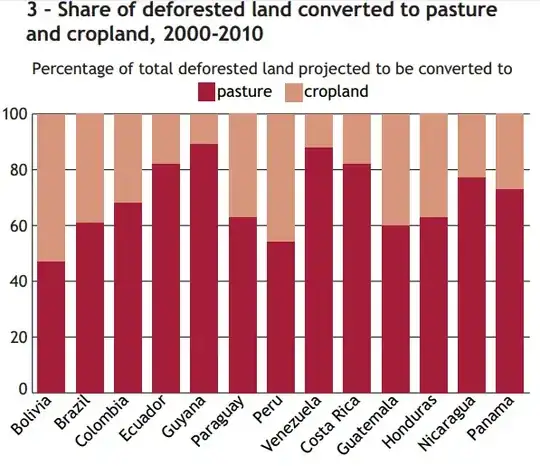
The chart shows that in general more deforested land was converted to pasture than to cropland in the considered countries.
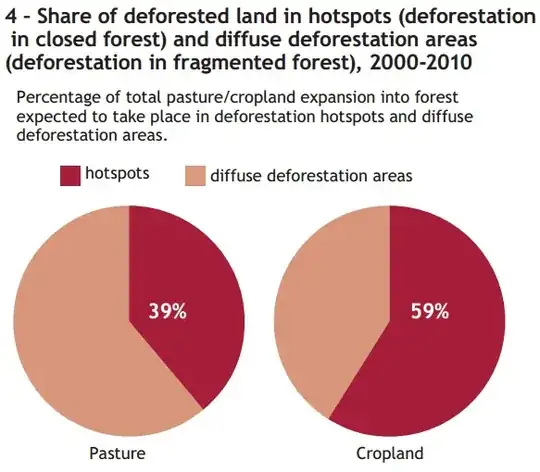
Differentiating between hotspots and diffuse deforestation areas, in hotspots more deforested land was converted into pasture, while in diffuse deforestation areas more deforested land was converted to cropland.
--
Another source of information on this issue is the scientific paper "Cropland/pastureland dynamics and the slowdown of deforestation in Latin America" by Graesser et al. By using thirteen years (2001–2013) of satellite imagery to characterize cropland and pastureland expansion across Latin America, they analyzed the respective impacts of the two usage forms:
17% of new cropland and 57% of new pastureland replaced forests throughout Latin America. In that time, cropland expansion was less (44.27 Mha) than pastureland (96.9 Mha), but 44% of the 2013 cropland total was new cropland, versus 27% of the 2013 pastureland total, revealing higher regional expansion rates of row crop agriculture. The majority of cropland expansion was into pastureland within core agricultural regions of Argentina, Brazil, Bolivia, Paraguay, and Uruguay. On the contrary, pastureland largely expanded at frontiers, such as central Brazil, western Paraguay, and northern Guatemala. As others have suggested, regional agriculture is strongly influenced by globalization.
...
The results illustrate agricultural cropland and pastureland expansion across Latin America is largely segregated, and emphasize the importance of distinguishing between the two agricultural systems, as they vary in land use intensity and efficiency

cellu
- 1,186
- 8
- 17