12

Out of universe, what made the Star Trek: Voyager creators/producers develop the role of the Conn Officer? In TOS, the role was different (a helmsman and navigator) and on the the Enterprise-D, Enterprise-E and Defiant the Conn Officers were a wide range of characters that rarely held the position for long.

Was Tom Paris's back story the only reason he got to be a prominent pilot? Was it because Voyager was in the Delta Quadrant, though navigational decisions did not seem to be his? Was it purely to try to be different?

Perhaps the answer is 'all of the above,' but I'd love to know if there is a clearer, defined reason given by the producers.

Praxis
  • 111,024
  • 50
  • 512
  • 690
ThruGog
  • 12,904
  • 3
  • 48
  • 82
  • 2
    The "hot shot (but rebellious) pilot" trope is a very well established archetype – Valorum Aug 13 '15 at 08:46
  • 2
    Related, but not dupe: http://scifi.stackexchange.com/questions/53361/why-is-there-no-consistent-chief-helms-officer-in-tng – Often Right Aug 13 '15 at 09:19
  • @Richard But, I would suggest, having that archetype in position for a seven-year Star Trek run is not particularly well-established. – ThruGog Aug 13 '15 at 09:35
  • 1
    @N_Soong Interesting information and some in-universe ideas there. Thanks for showing me. I notice on the Defiant you had Nog (from Operations department), Major Kira and Dax (Science department) piloting as well as 'randoms' so they follow the TNG pattern too. – ThruGog Aug 13 '15 at 09:39
  • I'm not sure what you mean by "the role was different", given that Tom Paris somewhat unites the two posts that TOS had even two permanent characters for. However, note that on the Enterprise-D, Wesley Crusher was initially a semi-permanent helmsman, and after his departure, it was the one bridge position that was not manned by complete no-names, but by occasionally recurring characters such as Ro Laren or Ensign Gates. On the Defiant, main cast such as Jadzia Dax would repeatedly take the helm, as far as I recall. – O. R. Mapper Aug 17 '15 at 06:35
  • @O.R.Mapper I was mostly only interested in the TNG era as it is more comparable, but regarding TOS I think two full-time jobs which are compressed into one full-time job a century later would be quite different. The Enterprise-D had a range of Conn officers and the Defiant had a range of lesser cast members as well as regularly being flown by Dax, Kira and Nog. These characters are all from different areas of Starfleet (and Bajoran) personnel, which again suggests just about anyone can fly a starship reasonably well. – ThruGog Aug 17 '15 at 09:12
  • 1
    An an additional justification of how Tom Paris is different to the rest (of his era) was that he was the only Conn Officer on the senior staff who wasn't there for another reason (e.g. Dax was sometimes at the Conn but was already on the senior staff for other reasons). – ThruGog Aug 17 '15 at 09:20
  • "on the the Enterprise-D, Enterprise-E and Defiant the Conn Officers were a wide range of characters that rarely held the position for long." Jadzia Dax did alright. – Lightness Races in Orbit Sep 27 '16 at 22:27
  • 1
    @Lightness Races in Orbit - See my other comments. She was Science Officer slash pilot, for one thing. Head of a science department on a deep space station far bigger than a starship... plus a pilot. It only serves to show how Paris was different. – ThruGog Sep 28 '16 at 17:29

3 Answers3

16

Voyager: the ship where not everyone is a happy camper

To get at the reasons for having Tom Paris as the USS Voyager's Chief Conn Officer, we must first discuss the objectives for Voyager as a television series.

Both DS9 and Voyager made efforts to depart from some of the philosophies of The Next Generation. For instance, DS9 increasingly attacked the notion of the United Federation of Planets as a Utopia. On the other hand, Voyager attacked (or at least was intended to attack) the notion of an orderly Starfleet starship in which the senior officers rarely make grievous errors and are generally infallible.

Stranding Voyager in the Delta Quadrant and forcing its crew to work alongside a group of very anti-Starfleet Maquis members was a catalyst for creating tension and disorder on Voyager. (Ultimately, the producers creative staff failed to capitalize on this tension by dissolving it too quickly, but that's another story.)

A good example that contrasts the general infallibility of crew in TNG is Harry Kim. Here, we have a wet-behind-the-ears ensign who is thrust by circumstance into a permanent bridge position, putting him at the conference table with the senior officers. And of course, he makes several notable mistakes along the way due to his inexperience.

Now we come to Tom Paris. The producers seemed to want to complete this tension by having a character in need of redemption — someone ill-at-ease with both the Starfleet personnel and with the Maquis who would have to earn their combined trust. This of course was filled perfectly by Tom Paris.

The template for this character was Nick Locarno, a brash Starfleet cadet whose plan to cover up a flight disaster in TNG's "The First Duty" almost cost Wesley Crusher his Starfleet career. Locarno was also played by Robert Duncan McNeill.
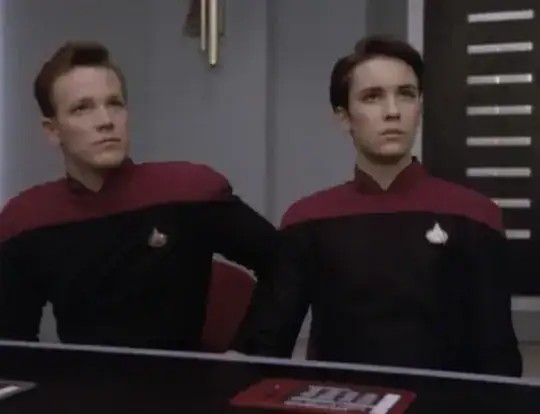
enter image description here

TNG itself had already borrowed a "broken" character from this very episode for one of its later episodes, "Lower Decks". There, Ensign Sito (one of the conspirators with Locarno and Crusher) must prove herself to Picard.

The initial plan was to use Locarno outright, but this would have meant paying royalties to the writers of "The First Duty". Also, Locarno was seen as a bad guy masquerading as a good guy, and the feeling was that the character they wanted should be the opposite:

As Robert Duncan McNeill explained, "Locarno seemed like a nice guy, but deep down he was a bad guy. Tom Paris is an opposite premise in a way. Deep down he's a good guy. He's just made some mistakes."

(Source)

From this realization, the Tom Paris we have come to know was born. Now for the tricky part: did being a pilot come into Voyager through the Nick Locarno inspiration, or was the Chief Conn Officer position an inevitability of the main plot lines of Voyager? Unfortunately, there are no statements from the creative staff to answer this.

My speculation is that it was a bit of both. I believe that the pilot aspect played naturally into Voyager's predicament: neither did the storyline need to be adjusted to accomodate Tom Paris being an exceptional pilot, nor was there a need to update the "Locarno profile" to give Paris a different expertise. Here's why:

Voyager was operating under unusual circumstances with a relatively small crew

The crew of the USS Voyager, Maquis included, was about 145. Kirk's Enterprises had crew complements of roughly 2 to 3 times this many (depending on which Enterprise and which decade of operation), and Picard's Enterprise had almost 7 times this number of personnel. Naturally, those ships would have more trained pilots than Voyager does.

For purposes of comparison and contrast, let's focus on the Enterprise-D as a ship that was nearly contemporaneous to Voyager. Being the flagship, the Enterprise-D was not on a long-term deep-space mission. It was freqently visiting various Starfleet starbases, and during TNG we see it visit Earth a number of times.

New junior crew members, often fresh out of the academy and requiring experience, were acquired by the Enterpise-D at various points. Riker and Troi were in charge of the bridge duty roster, and the "night shift" was frequently reserved for officers, including helmsmen, with less experience. Sometimes, however, an emergency strikes while a junior officer is at the helm, and sometimes another officer is seen to take over. All in all, there are plenty of reasons why we see frequent changes at the helm on the Enterprise.

Now let's turn to Voyager:

  • Voyager is stranded in the Delta Quadrant. The crew it has is the only crew it is going to have for the foreseeable future.
  • Of the only 120 or so surviving Starfleet crew members, only a handful would be competent enough to fly a starship through unpredictable circumstances. (In normal circumstances, the ship can fly itself if necessary, and the computer can also implement pre-programmed evasive maneuvers in an emergency, but a competent helmsman is required for most real battle scenarios. That's one of the reasons why starships still have helmsmen.)
  • Voyager's primary helmsman was Lt. Stadi. However, she was killed when Voyager was flung from the Badlands to the Delta Quadrant in the first episode.
  • Without being ordered to do so, Paris grabbed the helm and steered Voyager to safety. He also distinguished himself by saving Chakotay's life towards the end of the first episode.

Given Paris' expertise, the shortage of personnel, and his heroic actions, it was both prudent and justified for Janeway to make Paris into the Chief Conn Officer.

Upshot

The producers essentially borrowed a "broken" character from a prior TNG episode in order to paste in a certain trope (the troubled but good soul in need of redemption), and this character happened to be a pilot. On the other hand, having a Chief Conn Officer was also manifestly natural for Voyager given its situation, and so one can say that there was a need for such a role, too. It so happens that Tom Paris fills both these roles: he needed saving, and his skill was put to use in saving Voyager.

Praxis
  • 111,024
  • 50
  • 512
  • 690
  • 3
    Great work, as always +1 – Often Right Aug 17 '15 at 00:11
  • 1
    You cannot really compare the ship compliments like that. In Kirk's time they really crammed them in like sardines(DS9, Tribble ep). And Picard piloted a massive flagship with a large civilian population. And Voyager was newer, more like the Defiant which was crewed by like 9 people or something. The crew started off with 141 star fleet officers, so if anything they got a little crowded with the addition of the surviving Maquis. http://en.memory-alpha.wikia.com/wiki/USS_Voyager#Crew – Jonathon Aug 17 '15 at 02:11
  • 2
    @JonathonWisnoski : My only point in regards to ship complements is that there are more trained helmsmen on each of the Enterprises than on Voyager. Cramming and space considerations are irrelevant to my argument. – Praxis Aug 17 '15 at 02:45
  • 3
    A great answer - I really like the edit that includes the 'out of universe' aspect. – ThruGog Aug 17 '15 at 09:24
  • 1
    Great answer dude! – sumbuddyx Sep 03 '15 at 08:18
0

I think they really didn't care about the pilot, but rather they cared more about the character, and piloting was just his job. They weren't trying to develop the role of "Pilot", they were trying to develop the role of "Locarno" Tom Paris.

When Voyager was in early development, one of the characters was to be Nicholas Locarno, but they decided to replace him for several reasons, including audience reactions and money. Since the writers wanted to develop this character, they needed him to do something on the ship, so they made him a pilot, since that was what he did at the Academy.

In summary, they didn't give a crap about "pilot", they wanted to develop Locarno.

https://memory-alpha.fandom.com/wiki/Nicholas_Locarno https://memory-alpha.fandom.com/wiki/Tom_Paris#Background_information

Nate Watson
  • 2,479
  • 15
  • 13
  • 1
    I do find it interesting that Lacarno was changed but his job stayed the same. There isn't much reason that Paris didn't become something else who messed up, but the pilot aspect does fit well. (He could have been an engineer who took too many risks with the equipment or a slightly trigger-happy tactical officer?) But I'm sure these roles were already planned, and as explained in Praxis's answer, the in-universe reasons fit very well. – ThruGog Aug 17 '15 at 09:27
  • "so they made him a pilot, since that was what he did at the Academy" - FWIW, the impression I got from the TNG episode was that possibly any cadet would be required to have that kind of piloting training, rather than specifically being a "pilot". Remember that when we met Sito Jaxa again, she was a member of Security, not a pilot, either. – O. R. Mapper Aug 11 '20 at 20:41
-3

CONN is a nautical term for the act of "Controlling a ships movement at sea" A "Helm" is the equipment by which one takes control of a ships movements (yoke, steering wheel, etc) So the writers may not have known the exact terms but the emphasis was the same. A CONN officer being one who controls the ships movements and the HELM the device by which he does so. Every series of Star Trek the lead ship had a pilot TOS: Sulu TNG: variable, mainly Wesley Crusher for much of the series DS9: Dax piloted the Defiant Voyager: Paris piloted Voyager Enterprise: Mayweather

LazyReader
  • 1
  • 11
  • 12
  • 3
    This doesn't answer the question asked which is why they made the conn officer into such a prominent and regularised role. – Valorum Apr 22 '20 at 07:25