93

In Lord of the Rings: The Two Towers, in the chapter Shelob’s Lair, there is a rather lengthy description of Shelob, the last remaining child of Ungoliant in Middle-Earth. In this, there is also a description of her relation with Sauron:

And as for Sauron: he knew where she lurked. It pleased him that she should dwell there hungry but unabated in malice, a more sure watch upon that ancient path into his land than any other that his skill could have devised. And Orcs, they were useful slaves, but he had them in plenty. If now and again Shelob caught them to stay her appetite, she was welcome: he could spare them. And sometimes as a man may cast a dainty to his cat (his cat he calls her, but she owns him not) Sauron would send her prisoners that he had no better uses for: he would have them driven to her hole, and report brought back to him of the play she made.

I’ve never understood the bolded bit there. Tolkien is saying that Sauron sometimes sent prisoners to Shelob to keep her less-than-ravenous and in check, in an almost playful way, the way you might throw a dainty to your cat. So clearly Shelob is the cat.

But then why does it say, “but she owns him not”? Surely if she were the pet and Sauron the master, as seems to be the explicitly denied premise, he should own her, not the other way around.

Was Tolkien one of those cat-lovers who say that you never own your cat—your cat owns you? I don’t know why, but I’ve always assumed that was a much later jocular meme. Is there some other logical explanation for this seeming reversal of ownership?

Janus Bahs Jacquet
  • 14,055
  • 11
  • 66
  • 99
  • 5
    own can mean, "to concede", or it can mean relation, so it could be she does not concede to him, or that she is of no relation or partnership with him. – Himarm Jul 02 '15 at 18:16
  • 23
    As Nerrolken says, you're reading the word "owns" wrong. It used to mean something like "admits" or "acknowledges". So the line is "she doesn't acknowledge him". – Wad Cheber Jul 02 '15 at 18:22
  • 13
    When I read that I thought about the idea that cats own the insufferable humans they live with. If she were his cat, she would own him, but since she doesn't, she isn't his cat. – Jack B Nimble Jul 02 '15 at 18:27
  • 4
    It might be better understood if you think of its antonym: disown. – jamesqf Jul 03 '15 at 17:16
  • (his cat he calls her, but she owns him not) seems to me neither a misuse or archaic use of the word "own" - I think it is simply a juxtaposition between two concepts: A man throws a dainty to his cat, he owns the cat (in his mind). But the relationship is one-sided: the cat does not own the man, and in fact the relationship simply doesn't exist at all in the mind of the cat. It is as though Tolkien is saying "the man owns the cat, but the cat sure doesn't own the man [for that matter, the cat doesn't appreciate any relation between itself and the man]" – Darren Ringer Jul 04 '15 at 17:19
  • It should be read as "She doesn't own [to] him". – Bergi Jul 04 '15 at 18:32
  • You've read the quote wrong in another way. It's as @Bergi points out. You've forgotten the 'not'. It means as said: she does NOT own him. – Pryftan Feb 19 '19 at 00:47
  • 1
    @Pryftan No, I didn’t misread that. The preceding but implies that the expected situation is that she would own him, which was what I misparsed originally and couldn’t make sense of. That is the explicitly denied premise. The fact that it is denied doesn’t matter – it’s the unnegated form that’s the semantic premise and which should therefore make sense. Compare “she has ponytails, but she is not a boy”: the implication, created by but, is that only boys have ponytails, which is obviously not true. – Janus Bahs Jacquet Feb 19 '19 at 08:08
  • @JanusBahsJacquet If you say so. It's not the most common use or form but the 'not' refers to what I stated. Just as the answer suggests (that you have accepted). Just as other comments suggest. It means she does NOT own him plain and simple. The accepted answer says the same thing: that it could be reworded to His pet he calls her, though she doesn't recognize his authority. (notice the 'DOESN'T) as well as His pet he calls her, though she doesn't agree. (Notice the word DOESN'T again). – Pryftan Feb 19 '19 at 23:51
  • @Pryftan Exactly – and those two sentences also imply that if his statement (calling her his pet) were accurate, the expected situation would be that she recognised his authority/agreed, which makes sense: pets usually recognise their owners’ authority. Conversely, when you read own to mean ‘possess’ as I did originally, the expected situation would, according to the sentence, be that she possessed him if his statement calling her his cat were accurate, and that doesn’t make sense: pets don’t usually own their owners; hence the question. The not is an integral part of the question. – Janus Bahs Jacquet Feb 20 '19 at 00:04
  • @Pryftan If I had missed the negation, I would never have asked the question, because without the negation, the sentence makes sense with the incorrect meaning ‘possess’: “His pet he calls her, but she owns (=possesses) him” creates an opposition between her being his pet and her owning him – perfectly logical, since those two notions are opposites. It is the presence of the negation which renders the sentence meaningless until you read it with the correct sense of own in mind. – Janus Bahs Jacquet Feb 20 '19 at 00:08
  • 'The not is an integral part of the question.' Be that as it may it was what my comment was about. And therefore valid as a comment. I see very well that you were after something else but even so the fact the bold included what I commented about .... But bother that. All I was saying is that the not in the bold modifies it the way I was getting at. Nothing more than that. But I see you added another comment: I believe you misunderstood what I was trying to say with missing the negation. The connexion is to the 'why would she own him' and the fact the quote negates the idea. – Pryftan Feb 20 '19 at 00:10
  • @Pryftan A comment that's correct isn't automatically non-obsolete. Says the one who necro-posts, I know, but I felt like the OP's standpoint remained unclarified. – Egor Hans Feb 19 '21 at 08:16
  • It's clearly a typo, since Sauron is mightier, and the remark made Shelob mad, but Shelob still can't pwn Sauron. – Michael Foster Nov 15 '23 at 20:42

3 Answers3

148

According to a similar discussion on another site, Tolkien is using "own" in a more archaic sense of "acknowledge" or "yield to." The Oxford English Dictionary article on own contains one definition (4.c) of "own" as "To acknowledge as having supremacy, authority, or power over oneself; to recognize or profess obedience to (a greater power, a superior, etc.)."

If this is the case, the phrase could be re-worded to be...

His pet he calls her, though she doesn't recognize his authority.

...or, put more simply...

His pet he calls her, though she doesn't agree.

Janus Bahs Jacquet
  • 14,055
  • 11
  • 66
  • 99
Nerrolken
  • 38,517
  • 20
  • 154
  • 204
  • 29
    This. A million times this. The word "owns" is used, as are so many words in Tolkien's work, in an archaic sense. – Wad Cheber Jul 02 '15 at 18:20
  • 1
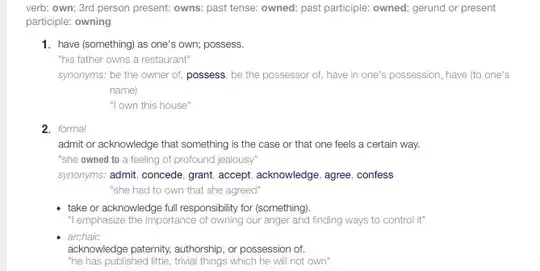
    I got you this screenshot of a dictionary entry for the word "own". Feel free to add it to your answer: https://farm4.staticflickr.com/3804/19171658790_2ca10243a6_o_d.jpg – Wad Cheber Jul 02 '15 at 18:39
  • 1
    @WadCheber I think it would be better as text (so it can be copy-pasted) and quoted from the source instead of as an image – user2813274 Jul 02 '15 at 18:40
  • 1
    @user2813274 - That would require me to add it myself, which I don't want to do without permission. – Wad Cheber Jul 02 '15 at 18:49
  • 3
    @WadCheber from what dictionary? Generally I think that copying/pasting individual word entries can be argued to constitute "fair use", at least in the United States. – Matt Gutting Jul 02 '15 at 19:10
  • 1
    @MattGutting - Whatever dictionary Google uses. Google the words "own definition" and that's what you'll see. The permission I was talking about was Nerrolken's permission to edit his answer, not the dictionary's permission to use their information. – Wad Cheber Jul 02 '15 at 19:12
  • 4
    +1. Such a simple solution! It never even occurred to me that it was own itself that held the key to a proper understanding, since we talk so commonly of owning our pets. I don’t think I’ve ever seen own used in this acknowledging way with a simple pronoun as its object; the OED definition you refer to also says “In later use only with abstract objects, esp. in to own (a person's) sway. Now somewhat _arch._”. The 1695 quote is by Blackmore: “The Prince of Darkness owns the Conquerour, And yields his Empire to a mightier Pow'r.” – Janus Bahs Jacquet Jul 02 '15 at 21:04
  • (I took the liberty of adding a link to the OED article, even though it’s subscription-only, and updating the exact wording of that definition to match the one given in the online version, taken from the OED3 published in 2005.) – Janus Bahs Jacquet Jul 02 '15 at 21:12
  • @Wad Cheber: NOT archaic - at least not to those of us who refuse to reduce language to the lowest common denominator! – jamesqf Jul 03 '15 at 05:21
  • @jamesqf - You're right- not archaic, just a bit obscure, or at least less common. – Wad Cheber Jul 03 '15 at 16:30
  • @anyone -- do you think there is any deliberate punning here? literary puns of this nature are often employed in sacred texts. – Walrus the Cat Jul 03 '15 at 21:12
  • @WalrustheCat I think there is a pun here. "own" does mean "acknowledge", as in to "own up" to misdeeds, but JRRT was also very fond of cats and I believe he is playing on the old joke/saying that a person never owns a cat; the cat owns the person. If so, he's underlining the mutual mistrust. – Nagora Jul 04 '15 at 22:03
  • 1
    @Nagora Why do you think Tolkien loved cats? DVK's answer to this question has an article saying the exact opposite, that he hated them. Personally, I don't think he was punning here, mostly because it seems out of character for him, especially during a passage describing the recreational execution of Sauron's enemies... – Nerrolken Jul 04 '15 at 23:49
  • So "own" in this sense is essentially the opposite of "own" the way we would use it today. Interesting. – trysis Jul 05 '15 at 00:19
  • It is also quite possible that this is an intentional play by Tolkien, using the archaic meaning of own along with the idea that while dogs have owners, cats have staff. It’s unlikely, I’ll grant, but I always have a bit of a smile at that passage imagining it could be. – lbutlr Jul 05 '15 at 13:16
  • Even so the 'not' after the rest negates the meaning in the first place. It means she does not own him. – Pryftan Feb 19 '19 at 00:48
21

To supplement Nerrolken's excellent answer, here is how the site dictionary.com defines the relevant usage of the word "own":

verb (used with object)
to acknowledge or admit:
to own a fault.

to acknowledge as one's own; recognize as having full claim, authority, power, dominion, etc.:
He owned his child before the entire assembly. They owned the king as their lord.

verb (used without object)
to confess (often followed by to, up, or up to):
The one who did it had better own up. I own to being uncertain about that.

Another dictionary:
enter image description here

In this case, "own" means "admit" or "acknowledge", not "claim possession of".

So the sentence isn't saying that Sauron doesn't belong to Shelob, it is saying that she doesn't acknowledge that she belongs to him.

Or to use the example from my quote under the second definition: "She did not own [i.e., acknowledge] him as her lord".

Wad Cheber
  • 69,816
  • 70
  • 523
  • 684
12

Another possibility is that Tolkien was using not an archaic version of "own", but an ironic notion - common to cat lovers and haters (with Tolkien strongly established as the latter) - that "really", it's the cat owning her human, not vice versa.

Even more ironically, that humorous slant seems to be more true than not. Science FTW!

DVK-on-Ahch-To
  • 342,451
  • 162
  • 1,520
  • 2,066
  • 1
    That was my impression upon my first reading of the line, but I think it was something more reasonable to a philologist like Tolkien. – Wad Cheber Jul 02 '15 at 20:00
  • 12
    @WadCheber - you're forgetting that Tolkien was a professional cat hater even more than a philologist :) – DVK-on-Ahch-To Jul 02 '15 at 20:03
  • I KNEW that there was another reason why I love the guy so much. Truly a man after my own heart. – Wad Cheber Jul 02 '15 at 20:04
  • 1
    That was the notion that I referred to in the question as well, but it seemed ‘wrong’ somehow to imbue Tolkien’s text with this meaning—the jocularity of the notion seems out of place in what is otherwise a lofty and dour section. Definite +1 for the link about Tolkien and cats, though! – Janus Bahs Jacquet Jul 02 '15 at 20:56
  • @JanusBahsJacquet see my comment on the accepted answer -- do you suppose there may have been some intentional punning here, perhaps thrown into relief against the (undoubtedly) "lofty and dour" context? – Walrus the Cat Jul 03 '15 at 21:14
  • I think this is the more likely answer. Cats behave as though they own their humans, not the other way around (like properly-trained dogs do). – Derek Jul 04 '15 at 04:01
  • +1 for the link about Tolkien's ailurophobia. :( He and I got issues. – La-comadreja Jul 05 '15 at 15:30
  • I've read contradictory evidence on that issue.

    Also, from the article in the link: "but because its context has changed at least once and probably twice over the past 10 thousand years, we can't be sure what they're thinking when they do it."

    –  Aug 08 '17 at 15:38