36

I know Aragorn is descended from Elros the half-Elf, and from what I've been able to find, there are somewhere between 64 and 99 generations separating Elros from Aragorn. I can't do the math, I don't know how many generations actually separate them, and I don't know if Aragorn had any other Elves in his family tree.

So how much Elven blood flows through Aragorn's veins? What percentage of his total DNA comes from Elves?

Wad Cheber
  • 69,816
  • 70
  • 523
  • 684
  • 5
    If you want to invoke actual genetics, you need to consider that people only have 2*23 chromosomes, so you're really talking about the probability of having at least one elven chromosome. Not sure how applicable genetics is to middle earth, after all Elrond's "choose your fate, half elf" doesn't fit well with science either. – CodesInChaos May 31 '15 at 08:10
  • 2
    https://en.wikipedia.org/wiki/Dol_Amroth - there could be other sources of elven blood – Mithoron May 31 '15 at 16:28
  • 5
    @CodesInChaos - But can't you pick up a few genes here and there without receiving an entire chromosome? – Wad Cheber May 31 '15 at 21:43
  • 3
    @Wad Cheber You're right, also elves seem to have big genome similarity with humans because they can reproduce with each other. – Mithoron Jun 01 '15 at 12:22
  • We also don't know elfin genetics, are they dominant or not? That has everything to do with answering this question, and so it can't. All we can say is he has elfin ancestry going back to Elros. – Escoce Jan 25 '16 at 17:11
  • 3
    @Escoce - 1. "Elven", not "elfin". Tolkien nearly killed an editor who changed "elven" to "elfin" :) 2. Elves and humans are one species, so I assume their genes have the same chances of being dominant or recessive. – Wad Cheber Jan 25 '16 at 17:30
  • 1
    Tolkien was pretty explicit that Elves and Men were the same species: their differences are best understood as spiritual, not biological. – Lexible Jun 28 '20 at 17:01
  • @CodesInChaos Chromosomes are recombined during meiosis so a parent with one 100% elven copy of chromosome 1 and one 100% human copy of chromosome 1 could produce a gamete that carries a copy of chromosome 1 that is 50/50 human/elven (or 60/40 or 40/60). – ApproachingDarknessFish Jun 29 '20 at 00:57

6 Answers6

67

It rounds up to none, but getting there is fun.

A note before I get started: I'm going to use the word "blood" a lot, and very imprecisely. I don't literally mean blood, or genetic markers, or anything like that. I just mean ancestry, the way I would call myself 1/4 Irish, because my grandmother was ethnically Irish. "Blood" is just a slightly simpler way to express that idea.

Aragorn's parentage diverges from the Elves with Elros, brother of Elrond, who made the choice of the Edain at the end of the First Age. There is no other intermarriage with Elves along Aragorn's line until we get to Aragorn himself, so we can simply count the Kings (and Queens) of Númenor, Gondor, and Arnor, and the Chieftains of the Dúnedain, until we get down to Aragorn. We start with part i of Appendix A.I, the kings of Númenor.

"The Thain's Book" (note: defunct and not archived) helpfully provided a family tree of the Kings of Númenor, which goes down as far as Isildur before skipping to Aragorn, so you can see how these different people relate to one another:

Big Númenórean family tree

For the sake of accessibility, and also citing some of the more surprising statements, let's go through the chain:

  1. Elros Tar-Minyatur
  2. Vardamir
  3. Tar-Amandil
  4. Tar-Elendil

At this point Aragorn's line diverges from the Kings. The next King is Tar-Elendil's son Tar-Meneldur, but Appendix A tells us that Aragorn is descended from Tar-Elendil's daughter Silmariën:

In the days of Tar-Elendil the first ships of Númenóreans came to Middle-earth. His elder child was a daughter, Silmariën. Her son was Valandil, first of the Lords of the Andúnië in the west of the land, renowned for their friendship with the Eldar. From him were descended Amandil, the last lord, and his son Elendil the Tall.

Return of the King Appendix A "Annals of the Kings and Rulers" (i) "Númenor"

So let's continue the list

  1. Silmariën
  2. Valandil

Unfortunately here we don't know any more until Eärendur, but he's identified in Unfinished Tales as the Fifteenth Lord of the Andúnië, so there are 13 unaccounted for names.

  1. Eärendur
  2. Eärendur's unnamed son (or daughter)
  3. Númendil
  4. Amandil1
  5. Elendil
  6. Isildur

From here we turn to Part ii of Appendix A, "The Realms in Exile". "The Thain's Book" again compiled a helpful family tree of the Rulers of Arnor, and the Chieftains of the Dúnedain, all the way from Elendil to Aragorn:

Another big family tree

For accessibility purposes:

  1. Isildur
  2. Valandil
  3. Eldacar
  4. Arantar
  5. Tarcil
  6. Tarondor
  7. Valandur
  8. Elendur
  9. Eärendur
  10. Amlaith of Fornost
  11. Beleg
  12. Mallor
  13. Celepharn
  14. Celebrindor
  15. Malvegil
  16. Argeleb I
  17. Arveleg I
  18. Araphor
  19. Argeleb II
  20. Arvegil
  21. Arveleg II
  22. Araval
  23. Araphant
  24. Arvedui
  25. Aranarth
  26. Arahael
  27. Aranuir
  28. Aravir
  29. Aragorn I
  30. Araglas
  31. Arahad I
  32. Aragost
  33. Aravorn
  34. Arahad II
  35. Arassuil
  36. Arathorn I
  37. Argonui
  38. Arador
  39. Arathorn II
  40. Aragorn II

So, what we have is that Aragorn is the 64th descendant of Elros. The Elven-blood gets a little more diluted with every generation. Unfortunately we can't nail down an exact percentage, because we don't know the lineage of these 64 wives; when you get a tree this deep, it's almost inevitable that you're going to end up marrying your 30th cousin or something (Arvedui married his 23rd cousin 6 times removed)2.

But we can put a lower bound on things by assuming that the spouses were all 100% human, so the bloodline dilutes by half each generation. Believe it or not, there's a formula for calculating this: for generation i, the amount of Elven blood is n/(2^i), where n is the amount of blood in generation 0 (which, in this case, is Elros).

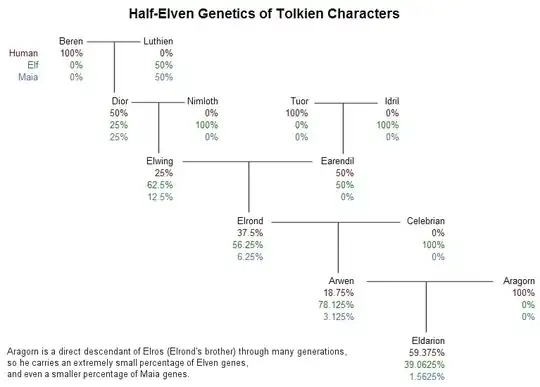
Now, Elros was not a full Elf. His parents were both half-Elven, and his grandmother was even more half-Elven.

  • Elros' father was Eärendil, who was the son of Tuor (a Man) and Idril (an Elf), so Eärendil was 1/2 Elven
  • Elros' mother was Elwing, the daughter of Dior (son of Beren and Lúthien3) and Nimloth, a full-Elf. Dior was 1/4 Elven, making Elwing 5/8 Elven.

This means that Elros, genetically, was 9/16 Elvish.

Finally, we can arrive at an answer, using the formula from earlier4:

(9/16)/(2^63) = (9/16)/9223372036854775808 = 6.1x10^-20 = 0.000000000000000000061 = 0.0000000000000000061%

That tiny number is the smallest quantity of Elven blood that can be in Aragorn's veins. Absent his complete family tree, rather than just the line of Kings and Queens, this is the best we can do. However, considering how tiny that number is, I highly doubt that there was enough Elven blood in all of Númenor to bring that up significantly higher; you might gain a couple of decimal places, but in the end it's still going to be effectively nil.

To give you an idea of how miniscule of an amount this is, if I mixed a single drop of my blood, a volume of 0.0357 mL, into Lake Erie, with a water volume of 4.8x10^14 L, Lake Erie would have about as much "me" in it as Aragorn has "Elf" in him.


1 That Amandil was the son of Númendil is repeated frequently throughout History of Middle-earth XII.

2 It's nearly impossible that there wasn't some marriage between (distant) cousins in Aragorn's family tree. A 2004 paper estimated that the most recent common ancestor of all humans lived about 3000 years ago, and Aragorn and Elros are separated by much, much more than that5 In fact, we know this happened at least twice: Arvedui's wife was a princess of Gondor descended from Elendil, and Aragorn's mother Gilraen was said to be related to the Chieftains of the Dúnedain.

3 Since Lúthien's mother Melian was a Maia, we can use this same formula to determine that Aragorn is 1/(2^66)=1.355x10^-20=0.000000000000000001355% Maia

4 Because my formula assumes Elros is generation 0, but my list counts from 1, I'm going to use the exponent 63 instead of the 64 I gave earlier for Aragorn's generation number.

5 From Appendix B, Elros died in S.A. 442, and Aragorn was born in T.A. 2931; so Aragorn was born nearly 6000 years after Elros' death.

DavidW
  • 128,443
  • 29
  • 545
  • 685
Jason Baker
  • 163,357
  • 44
  • 898
  • 794
  • 7
    Give or take a couple of 0's. Honestly, with numbers that small, an order of magnitude doesn't really matter – Jason Baker May 30 '15 at 02:41
  • +1 yet again. Thank you! That's about what I figured. By generation 5 after Elros, we have less than 1% Elf DNA. But on a point of relatively minor detail, if we only count the Kings of Numenor, Arnor, and Gondor, aren't we leaving out many generations of Chieftains of the Dunedain? – Wad Cheber May 30 '15 at 02:46
  • 4
    @WadCheber No, I counted them. I should maybe say that I counted them, but I did count them – Jason Baker May 30 '15 at 02:47
  • Yeah, the first time I read it I missed the part about the extra 38 generations. My bad. I came up with 99 by just adding together all the names in the lists and assuming/hoping that each one represented a generation. – Wad Cheber May 30 '15 at 02:49
  • My guess (in a comment on another question here) was that Aragorn was probably 1/1,000,000,000,000th Elf. Apparently I overestimated. – Wad Cheber May 30 '15 at 02:57
  • 2
    @WadCheber - It brings us back to that conversation about the blood link between Aragorn and Arwen, it's very tiny. That reminds me of the fact that for every modern human if we go back in the family tree, I think it's 2500 or 3000 years, we all have the same number of ancestors as there were humans on earth back then, so in theory, each of us descends from all the living humans on earth at about the time of the foundation of Rome. – Joel May 30 '15 at 04:54
  • 4
    Given that humans have only about 3x10^9 base pairs, it seems exceedingly unlikely that Aragorn had any Elvish DNA left. – microtherion May 31 '15 at 22:28
  • 4
    @microtherion That's a bit outside my wheelhouse, but I can't argue with you. The amount of Elvish genetic material in Aragorn's body is nearly homeopathically-low – Jason Baker May 31 '15 at 22:32
  • 19
    @JasonBaker which, according to homeopathic theory, would make the Elfishness all the MORE powerful ):-) – microtherion May 31 '15 at 22:40
  • @microtherion - then what's all the hubbub about people having Neanderthal DNA in them? Surely more generations separate us from Neanderthals than separate Aragorn from Elros, no? – Wad Cheber Jun 01 '15 at 01:15
  • 2
    @WadCheber You're making a mistake between genes in one man vs a species. When Aragorn's ancestors procreate with a human female, the Elven genes can be swapped out for a human equivalent. But at the species level, Homo Sapiens and Neanderthals exchange genes when interbreeding, and natural selection determines which genes are kept in the long run. Traits are some of us have are attributed to inheritance of Neanderthal genes. More info here http://www.sci-news.com/othersciences/anthropology/science-neanderthal-genes-modern-human-dna-01734.html – thegreatjedi Jan 25 '16 at 06:10
  • @microtherion Yeah but it would also cure him of his elvishness! – Misha R Dec 24 '16 at 05:40
  • You listed Arathorn II twice. I think you meant #60 to be Arathorn I. – KorvinStarmast Jul 15 '19 at 15:41
  • 3
    You correctly note that this is the lower bound, but I would say this is an extreme lower bound: Royal houses tend to be significantly more inbreed than commoners at large. The house of Elendil was not as inbreed as the Targaryens or the Habsburgs for example, and when they ruled in Andúnie they had not to observe the law that required the Kings of Númenor only to marry other descendants of Elros, but still, for example in late TA Arnor, the pool of eligible noble Dúnadan brides would be quite small and interrelated, – b.Lorenz May 24 '20 at 12:06
  • +1 for mentioning Elros's complicated lineage. I always thought Elrond half-elven should have been called 9/16 elven ; ) –  Jun 23 '22 at 03:15
  • 1
    @joel No, we're not all descended from "all the living humans on earth at about the time of the foundation of Rome." There are certainly humans who were alive then who had zero descendants -- infant deaths, if nothing else. There are humans who had children but no grandchildren, grandchildren but no great-grandchildren, etc., etc. It's very easy for a line to die out. What might be true is that all humans alive today are descended from the same group of humans who were alive at the founding of Rome. Although I'd doubt that too -- not enough population mixing to guarantee that. – Ross Presser Sep 30 '22 at 14:06
  • @joel The answer below by Buzz makes my point much better. – Ross Presser Sep 30 '22 at 14:08
  • @RossPresser I don't find my original post, but I know what I meant by that, and I guess you misunderstood what I'm saying.

    What I meant is this: "lines" don't mean much, since 1 person doesn't have only the ADN from his father's "line" but also the ADN from his mother's, and countless other people, exponentially increasing with each generation: 1 child, 2 parents, 4 grand parents, 8 great grandparents and so on... counting back this way, you have as many ancerstors when you get to the Roman period as there were people on Earth then. Aragorn is much further than that from Elros in time.

    – Joel Oct 03 '22 at 15:44
  • @Joel this was your comment that I was responding to. I'm only objecting to the idea that if someone was alive in Roman times he must be my ancestor -- he might not be anybody's ancestor. However I agree completely with the restatement you made in today's comment. – Ross Presser Oct 03 '22 at 17:22
18

The answer to this question should be primarily determined not by how many generations passed between Elros and Aragorn, but rather by how many Edain populated Númenor originally. If there were only between five and ten thousand Edain (cited here: How many Edain were left at the end of the First Age?), then after less than twenty generations, almost all the original settlers would fall into one of two categories. There would be those with no living descendants and those who are ancestors to essentially all the living Númenóreans.

By the time of the fall of Númenor, just about everyone on the island would have had roughly equal Elven ancestry. Since the initial population of less than ten thousand had one member who was approximately half Elvish, each member of the population would have had Elven ancestry at the level of about a part in ten thousand.

If Aragorn is a pure-blooded Dúnadan, this level of Elven blood would not have been further diminished. On the other hand, if his ancestors intermarried with the common folk of Arnor, his fraction of non-human ancestry would be correspondingly diminished. However, the total amount could never be as low as the numbers cited in the other answers to this question.

DavidW
  • 128,443
  • 29
  • 545
  • 685
Buzz
  • 97,359
  • 18
  • 292
  • 479
  • Also, those with more Elvish ancestry may well have an advantage in courtship (and in child mortality), making even Buzz's estimate low. – Anton Sherwood Apr 26 '17 at 07:51
13

All of the answers assume there was no inbreeding amongst Aragorn's ancestors, which is impossible considering the assumed size of the Númenórean population and the number of generations involved. Buzz's answer touched on this.

You cannot simply do the math and say (for example) "One half-elf 50 generations ago means the amount of Elven blood is 2-51." It's very unlikely that the human population of Arda 50 generations ago was 2.252 quadrillion, which would be necessary if all of Aragorn's ancestors at that time were completely unrelated. According to this answer (which cites The Peoples of Middle Earth), the actual number of Edain at the start of the Second Age was 15 thousand at most.

Somewhere along the way, some cousins married; in fact, this happened many times. We know from Akallabêth that the Númenóreans disapproved of marriage between first cousins, but marriage between more distant cousins was permitted (and would have been necessary).

Bottom line: without more detailed knowledge about the size of the Númenórean population and the amount of inbreeding in the royal family, it's impossible to know. Too bad Aragorn never had his DNA tested!

DavidW
  • 128,443
  • 29
  • 545
  • 685
Mike Harris
  • 1,476
  • 13
  • 13
  • Your answer has a mistake in it. You're assuming there is more Elven blood in any other Numenorian lines. There wasn't. While of course, the various lines of Elrond's children would certainly have traces of Elven blood, this would diminish incredibly quickly. Down to 1/4 before the first second cousins could even be married. If assuming then it was rare, it would have dropped to miniscule figures ridiculously quickly. It would continue to become a minor factor for many a generation. Becoming a very insignificant part of his lineage. – Edlothiad Jan 09 '18 at 15:26
  • 2
    Hi @Edlothiad, I didn't assume that. My only assumption was that the total potential breeding pool during the Second Age was limited to the population of Númenor, since there wasn't a lot of traffic between Númenor and Middle-Earth (presumably even less so amongst the royal family). And you are correct (as is Buzz) that the amount of Elven blood will quickly reach an almost insignificant proportion, but still more than 2-64. – Mike Harris Jan 09 '18 at 15:36
  • Sure the top answerer has simplified the calculation but that’s a mere numerical addition to his answer, which states the Elven blood is infinitesimally small. Remove the calculation and the point remains effectively the same. – Edlothiad Jan 09 '18 at 15:45
  • 2
    @Edlothiad I agree that they're both very small portions! But 1/15000 is quite different from 1/18,446,744,073,709,551,616 or the 6.1x10^-20 figure in the accepted answer. The real answer is somewhere in between. – Mike Harris Jan 09 '18 at 15:55
  • But how have you derived that it would only be 1/15000 it would surely be far smaller. It would be 1/2^4 before any possible Elven blood could be mixed, at that point it would simply continue to drop. You seem to insist that the only point the answer makes is the calculation, this is incorrect, the OP of the answer themselves acknowledges that their calculation is wildly incorrect. – Edlothiad Jan 09 '18 at 16:15
  • 2
    Speaking as the poster of the accepted answer, to which you seem to be taking the most offense, I agree with absolutely everything you say. My answer is a lower bound, and nothing more, as I state repeatedly – Jason Baker Jan 09 '18 at 17:41
  • 1
    @JasonBaker oh, no offense was taken at all! In fact, I upvoted your answer for its thoroughness. My only point was "we really don't know" but that was too short for an answer! (Or: "somewhere between a really tiny number and an even tinier one") – Mike Harris Jan 09 '18 at 18:36
13

The Half-Elven line

I made this a while ago, using spreadsheets. The exact number of generations from Elros to Aragorn is unknown, but somewhere in the range of 65. I've calculated that this gives Aragorn 0.000000000000000003049318610115481% of elven "genes", and 0.00000000000000000033881317890172013562732900027186% of Maia "genes".

The table shows some interesting things: although Elrond is often called Half-Elven, he's more of an elf than he is a man. Only Eärendil was truly half-elven, 50/50.

With Arwen having some human "genes" from her grand-dad Eärendil, her and Aragorn's son Eldarion is more Human than Elven.

DavidW
  • 128,443
  • 29
  • 545
  • 685
Maksim
  • 4,436
  • 1
  • 17
  • 33
  • Wow! +1. I guess Aragorn has so little elf DNA that it is essentially 0%? – Wad Cheber May 31 '15 at 21:30
  • 4
    Can you post your calculations for Aragorn? I'm curious to see where you and I diverged – Jason Baker May 31 '15 at 21:36
  • That's a little better; the claim that Aragorn had "slightly higher than 1% elvish genes" was throwing me a bit. We at least agree on the order of magnitude now, but your number is slightly lower than mine (and significantly lower on the Maiar figure). Can you share how you derived them? – Jason Baker May 31 '15 at 21:44
  • 1
    I've just updated the post, as I made a silly mistake, so it should be correct now. To put it simply, I took Elron's elven percentage (since Elros had the same) and divided it by 2 64 times. Same with the Maia percentage. So, the result assumes that there were 65 generations (including Elros and Aragorn), and that there were no other marrieges to elves in that line. – Maksim May 31 '15 at 21:44
  • 1
    Jason, my spreadsheet shows that Elrond (and therefore Elros) was 56.25% elven, which is 9/16. The spreasheet is faily basic - each child inherits half of each parent's human/elf/maia ancestry. – Maksim May 31 '15 at 21:56
  • 1
    Okay, I see what I did wrong; I had miscalculated the percentage for Elwing - that's what I get for trying to do it in my head in the middle of the night. We disagree by a factor of 2 (and a rounding error), which is because I divided by 2 only 63 times. I maintain that was correct, though; I think you've calculated the percentage of Elven blood in Eldarion instead – Jason Baker May 31 '15 at 21:58
  • 1
    I guess it all boils down to exactly how many generations we're dividing that lineage by. :) – Maksim May 31 '15 at 22:01
  • 3
    Luthien was also truly half-elven. But the other half was Maia, not human. – Mike Scott Jan 25 '16 at 17:09
  • +1 Specifically for the scare quotes around the use of the word genes. – Lexible Jun 28 '20 at 17:07
  • I guess "Elrond the half and one sixteenth elven" just doesn't roll of the tongue. – chx May 03 '21 at 04:06
5

This is a fascinating questions, but I think that some of the very well-researched answers, above, erred by not calculating the inbreeding that must necessarily have occurred. The problem is that there's no simple formula that can be applied, but there are some general arguments which apply. But there are some simple arguments which let us estimate an answer, and that dramatically increases Aragorn's elven ancestry.

Start with the facts as we know them: Elros was the only Half-Elven person who contributed to Aragon's ancestry. Elros was the first king of Númenor, and as @Buzz noted, Númenor was settled by between 5,000 and 10,000 Edain and the population grew from there. I don't believe that we have any population figures for later than that, though.

So we have a population of 10,000 founders, one of whom was 50% elven. (I know it's not exactly that, but that's close enough.) In our own history, kings, being rich, tended to have more than the average number of descendants. It's true that their heirs tended to have a high mortality, but they also left more bastards than the average person. So the genes of kings tend to spread through the population more efficiently than those of ordinary folk.

Until the Númenóreans started living back on the mainland of Middle-earth, they probably married almost exclusively among themselves. In about 13 generations, each Númenórean would have around 10,000 13th-great-grandparents and major league ancestry collapse would have occurred. This is true for everyone and is inescapable, since no Númenórean could possibly have had more than 10,000 distinct ancestors at the time of the founding. Which means that the average Númenórean had about 1/20,000th elvish ancestry (some had more, some had less, but that's a lower bound to the average assuming that Elros' descendants had average or better reproductive success.)

As time goes on, as long as the Númenóreans breed only among themselves, the percentage of elvish ancestry cannot decrease further! It can only be much higher if Elros' descendants tended to have more surviving children that other peoples' children. (Note: I'm not talking about the line of kings, but about all the people many generations removed from the kingship who nonetheless were descended from Elros.) Given the beliefs about the Kings of Men, I think a plausible argument could be made that this is so, but I won't try here.

(Of course, the line of Kings may have been more inbred than the average Númenórean, and this would have had some impact on Aragorn's percentage, also.)

Once Númenor foundered and the Númenóreans were the lords of Gondor and Arnor, the percentage of Elvish blood would decrease further, depending on the fraction of outcrosses. It's very hard to say how frequent they were, but still by the time of LotR, there's still a serious cachet to having Númenórean blood and people are spoken of as being true or pure Númenóreans. This suggests that some of the main families made a point of marrying within the Númenórean clan, so to speak, and that in some families the fraction of non-Númenórean ancestry would be much less than pure chance would suggest.

Bottom line: Aragorn's fraction of Elvish ancestry was much higher than 10-20 and if he was a pure Númenórean blood, it was most likely about 1/20,000, but could have been higher.

(Note also that this assumes that Elvish blood follows human blood's rules. This is a reasonable assumption, but it is only an assumption, and a plausible argument can be made that it doesn't. Note also that it seems unlikely that in Middle-earth "Elvishness" is carried in some set genetic loci which differ from Humans'. Elvishness seems to more a matter of their spirit or soul than of their DNA.)

DavidW
  • 128,443
  • 29
  • 545
  • 685
Mark Olson
  • 41,115
  • 8
  • 176
  • 176
-2

We know that it's too far back in his lineage to actually claim him to be an elf. However, what if elf genes are dominant to human genes and those genes usually get passed down? It's not a question of blood as much as it's a question of DNA, chromosomes, and dominant and non dominant genes.

I won't pretend to be an expert in this subject as I clearly am not and know just a little more than the average Joe (I'm a computer programmer), but from my understanding, if I said that elves have dominant traits that would have a higher chance to pass through each generation instead of the human ones, then technically Aragon would still be more elf. Now obviously this is speculation, but as I see it, elves are to me like more evolved humans. I say this because they obviously share a common ancestor, meaning they are of the exact same species but are more advanced in every way, they live longer, hold more wisdom, better eyesight, quicker reflexes, not sure if they're stronger but they probably have the potential to be.

A good real world example of this is the relationship between early humans, neanderthals, and the homo sapiens of today. I differentiated between homo sapiens and humans only because most of the world today, especially in the Eurasia area, have some percentage of Neanderthal genes, as opposed to our pure human ancestors who came from Africa that were pure whatever they were (I forget name), before they interbred with neanderthals, to create us.

Since elves and humans can breed together with no genetic deformity or complications, then science proves that they come from a direct common ancestor, where that ancestor for one reason evolved to human and the same ancestor for another reason evolved to elf. The main reason for evolution is the need for survival, a species gets either wiped out or is forced to take on a change that will allow it to survive.

Imagine 2 sets of boars, one with a thick outer coat and one with a lesser coat in a cold climate, the thicker boar would retain heat better and in turn need less energy to keep its temperature and would probably be stockier opposed to the boar with a lesser coat, that would have to eat more, because so much of its energy would be spent on maintaining temperature. The result of this would be no need for further evolution for the thick skinned boar but the lesser coat boar would need to evolve to be smaller and skinnier to require less food to maintain body and muscle so that all of its energy goes to temperature regulation. If this didn't happen it would most likely not be able to maintain its temperature and die unless another advantageous evolutionary trait occurred.

So most likely the ancestor that turned human must've had it easier and didn't need to evolve as drastic as the ancestor that evolved to elf. A good example to give would be eleven eyes and how precise they are.

Imagine a world with plenty of food and no real top predator besides humans. Humans would thrive and there would be no need for a change. Then imagine that same species in an area that, for example, food is scarce and there are many predators trying to eat. That species would in the beginning suffer and start to die off. The strongest and fastest would survive and breed and this process would repeat until those traits became refined to almost perfection to allow for a better chance at survival. Eyesight speed and strength are good examples.

In conclusion, elf genes are more than likely dominant since they allow better chances for survival and probably carry over again and again through generations. So he more than likely is, for all technical purposes, a good part elf, even if his appearance doesn't look it since the genes that deal with that can go one way or the other since they don't really have an advantage one way or the other, or else they're very minute advantages or disadvantages.

Wad Cheber
  • 69,816
  • 70
  • 523
  • 684
Bobby
  • 29
  • 1
  • 3
  • that's not how dominant traits work (at least in Mendelian genetics) and 2) your answer can benefit from some paragraph indents, references, and common sense enough not to post a wall of text. Also, this doesn't really answer the original question.
  • – Gallifreyan Dec 18 '16 at 04:57