22

Odin casts the following spell on Mjolnir:

Whosoever holds this hammer, if he be worthy, shall possess the power of Thor.

I have boldfaced he to emphasize that Odin didn't say the following.

Whosoever holds this hammer, if they be worthy, shall possess the power of Thor.

(Minor but important digression: English does have a use of they as a singular, gender-neutral pronoun, so this is is a valid thing to say)

These two spells are crucially different. By using he instead of they, Odin is effectively restricting the use of Mjolnir to men. The Black Widow and Maria Hill could be worthier than anybody else, but they would still not possess the power of Thor. Is there any in-universe evidence that things work this way?

Laurel
  • 22,998
  • 4
  • 81
  • 114
Koldito
  • 3,381
  • 3
  • 22
  • 32
  • 13
    Imagine someone goes into your house, steals something, flee away, and you realise just too late and cannot see more than a shadow running away. What do you ask “Where is he gone?” ”Where is she gone?” ”Where are they gone?” Why do you believe that “he” is gender specific? – Michaël Le Barbier May 24 '15 at 23:14
  • 2
    Do you really think the power of the Allfather would be held in thrall to Midgard semantics? Odin, son of Bor is a just and wise king, and if he saw fit that anyone, man or woman, were worth of Mjolnir, they would wield it just the same, regardless of what was scratched on the side of the hammer. –  May 25 '15 at 03:55
  • Out of curiosity are you asking about Thor & Odin in the mythos, or a specific interpretation of Thor (such as the Marvel superhero) as per Eike Pierstorff's answer? It might be a good idea to clarify this explicitly :) – Robotnik May 25 '15 at 05:27
  • 39
    You may think of it as a silly question but those semantics tricks got Witch King of Angmar killed. So this is a valid question. – Sok Pomaranczowy May 25 '15 at 06:41
  • 1
    @SokPomaranczowy AFAIK there wasn't anything "official" in that case. It was just a saying, in the same way as a Chuck Norris fact of today. People were simply so scared by the Witch King to say things like that that later became legends. – Bakuriu May 25 '15 at 09:16
  • 2
    @MichaelGrünewald "Where have they gone?" every time, it even feels more natural (as well as being correct). "He" is 100% gender specific. That said that is modern usage, I know that in "singular they" has only existed since the 16th century - however its a translation from ??? into modern english so modern english rules apply. – user20310 May 25 '15 at 12:05
  • 9
    He/his/him are both masculine and gender-neutral pronouns. There's no issue here. The increasing unpopularity of using it as such is a very new thing. – Shamshiel May 25 '15 at 12:05
  • 7
    @user20310: It is Modern English usage to use it in a gender-neutral sense; it's just now becoming less popular for PC reasons. But it's still mainstream usage. – Shamshiel May 25 '15 at 12:12
  • 3
    @Shamshiel Possibly it's a country specific thing (I'm from the UK) but using "he" to refer to someone who could be female sounds jarring and strange. The oxford english dictionary refers to it as "in modern use, now chiefly replaced by ‘he or she’ or ‘they’". I think the old fashioned usage was largly informed by the fact that it largly would be men being talked about 95% of the time. P.s. it's not PC reasons, its accuracy reasons; what if you actually want to talk about just men? – user20310 May 25 '15 at 12:16
  • 6
    @user20310: The key word there being 'chiefly.' And no, by definition, a gender-neutral pronoun (evaluated in context) is not referring to only men, that's the whole point. It is for PC reasons - using gender-neutral pronouns that double as masculine pronouns is seen by some as excluding. It shows up all the other time in other English words: e.g. 'mankind' does not refer only to humans of male gender. (Interestingly, more gender-bound languages don't seem to have these PC debates.) Notice OED also says 'until relatively recently' and that 'they' is only now becoming acceptable. – Shamshiel May 25 '15 at 12:19
  • @Robotnik, I'm pretty sure the enchantment is not a part of norse myth but something added by Marvel (I don't know, and would not be able to read, any original norse text, but the translations and re-tellings of the myths I know make no mention of such a spell). – Eike Pierstorff May 25 '15 at 14:12
  • 5
    @Bakuriu Your argument would have more merit if Chuck Norris facts weren't true. – corsiKa May 25 '15 at 15:08
  • @Shamshiel Absolutely correct. To add to your point, it should also be noted that in many contexts (especially academic ones), even the female pronouns can be used as gender neutral nowadays. (This is very new, I believe; only maybe 10 to 15 years since it became widespread.) It's really kind of a "anything goes" state right now. – jpmc26 May 25 '15 at 15:09
  • 4
    Why would Odin speak Modern English? – Raphael May 26 '15 at 06:10
  • "These two spells are crucially different." You claim. You are stating this as a fact when it's not -- especially since it is well-established that Asgardians use archaic language and that using he in this context as a generic pronoun is also well-established, especially in archaic language. – ThePopMachine Dec 07 '21 at 16:14

5 Answers5

38

The current owner of Mjolnir is Jane Foster (Earth-616), wikia.

Marvel themselves have a press release for the new Thor

Writer Jason Aaron and artist Russell Dauterman unveiled longtime Marvel mainstay Jane Foster as the Goddess of Thunder on the issue’s final page

For the enchantement, there's this image:

"if she be worthy" on hammer, with glowing "s" in she.

I'm not much a comic reader, but it seems the answer is no, unless you talk specifially about MCU in which case we don't really know yet (but the Wikipedia entry for the upcoming "Thor - Love and Thunder" bills Nathalie Portman as "Mighty Thor", so it seems at least likely that the MCU works similarly).

Laurel
  • 22,998
  • 4
  • 81
  • 114
Eike Pierstorff
  • 17,646
  • 3
  • 67
  • 78
  • 3
    I've seen that image dozens of times, but I'e never noticed the "S" being burned into the hammer before now. Cool! – Nerrolken Aug 13 '15 at 16:22
26

The English used in the spell is rather old-fashioned ("whosoever", "be worthy" instead of "is worthy"), and until the mid-20th century, it was common (and often preferred by authorities) to use he as a gender-neutral pronoun, which in appropriate context could be understood to include both genders. See Wikipedia and references therein. You still see this usage occasionally today, though it has mostly fallen out of favor.

Given that Thor is at least 2600 years old, it is not surprising that his English usage would not entirely conform to modern preferences.

So despite the use of the apparently masculine pronoun, it's entirely consistent with the language that the spell could be intended to include females. And Eike Pierstorff's answer gives canon evidence that in fact it is.

(In legal writing, this convention is sometimes made explicit with a clause that says something like "masculine pronouns in this document shall be construed to include the feminine". Maybe the legal codes of Asgard contain a similar statute.)

Nate Eldredge
  • 960
  • 9
  • 16
13

I would expect Odin to perform the casting in old Norse, which has masculine, feminine and neuter. And the neuter form is generally used when the gender is unknown, which is what this phrase really calls for, since it is unknown who would hold it (actually I would have expected the cast to be "He who holds..." if he indeed intended to restrict it).

Wikipedia article has an interesting section about Old Norse Syntax.

I would blame the editor for doing a bad Norse translation into English. :)

Ángel
  • 497
  • 1
  • 3
  • 9
  • 8
    Is the language used by Marvel's Asgardians (reminder: high-tech space aliens) ever explicitly specified? It could be English or Galactic Common as easily as Old Norse. – Avner Shahar-Kashtan May 25 '15 at 05:05
8

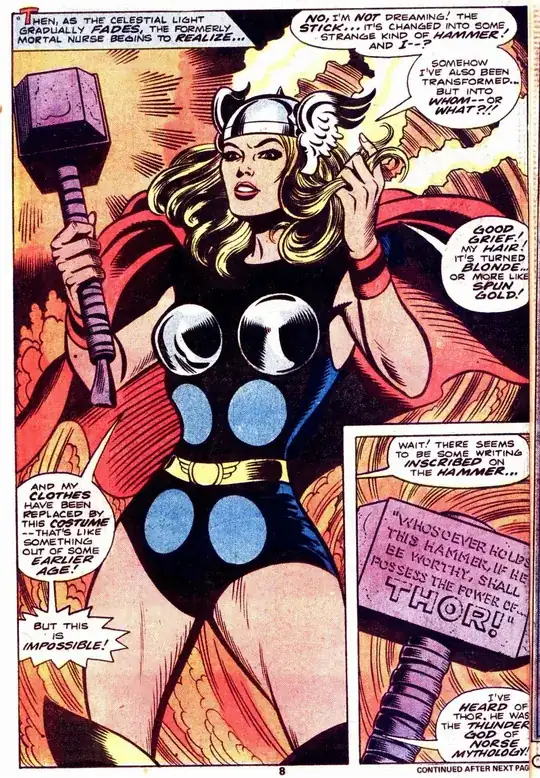
What If? #10 (August 1978) tells the story "What If Jane Foster Had Found -- the Hammer of Thor?". It retells the origin of Thor in the Earth-616 universe, only Jane Foster finds the disguised Mjolnir instead of Donald Blake. Foster gains the powers of Thor and calls herself Thordis. The image of her as Thordis contains an inset image of the hammer with the well-known inscription intact:

enter image description here

Technically, these events are set in a different continuity, Earth-788. But it's presented as a way that the Earth-616 origin of Thor could have happened. So it supports the idea that the enchantment on Mjolnir isn't gender-specific.

Kenster
  • 6,726
  • 2
  • 30
  • 50
3

In-universe evidence: Wonder Woman, Storm, and Jane Foster have all wielded Mjolnir.

In-MCU evidence: Vision (android so male might be a bit of a stretch) was able to wield it.

Seems like there is pretty clear canon that the term 'he' was meant in a gender neutral form in Odin's spell.

Rubix Rechvin
  • 514
  • 3
  • 10