18

OK so imagine a human wearing normal clothes: t-shirt, pants etc., out in the middle of the winter. They wouldn't last long. Now replace that human with a zombie. Zombies have no blood circulation, meaning they freeze easier.

How did any zombies in The Walking Dead survive the winter that was alluded to between seasons 2 and 3? I was reading the original comics and there is mention of zombies freezing and dying because they don't have any circulating blood.

shim
  • 1,299
  • 12
  • 16
Jackson Walker
  • 549
  • 2
  • 4
  • 13
  • 2
    arnt they in Atlanta during the show? it typically doesn't get below freezing very often in Atlanta. – Himarm May 13 '15 at 00:58
  • @Himarm They are no longer in Georgia in the show, and they haven't been there in years in the comic timeline. – phantom42 May 13 '15 at 03:15
  • 1
    This part of TWD universe is comparable to the question of why didnt the fellowship in LOTR use the eagles to destroy the ring. Yes, the zombies are already dead, but freezing does cause damage. Of course this wouldnt kill the zombies, but i see it as a loophole because the group never seems to wander north. If zombies are slowed/injured by the cold then why not go to Canada or Alaska, or even the Rockies for that matter? Why stay in the south where it hardly ever freezes? That and zombies arent very coordinated, imagine one walking in 3 ft of snow. The living is harsh, but way safer than hang –  Jan 05 '16 at 15:31
  • 1
    I think that, if something survive without blood circulation, then you can assume that a living human isn't the best model for what can and cannot hurt it. As for winter cold, it's probably good for zombies. Decomposition seems to be the main impediment to the zombie lifestyle, and cold temperatures slow that down quite a bit. – Misha R Nov 12 '17 at 22:34
  • What is dead may never die. – Paul D. Waite Aug 20 '19 at 11:37

7 Answers7

18

I've read the comics many times and I can't recall a single time when there is mention of the zombies dying from freezing. However, the zombies do slow down and potentially freeze solid.

Why would the winter kill the zombies from lack of circulating blood? During the rest of the year, they also don't have circulating blood. They're zombies. Blood circulation has nothing to do with anything. We are literally talking about the walking dead here- the rules of biochemistry are forced to go out the window on close enough examination.

That said, a non-canonical answer from Max Brooks seems to be that they don't need circulating blood, but the consistency of the blood changes and acts like antifreeze were poured in- it requires a significantly lower temperature to freeze solid, and when it does get cold enough, fluids in the zombie's body don't have sufficient water to expand as they freeze, and don't crystallize such that they turn into frozen strawberry mush when thawed.

Edit: Wow, okay, let me clarify my comment a little bit: Yes, they freeze, and no argument. But my argument was that they aren't damaged by the freezing/thawing process, as Wad pointed out happened in Wiltshire. The freezing temperature is going to be sub-zero more than likely due to low water content. It also means that the crystals formed (if any) when frozen would not be sufficient to damage the tissue. We don't know the fluidic makeup of the zombie cells. If anything, the survivable (if you want to call it that) freeze/thaw cycle argues that it forms an amorphous solid rather than crystal on freezing. That means that the fluid in the cells does not necessarily expand to destroy the cell on freezing.

Rand al'Thor
  • 134,408
  • 65
  • 607
  • 854
Broklynite
  • 22,612
  • 6
  • 74
  • 119
  • Freezing ruptures cells. Even if it didn't un-live the zombies, it would give them frostbite. – Major Stackings May 13 '15 at 01:34
  • I guess that zombies don't suffer too much from frostbites. And frozen meat isn't completely spoiled, that's the principal of freezers. Note also that walkers are dead but not inactive meat. We know close to nothing in the TV show about their metabolism: they eat, so they may product their own heat to maintain a reasonable temperature. They also are virus-carrier, which may imply some kind of fever. – Taladris May 13 '15 at 05:22
  • 1
    Yum... Freezer burn. – Major Stackings May 13 '15 at 07:08
  • The frozen zombie is in comic book 2 – Jackson Walker May 15 '15 at 22:46
  • This is the right answer. They freeze solid and thaw out in the spring no worse for the wear. Mit doesn't harm them at all. – Wad Cheber May 20 '15 at 03:47
  • Nobody is arguing that Zombies can't freeze, we simply have never seen it matter. – Broklynite May 21 '15 at 08:03
  • @Broklynite - Remember Wiltshire from the comics? Zombies froze, Rick's group moved in, it thawed overnight, zombies woke up, and a bunch of people died. I think that was the group's first attempt at amputation to save a bite victim. I forget the guy's name... The dude with the beard. The father of the twins. His wife died, and I think he was bitten. – Wad Cheber Jun 19 '15 at 14:41
  • @MajorStackings - correction: freezing ruptures cells if they contain liquid, mainly water. We don't know whether zombie cells contain water, or any liquid. And since the worst part of frostbite is the creation of necrotic tissue, but zombies are already necrotic, it probably wouldn't make much difference if a zombie got frostbite. They don't feel pain and they can't get any deader. – Wad Cheber Jun 19 '15 at 14:45
  • 2
    @WadCheber I surmise that, with the amount of goo and splatter that we see when zombies are dispatched, they contain liquid. – Major Stackings Jun 19 '15 at 15:03
  • @MajorStackings - I think that has more to do with making the show gory and less to do with the way things really work. The show definitely features a lot of goo and thick black bloody liquid, but this is less true of the comic books. And we seem to be seeing the "blood" still trapped in the zombies' circulatory system, not anything contained in their cells. Note that when someone grabs a zombie by their skin/flesh, it is mostly dry. The blood only starts flowing when a vein or artery is severed. – Wad Cheber Jun 19 '15 at 15:35
  • 1
    +1 for "the way things really work." If we knew how things really worked, we could eliminate zombies in our lifetime. – Major Stackings Jun 19 '15 at 18:30
  • @MajorStackings - I think I meant to say "in the comics", but I stand by my statement. Don't come crying to me when the inevitable zombie apocalypse happens. – Wad Cheber Jun 20 '15 at 19:22
16

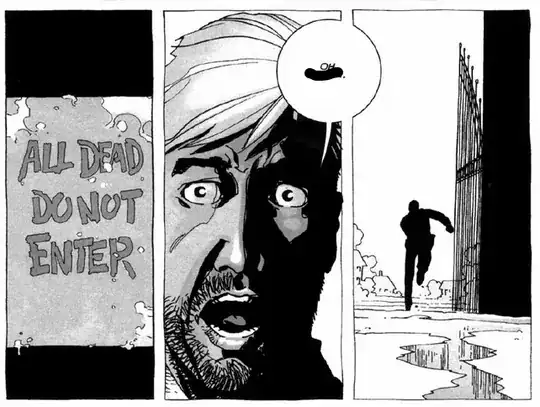
Actually, the comics don't suggest that zombies can freeze to death. In fact, quite the opposite. When the group finds the walled community of Wiltshire Estates, it is extremely cold. They sweep the area, find no zombies, and settle into the houses. Overnight, the temperature rises. A layer of snow and ice on a sheet of plywood outside the gates begins to melt, and soon we see that it is in fact a sign:
enter image description here

You can imagine, based on Rick's reaction and the naughty word I blacked out, how Rick feels about the warning painted on the sign. He clearly realizes that the reason the group didn't find any zombies roaming around is that they were all frozen. Now everything is thawing out, including the zombies, and Rick knows that this is a very bad thing indeed. By the time he begins to warn the others, it is too late. The zombies are up and about, and people are being attacked. One person, a woman named Donna, is killed.

This answers your question - zombies are essentially unharmed by the freezing process, and remain in a sort of hibernation until the weather allows them to thaw out and become active and mobile again.

From the Walking Dead wiki page for issue #8 of the comics:

At the road, they find a house but it's burned. Rick says they have to leave. While Glenn is filling the gas tank, Dale screams and falls down in front of a frozen zombie. Dale confirms he's not bitten, and Andrea runs to Dale and hugs him, glad to see he is unharmed. The frozen zombie moves and Glenn gets scared. Rick kills the zombie. Survivors learn the zombies freeze faster than normal humans. The group come across a group of houses enclosed by a fence, titled "Wiltshire Estates". The group proceeds to clear a house which leads them to think that they may have found a permanent sanctuary. They end up spending the night inside the cleared house. What they don’t notice is that a snow covered sign that reads “ALL DEAD DO NOT ENTER.”

This is also consistent with the holy bibles of zombie media, Max Brooks' World War Z and The Zombie Survival Guide. Because zombies aren't actually alive, they suffer no ill effects from extreme cold. Extreme heat isn't an issue either, unless it is so extreme that the zombies burst into flames. The zombie dichotomy is at work here: they are simultaneously very easy to kill and very difficult to kill. That is to say, if you know what you are doing, you can kill them without much difficulty, but they don't die very easily when left to their own devices.

The most "scientific" explanation for this is to be found in Max Brooks' books, as I mentioned above. The reason people die from hypothermia is because their body temperature drops below safe levels. Zombies, on the other hand, have no internal heat regulation system, and their bodies are roughly the same temperature as the air around them. When a person develops extreme hypothermia, the brain begins to shut down essential functions, like your heartbeat, breathing, blood pressure and circulation, etc. A zombie doesn't have to worry about any of these problems, because it is dead. It has no heartbeat, it doesn't breathe, its blood just sits in its veins and arteries rotting away, and its body temperature reflects the ambient conditions around it.

Whereas the human brain is a complex array of neurons, axions, synapses, and electro-chemical signals, all of which work in tandem with each other, and are powered by the digestion of caloric materials, the zombie brain is very different. It is largely dead tissue, slowly decomposing inside the skull, and only the brain stem is partially active.

However, even this limited activity has nothing to do with digestion or the natural electro-chemical signals present in a normal brain - it is merely the result of a virus (Note: in The Walking Dead comics, and to a lesser extent on the show, we don't know exactly what the infectious agent is - virus, parasite, fungus, etc, so it would be best to think of it as a pathogen, but for the sake of convenience, I will refer to it as a virus - as it happens, in World War Z, the infectious agent is indeed a virus, which is called "Solanum").

The virus reactivates the basic sensory and motor functions of the body. It doesn't rely on the body's natural functions of resources, and it exists only in order to spread itself to new host organisms.

The virus only activates the parts of the brain necessary for making the body detect prey, follow it, and bite it. The parts of the brain used for all other purposes are left unchanged and inactive. Even the functions we consider vital to our survival- circulation, respiration, blood filtration and oxygenation, etc, are totally irrelevant to the purposes of the virus and the zombie it creates.

And viruses are nothing if not resilient and virtually indestructible. They can survive extreme heat and cold, arid conditions, humidity, and so on, and can lie dormant for surprisingly long periods of time without dying. So when the zombie freezes, the virus basically goes to sleep and waits for spring to arrive. The zombie's muscle tissue might suffer a bit of damage from freeze/thaw cycles, but not enough to kill it.


Out of universe, there are actually a number of animals that can freeze solid for extended periods of time, then thaw out and go on doing whatever it is that they do, none the worse for wear. Perhaps the most famous of these is a species of wood frog indigenous to the northeastern U.S., which begins to produce a natural form of antifreeze (glycol, if I'm not mistaken) when temperatures drop. This prevents crystals from growing large enough to puncture cell walls, which would cause irreparable damage to the muscle tissue. When spring comes, they thaw out and hop away unharmed.

And it is worth mentioning that we're talking about mobile, cannibalistic corpses. If you are willing to accept the premise that such creatures can even exist, it probably makes sense to just accept that they don't freeze to death.

Wad Cheber
  • 69,816
  • 70
  • 523
  • 684
  • Remember tho that Brooks' zombies are the result of a viral infection, whereas we have no indication of that in Walking Dead- the comic, at least. So it can't be considered canon. – Broklynite Jun 21 '15 at 10:23
  • @Broklynite- it is some sort of infection. – Wad Cheber Jun 21 '15 at 18:55
  • Can you cite exactly where in the comic they discover that? Because I've read and re read them many times. The closest they come that I recall is saying that they don't know the cause, that if it is a disease they are all already infected. They had initially thought it was a disease you got from being bitten, until Rick dug up Shane and saw that he had turned even after not being bitten. – Broklynite Jun 22 '15 at 20:02
  • 1
    @Broklynite - Exactly what else could it be? Something that infects you is by definition an infection. They are all infected. Thus, it is an infection. – Wad Cheber Jun 22 '15 at 20:28
  • 1
    @Broklynite - from the TWD wiki: Pathogen Most, if not everyone, on the planet within The Walking Dead universe somehow contracted the pathogen that, for reasons and through means unknown, brings the dead back to "life." It is unknown how the disease is spread, though its almost-total infection rate worldwide suggests it is either water-borne, air-borne, or both. The exact taxonomy of the pathogen is unknown. The pathogen itself does not kill its hosts, but it seems to weaken their immune systems considerably, to the point where even minor illnesses are far more fatal than normal to humans. – Wad Cheber Jun 22 '15 at 20:31
  • Every part of that makes it clear that this is an infectious disease of some kind. – Wad Cheber Jun 22 '15 at 20:32
  • @Broklynite - I added a note to clarify the issue of the infectious agent being unspecified in TWD. It still seems to me that the agent is indeed a virus, but it makes sense to point out that we really don't know either way. However, the part of my answer that mentions the virus is actually related to WWZ, in which the infectious agent is definitely a virus, specifically a virus known as Solanum. – Wad Cheber Jun 22 '15 at 20:57
  • @Broklynite - The funny thing is that you and I actually agree on all the important points here. The only difference between us is that I am more willing to resort to outside information in trying to compose an answer. I think TWD and Brooks' work can be brought into a kind of harmony with one another, for the most part. – Wad Cheber Jun 22 '15 at 21:17
  • Don't get me wrong, I'm a huge fan of WWZ and Zombie Survival Guide, and you'll see that I even use Brooks as a non-canonical answer. I do note that the wiki seems to combine both the comic and the show, which are different. I also note that the question pertains to the TV show in which it is definitively stated that it is an infection, whereas I read it thinking of the comic where it is left vague and unknown. Kirkman in the comic seems to have left it like Romero- ultimately, it doesn't matter how or why they turn, they simply do. – Broklynite Jun 23 '15 at 09:17
  • So, yea, my apologies. My mind leaped to the comic but you are absolutely right to have made the Brooks argument; in this case, it's the best source we have for an explanation. – Broklynite Jun 23 '15 at 09:19
2

You should read about the Wood Frog that clinically dies during the winter as a result of freezing to death and then emerges in the spring alive.

Basically the zombie, like the Wood Frog, functions by the virus creating the necessary oxygen and other components needed to walk its living dead shell only. The virus feeds on non-essential functions of the brain and the body itself. You have to remember that the zombies only function is too move, see, hear and smell living creatures in order to consume flesh to then pass its own virus DNA into as well as sustaining the zombie shell until it deteriorates. All other aspects of the zombie, such as emotions, that are stored chemically in the brain and are not needed are thus fed on to provide the virus with the smallest amount of energy necessary to create functions of movement for example.

The zombie would basically function the same as the Wood Frog's body during warm seasons as the Wood Frog's body would function during the winter time.

shim
  • 1,299
  • 12
  • 16
1

Freezing would destroy brain cells, so the zombies would actually completely die at -1°Celsius, which means Russia, Alps, Alaska, kanada, arctic is nearly Zombie free after one year

Featsebi
  • 11
  • 1
-1

There's a lot bout TWD you just can't think about:

  • Zombies wouldn't remain intact, they would fall apart and turn to goo.
  • Insects and bacteria would devour them as zombies don't have antibodies or immune system.
  • Wild animals would find zombies easy hunting, they're slow and stupid in TWD.
  • Deterioration of tissue from natural movement wouldn't be repaired and zombies would soon be crawling around on wrist and ankle stumps, they would also be literally skin and bone and have no way to propel themselves without chemical energy(no digestive system even if they do eat.)
  • I could go on, but in conclusion TWD zombies aren't very thought out. It's better to just put it in the suspend my disbelief column trying to enjoy the story without thinking about it.
Minativ7
  • 297
  • 2
  • 7
-2

You have to remember that Walkers are DEAD people the only things that's human like with them is their brain. Mentioned at the CDC which is also tested the brain is shut down then restarts but only some of the brain restarts (hearing, smelling ,the ability to walk,grabe,bite,and make some kind of noise) everything is still shut down... they aren't alive people so their bodies and blood don't need clothing according to the weather like we do

  • 1
    Lack of higher brain activity wouldn't stop a walker from turning into a Zombicicle. Exposure to low temperatures does have a damaging physiological effect on meat, even dead or non-human meat – Jason Baker Sep 01 '15 at 01:29
-3

well i watch the show but i remember the episode that they tried to get that walker out of the well or whatever it was one of the characters said ''it has gills'' or whatever fish breathing organ is and so the walkers could have adapted to the cold as that one did in the water

Linxe
  • 1
  • 2
    I haven’t watched that episode, but based on my limited knowledge of The Walking Dead, zombies evolving gills seems unlikely. It would seem more likely that Andrea was making a joke, or employing a figure of speech. – Adamant Oct 25 '16 at 08:55