57

So two questions previously asked about vibranium, links below, they both came down to vibranium absorbs kinetic energy, IE absorbing the force. And it seems that way for most vibranium based questions.

Question #1

Question #2

My questions is, if Captain Americas shield is made from vibranium, how does he hurt people with it? I originally thought it was because his shield was not pure vibranium, but a mix between vibranium and proto-adamantium. But that would only reduce the amount of force it absorb, not take away its ability to do so.

From the Wiki

It is able to absorb all kinetic energy and transfers very little energy from each impact, meaning Cap does not feel recoil or transferred impact forces from blocking attacks......

In both cases there is no recoil and very little energy transferred. If these are both true, then there is no energy being transferred to his opponents right?

My question again slightly refined, how does take down his opponents with his shield, if there is no kinetic energy being transferred?

Clyde
  • 2,461
  • 1
  • 17
  • 20
  • Umm, what's the matter with him hitting them with the shield? If a bullet reflects off the shield it's the same as hitting the bullet with the shield and causing it move in the appropriate direction. – einpoklum May 08 '15 at 13:37
  • 5
    @einpoklum If the shield does not transfer kinetic energy, then there is no force hitting the person. – Clyde May 08 '15 at 13:38
  • 7
    @einpoklum It absorbs all the force from the impact, so there shouldn't be anything left to be transferred to his opponent - like hitting them with a feather. Plot hole and writers with no concept of physics. – JRE May 08 '15 at 13:38
  • This answer might help:

    http://scifi.stackexchange.com/questions/7171/how-does-captain-americas-shield-work?rq=1

    – maguirenumber6 May 08 '15 at 13:40
  • 7
    It also emits it, but only at bad guys. – Paul D. Waite May 08 '15 at 13:42
  • Apologies for putting my link in the wrong box. – maguirenumber6 May 08 '15 at 13:57
  • 2
    @JRE - Your own comment doesn't really make sense to me from a physics standpoint--what does it mean for force to be "absorbed"? Newton's third law means forces must always be equal and opposite in a collision. The reason it doesn't hurt to get hit with a feather is a combination of its low mass, air resistance slowing it down, and the fact that the time you and the feather are in contact is spread out more compared to a more rigid object because the feather can deform more, which means the force needed to drop its momentum to zero is smaller (momentum change = avg. force * time in contact). – Hypnosifl May 08 '15 at 14:02
  • 44
    Because comic book physics. – KSmarts May 08 '15 at 14:07
  • 1
    Perhaps the effect is directional, something to do with how the material was laid down when the shield was made. Do we ever see the inside of the shield get hit? – T.J.L. May 08 '15 at 18:05
  • Also, I feel that this almost obligatory: How can he hurt people with his shield? Quite well, thank you. – KSmarts May 08 '15 at 21:34
  • 1
    @Hypnosifl If you absorbed force then you converted the kinetic energy to another form like: electricity, heat, light, sound, or kinetic energy in the opposite direction. – Trisped May 09 '15 at 02:00
  • 1
    @Trisped in the comics, the kinetic energy absorbed by the shield is stored in between the bonds of the atoms of the shield. It eventually breaks because it absorbs too much. –  May 09 '15 at 02:59
  • @Hypnosifl: Newton's third law is irrelevant to the discussion. There are numerous ways that kinetic energy can be absorbed or converted. Springs convert kinetic energy into potential energy and heat. Inertia dampers also exist in various forms. Regardless of whether the technology exists in real life, Cap's shield is described in canon as completely absorbing kinetic energy. The question is, given this premise, how can he still hurt people with the shield. – Lèse majesté May 09 '15 at 04:17
  • 1
    @Lèse majesté - I never said anything about kinetic energy in the comment you are responding to (I know that linear kinetic energy can be transformed into heat or potential), I was responding to JRE's comment about forces, the one saying "It absorbs all the force from the impact, so there shouldn't be anything left to be transferred to his opponent". Newton's 3rd law says whatever force a villain's face exerts on the shield when they hit each other, the shield must exert an equal and opposite force on the face, there can't be a situation where there isn't "anything left to be transferred". – Hypnosifl May 09 '15 at 11:50
  • @Trisped - See my comment above to Lèse majesté. Do you agree that regardless of how much linear kinetic energy is converted to heat/potential, the force of the shield on the opponent must be equal and opposite to the force of the opponent on the shield? Also, as I mentioned in a comment on Omegacron's answer, there is also conservation of momentum to worry about, which places a lower bound on how much of the linear kinetic energy before the collision can be transformed into heat or potential energy. – Hypnosifl May 09 '15 at 11:54
  • 2
    Perhaps it only absorbs in the center, but the edges don't absorb energy (and it's usually the edge that he hits people with) – user2813274 May 10 '15 at 15:16
  • 1
    My assumption always was that Cap's shield wasn't so much a consistent alloy of adamantium and vibranium as it was mostly adamantium on the outside (front) where it hits or is hit by things, and mostly vibranium on the inside (back) where Cap holds it and is shielded by it. Thus the inside absorbs shock, but the outside can transmit it. – RBarryYoung May 10 '15 at 17:55
  • I don't get the problem. A wall also absorbs kinetic energy. You still don't want to get hit by one. – flq May 10 '15 at 21:36
  • @flq the point is a wall has fortified ground it can transmit it too. The shield while hold doesn't have. – Zaibis May 11 '15 at 05:58
  • @Hypnosifl I agree that the force of an object on the shield will be matched by the force of the shield on the object. Punch the shield and you will hurt your hand. As for conservation of momentum, we do not have the material to test, so we do not know if it follow the requirements of this theory. – Trisped May 11 '15 at 18:25
  • By that logic the shield would also not be able to bounce off any surface, even though he is shown doing this many times. –  May 15 '16 at 18:46

4 Answers4

72

He can deal damage with his shield because it's designed to work as a story element in a comic book. In terms of real physics, it makes no sense.

Newton's Third Law says that for every action there is an equal and opposite reaction. This is a pretty fundamental property of how masses interact with each other, and makes this concept fail.

The problem is that if we postulate some sort of material that absorbs the kinetic energy, that precludes the shield from imparting kinetic energy upon its target. This is because whatever is going on at the molecular or atomic level to do this absorbtion would also prevent the imparting of energy due to Newton's Third Law.

It's perfectly acceptable to me to postulate magical substances in comic books with physically impossible properties. However, there isn't a way to explain this one due to its asymmetric nature, unless the shield somehow "knows" which energy to absorb and which not to. I'm not aware of it being assigned any kind of consciousness, so that's out.

Almo
  • 1,065
  • 6
  • 13
  • 6
    Haha. I like this answer. – Clyde May 08 '15 at 19:15
  • 2
    Physics for the win. – jgallant May 08 '15 at 19:55
  • 19
    I'll comment that I'm prefectly fine with ridiculous comic book physics. Just because I have a degree in physics and understand these things doesn't mean I can't enjoy the comics. :) – Almo May 08 '15 at 19:59
  • 16
    while this is obviously the right answer, it's also the right answer to every single question ever asked on this site, thus making is kinda useless. We still like to pretend that our fantasy universes have some kind of internal logic... – KutuluMike May 08 '15 at 23:46
  • 17
    I don't agree. Sometimes we are able to make sense out of these questions. In this particular egregious example, we're not. This is why, despite having read countless questions like this, I only chose to post this answer on this one. – Almo May 08 '15 at 23:52
  • Sadly, this answer is correct. – reirab May 10 '15 at 03:05
  • 2
    I've flagged this as a non-answer. Comic book physics are mostly story driven, that doesn't meant there isn't a way to explain some of it. –  May 10 '15 at 12:24
  • 1
    @Lego Stormtroopr I'm afraid there's no good in-universe explanation... – Mithoron May 10 '15 at 15:14
  • @Almo Your answer is IMO nice, but would be better if you expand it :) – Mithoron May 10 '15 at 20:09
  • 2
    @MichaelEdenfield Alternatively, you could look at this as saying, "There is no explanation for this, even in universe. We have no means of making any sense of this inconsistency." – jpmc26 May 11 '15 at 07:18
  • "Nobody knows less about science than me" — Stan Lee. Kirby came close though. – Jon Hanna May 11 '15 at 09:43
  • @jpmc26 that would also be a good answer, if properly worded and backed up by actual canon references. – KutuluMike May 11 '15 at 11:00
  • I almost want to check this one of as right answer, but I'm going to give it a few more days. – Clyde May 11 '15 at 12:42
  • the fact that this answer got upvoted and potentially accepted over the much better, more detailed, more informated, in-universe other answers makes me seriously wonder if I'm missing the point of this entire site. :( – KutuluMike May 11 '15 at 17:37
  • 2
    Omegacron's answer just doesn't make sense. As I said in a previous comment, I've seen a lot of these questions answered well. This particular instance is so ridiculous, it defies any attempt at logical explanation. Just accept it doing what it does and enjoy the story. – Almo May 11 '15 at 17:39
  • This might be the correct answer but its also the most boring one.. – Peter May 13 '15 at 07:55
  • This is an entirely unsatisfying answer. Just because comic books are fantasy doesn't mean that all of their physics has to be. It's fun and satisfying to think through the consequences and possible causes of fantasy situations in the lens of real physics, and to try to figure out where exactly the two must diverge. – jvriesem May 15 '15 at 18:40
  • 2
    Where they diverge is not an answer to the question. If the source material doesn't explain their fantasy physics, then there's no way to answer the question in a satisfactory way, because you would just be making stuff up. When these questions are answered well, they cite in-world sources that explain what's supposed to be happening. All I see here are appeals to Newtonian physics which must fail, and therefore do not answer the question. – Almo May 16 '15 at 16:53
  • This non-answer is technically the answer for almost any question related to comics on this site. Thus while we acknowledge it as a fundamental truth, we seek to discover a way within the universe's framework to explain if, and how it COULD work. Even if you want to violate the laws of physics, an explanation both for and against this makes it entertaining and informative, something we ideally seek. @Omegacron's answer is exactly that response. Positing the shield transfers energy in relationship to its frame of movement is an EXCELLENT premise and one I had never considered. – Thaddeus Howze May 16 '16 at 18:25
  • 1
    @ThaddeusHowze have you read my other comments here? I have already addressed your concerns. In this particular case, you just can't make it work. – Almo May 16 '16 at 18:27
  • @Almo, I am a scientist. I KNOW you can't MAKE it work using real world physics. Our goal is to creatively abuse the laws of physics as they exist in the comic universe to make a satisfying potpourri that explains most of the circumstances we see the physically offending object engaged in. Don't take this so serious. You should see the things I have to do to justify most superhuman abilities... – Thaddeus Howze May 16 '16 at 18:32
  • I just wanted to drop BY and say that I just joined this community to UPVOTE this awesome ANSWER! –  May 16 '16 at 19:05
  • Thank you for editing this old answer to add more detail! Post notice now removed :-) – Rand al'Thor May 16 '16 at 19:10
  • @Randal'Thor Sure! Sorry I had not added more detail to begin with. :) – Almo May 16 '16 at 19:13
  • Everything said here has been false so far. Not only is it consistent with science, but it also DOES have an in-universe explanation. https://news.ncsu.edu/2014/04/captain-americas-shield/ –  Mar 10 '17 at 19:14
  • Go to the 3rd and 4th question here: http://www.popsci.com/black-panther-marvel-civil-war-technology-wakanda –  Mar 10 '17 at 19:18
53

You have to keep in mind that Vibranium only absorbs kinetic energy directed into it. If the shield absorbed ALL kinetic energy from any impact, it would be useless as a tool or weapon. Also, Vibranium does not absorb 100% of an impact's kinetic energy, only most of it. Let's speculate!

When Captain America throws his shield at a person or object, keep in mind Newton's First Law:

An object at rest stays at rest and an object in motion stays in motion with the same speed and in the same direction unless acted upon by an unbalanced force.

So what you have here is a near-invulnerable object travelling through the air at whatever speed it was thrown. Normally, the only thing that would stop such an object is the outside forces applied against it. In the case of the shield, however, most - but not all - of that outside force is nullified by the properties of the material.

Captain America has obviously learned how hard & fast to throw the shield in order to have it impact an object and still bounce back. In fact, his ability to accurately predict the trajectory of the shield is what makes him one of the few people in the Marvel universe who can wield the shield with any sort of effectiveness. In most people's hands, it would be no more effective than a big, near-invincible Frisbee.

As for transferal of energy, it actually works the opposite of what you're thinking - the material prevents kinetic energy from being transferred through it, not out of it. For instance, when someone like Thor or The Hulk hits Captain America's shield, any other material would transfer that kinetic energy directly into the Captain's body. At the very least, his arm would be shattered, and after that his legs would probably turn into pulp. However, because of the Vibranium's properties most of that energy is negated, resulting in a much smaller impact as far as the Captain's bones & muscles are concerned.

enter image description here

In regards to Newton's Third Law, which states

For every action, there is an equal and opposite reaction.

perhaps we can state that the Vibranium is actually re-directing the energy instead of absorbing it. Obviously, a bit of hand-waving is needed here, but we might speculate that - say 80% - of any kinetic force being applied to the shield is reflected away from the shield, or even back upon its source. This would be supported by a scenario like in Marvel's "The Avengers", where an attacker (in this case, Thor) is knocked backwards at almost the full force of their OWN blow. However, we would then be forced to explain other scenarios - like that in Captain America: Winter Solder - where an opponent strikes the shield with no obvious effect.

We might even go so far as saying that Vibranium is polarized, with one side of the shield having a positive charge and the other having a negative charge. This would attempt to explain why impacts on one side of the shield reflect/re-direct while the other side somehow absorbs/nullifies. However, it's far more likely that both sides react to kinetic energy in the same way.

Of course, even with all this in mind... it's also important to keep in mind that applying real-world physics to a comic book will almost always result in frustration.

Omegacron
  • 63,111
  • 18
  • 213
  • 388
  • 22
    The only problem with "directed at it" is I don't think it is worded correctly. If a someone with a bat hits my shield it absorbs kinetic energy, but if I hit my shield against a bat with the same force it doesn't? Force isn't just one way, every time something has force acted on it, it "pushes" back with force. If it pushes back equally nothing happens and if it pushes back with less it moves. – Clyde May 08 '15 at 14:23
  • You do have some good information in your post, and I do get it's a comic book world too. >.< Frustrating indeed. Thumbs Up! – Clyde May 08 '15 at 14:37
  • Every action has an equal an opposite reaction. That's what recoil is. A gunshot causes the same energy to go into the gun as it causes to go into the bullet out into the target. And relativity would tell us that there is no difference between the moving shield hitting a non moving person as a moving person hitting the shield. –  May 08 '15 at 14:44
  • 6
    If it prevents kinetic energy from being transferred through it, shouldn't that apply to the kinetic energy of Captain America's own arm when he tries to move the shield? If he hits someone in the face with the front of the shield, didn't the kinetic energy they feel from the shield have the origin in his arm movement? Or if you say that's a case of kinetic energy being "transferred out of it", then why doesn't it work from front to back (Thor hits front, shield transfers kinetic energy to Cap's arm) as it does back to front (Cap pushes out with arm, front of shield transfers KE to villain)? – Hypnosifl May 08 '15 at 15:09
  • 10
    ...basically, I think we should just leave it at the last line of your answer (or KSmart's comment above)--it's comic book physics, any attempt to analyze it in terms of real physical principles isn't going to work. – Hypnosifl May 08 '15 at 15:12
  • 2
    you can't have newton's first law without newton's third law... – njzk2 May 08 '15 at 16:53
  • I added a section about the Third Law, you guys. Yeesh. – Omegacron May 08 '15 at 17:20
  • 2
    What about conservation of momentum? If Thor's fist comes in at the shield in a leftward direction, then if the shield stops his fist, the shield itself must gain the same momentum to the left, and if it doesn't go flying that must be because Captain America planted his feet in the ground and the momentum was transferred through his body to the Earth. But whatever momentum mv it initially gains before Cap has time to decelerate it (equal to the momentum MV of Thor's punch), it must transfer kinetic energy (1/2)mv^2 to Cap, there isn't really any way to get around this in Newtonian physics. – Hypnosifl May 08 '15 at 17:31
  • 1
    @Hypnosifl : ... you guys are killing me here. – Omegacron May 08 '15 at 17:35
  • 2
    Well, I'm not really asking you to come up with a good explanation for this, just making the rhetorical point that this is pretty much impossible to explain in terms of any real physics principles so the best answer is just "comic book physics". Probably the closest you could come to a more coherent answer would be to say the kinetic energy and momentum are being shunted off to another dimension (the same one The Hulk gets his extra mass from?), and that this shunting only works in one direction, so when Cap pushes the shield from behind it doesn't get shunted. But no canon support for this... – Hypnosifl May 08 '15 at 17:46
  • @Hypnosifl I'm not sure the momentum example is even a concern. The system in your example would be Cap MV_0 == 0 and Thor MV_0 > 0. But the two have similar masses, and Thor's punch doesn't necessarily have such high magnitude V that it trumps Cap's Super Serum body. Also, we see in The Avengers during the Battle of New York that when Cap is mid-air and a force meets his shield he does get blown back (see the scene in the building when a Chitauri grenade launches Cap out a window.) –  May 08 '15 at 17:46
  • @Hypnosifl - I had a similar thought, i.e. absorbing all kinetic energy = immovable object. In which case it could work by anchoring Cap so that it looks like he's throwing the shield, but really, the shield is remaining stationary and he is moving the entire universe in such a way that the bad guy is being pulled towards the shield at high speed. – Wad Cheber May 08 '15 at 17:51
  • @Hypnosifl - A bit like the Planet Express ship on Futurama, which has engines that move the universe while the ship sits still – Wad Cheber May 08 '15 at 17:53
  • @CreationEdge - Good point about Cap getting pushed back in mid-air. As for the rest, I assumed that super-strong characters either had much more mass, or their muscles could twitch at super fast velocities--I can't think of specific examples of feats of strength, but doesn't Thor sometimes punch through very solid-seeming objects or hurl very heavy objects, suggesting great momentum? But Cap also has a form of super-strength so I guess it's possible that lets him channel large incoming momentum through his body into the Earth without breaking bones--but if so, how is the shield helping? – Hypnosifl May 08 '15 at 18:01
  • @Hypnofisl I think maybe the physics of super strength in Marvel deserve their own question. –  May 08 '15 at 18:02
  • 1
    The ratio of absorbed/converted energy might scale up with the amount of energy. The harder the hit, the higher the % of energy is that is absorbed. This would make the shield easy to move (since there is a low, continuous/long acceleration) and great at absorbing impacts (since there is a high, instant/short acceleration). – Trisped May 09 '15 at 02:20
  • It is also important to remember that for every force there is an opposite force. This means that when the object applies a force to the shield, the shield applies that force back, resulting in both the object and the shield experiencing the same impact. The shield has the advantage because it can withstand massive impacts (durable) and because it does not transfer the energy of the impact to other objects. The physics are actually pretty simple, it is just the magic of the absorption which cannot be explained. – Trisped May 09 '15 at 02:23
  • 1
    In regards to the idea of the shield being "polarized" maybe the shape of the shield has something to do with it. Combined with the properties of vibranium, perhaps the curved shape of the shield results in more of the energy from impact being directed towards the front of the shield, regardless of which side the impact strikes from. – Ajedi32 May 09 '15 at 16:31
  • Of-course, our current understanding of physics might be flawed. Although I'm not sure how making our current physics model less reliable improves the reliability of comic book physics, it should be noted that Newtonian physics are quite old and may collapse after research. – Mast May 12 '15 at 09:55
  • I like this answer SO much. I never considered the idea of the shield's movement being conserved through the action of the vibranium and the shield moving state. It also makes sense why it could deflect things when Cap is standing still and yet with the right motion capable of bouncing bullets or blasts to other targets. When the shield is at rest, it causes any action against it to remain 'at rest'. When the shield is in motion, it tends to stay in motion unless a target absorbs the shield's moving energy; i.e. hitting the Blob's belly, for example. It wouldn't bounce, it would just drop... – Thaddeus Howze May 16 '16 at 18:28
16

While it's possible that something absorbs enormous amounts of kinetic energy, thermal energy, electrical energy, etc., there is one thing that (according to physics in this universe) can never, ever be destroyed, subverted, or "absorbed":

* Momentum *

It must be transferred.

Captain America takes some heavy hits, but he never just stands upright and lets his shield absorb the impact with its magical Vibranium. He braces for impact.

Thor

enter image description here

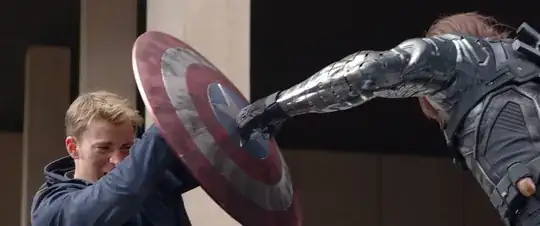
Winter Soldier

enter image description here

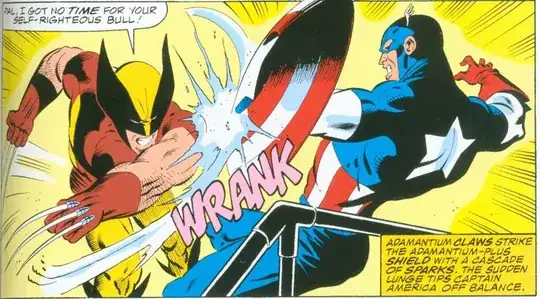
If he doesn't brace against something, he gets knocked over like everyone else.

enter image description here

Adamantium claws strike the the adamantium-plus (vibranium) sheild with a cascade of sparks. The sudden lunge tips Captain America off balance.

The shield doesn't magically absorb blows. Cap' does that.

It is strong enough to withstand them. The blow is distributed over a wider area, and Rogers can use his arms and body to more gradually absorb the energy of the punch/strike/explosion and transfer its momentum.

That doesn't quite line up with your quote, but that's physics in this universe. And it means that shield makes for a very fine weapon.

You can accept that and take canon less literally, or (my suggestion) you can accept the canon explanation and take this universe's physics less literally. Either way works :)

Paul Draper
  • 5,103
  • 4
  • 27
  • 48
  • 1
    Momentum can be absorbed/converted to another form. For example: electromagnetic locks, explosions, and gravity can change the momentum of objects. The important point is that total energy is conserved. – Trisped May 09 '15 at 02:16
  • @Trisped, right, it can only be transferred. – Paul Draper May 09 '15 at 05:44
  • 3
    Yeah I mean he just wouldn't be able to even move it if it absorbed all kinetic energy. – Lightness Races in Orbit May 10 '15 at 02:21
  • 3
    @Trisped In all of the examples that you list, momentum is actually conserved. It's just being transferred to very large things (such as the Earth and/or its atmosphere,) resulting in a non-noticeable difference in velocity. Also, note that momentum is a vector quantity. An explosion radiating out in all directions produces a net momentum change of zero. – reirab May 10 '15 at 02:57
  • In classical Newtonian physics, momentum is defined as p = mv. Kinetic energy is defined as k = 1/2 mv^2. "Absorbing" kinetic energy is equivalent to "absorbing" momentum. You can't vary one of these quantities without varying the other. Momentum will not be conserved if the total kinetic energy of the system is not preserved. Additionally, conservation of momentum only works for forces internal to a system; in @Trisped's examples, the Earth and atmosphere are considered external to the system. – jpmc26 May 11 '15 at 07:28
  • @jpmc26, absorbing kinetic energy is the difference between inelastic and elastic collisions. Kinetic energy can be converted to non-kinetic energy. Momentum cannot be converted to non-momentum. Kinetic energy depends on the materials involved; momentum doesn't, which is why I mention it. – Paul Draper May 11 '15 at 14:29
  • If the momentum energy must be transferred, then the shield would not be able to meet the definition: "transfers very little energy from each impact". You have found a physics theory which does not apply to our comic book material. If this was a real world material, the theory would be revised. In our case it is not, so the theory stands, we just do not apply it to the material in the story. – Trisped May 11 '15 at 18:34
  • 2
    @Trisped, right. There is no way to completely resolve physics in this universe and that description. And without mechanical physics (a generalized description of how things move), an answer to the OP's question is "just 'cause". – Paul Draper May 11 '15 at 18:50
3

Energetics

If the hypothetical Vibranium absorbs kinetic energy, it probably does so in its own frame of reference. In this frame, the target of the shield is coming with great speed towards the shield. Upon impact, the shield somehow absorbs all of the target's kinetic energy, reducing the target's relative velocity (in the shield's frame) to zero. What happened from an observer's perspective? The shield collided with the target, somehow caused the target to match the velocity of the shield upon impact. In the observer's frame of reference, it could be that the shield actually imparted kinetic energy to the target.

Where does the kinetic energy go?

Presumably Vibranium heats up or deforms ever-so-slightly when it absorbs kinetic energy. Beyond that, it's comic book physics. :-)

Momentum

How can momentum be conserved?

It's a textbook example of a purely inelastic ("sticky") collision. The shield is moving, hits its target, and the two move with the same final velocity. The shield would have to have changed its velocity during the impact in order to conserve momentum.

How does the shield inflict damage by absorbing kinetic energy?

When the shield impacts its target and somehow makes target match its own speed, the new speed of the target may be very different from its original speed. This impact does damage to the target because the target potentially experiences very large accelerations. It's the same kind of damage that a punch delivers: the painful part of a punch isn't usually in the impact, it's in the sudden (whiplashing) change of velocity that results from the impact.

If a boxer punches an opponent's teeth and knocks a few teeth out, it's not the impact that knocks them out. The teeth break near their roots, yet the boxer's glove doesn't impact the roots. The impact changes the tooth's velocity, which puts incredible shear stress on the tooth's roots as a result. The tooth, being unable to withstand the shear stress caused by the sudden change in velocity, breaks loose at its weakest point.

Other remarks

It might be easier to think of how it works if you consider the limit of the shield having nearly-infinite mass (but Cap somehow is strong enough to wield it).

jvriesem
  • 130
  • 5