70

Nowadays when we think of a wizard, the most common image we conjure up is:

  • A wise old man with a long white beard
  • Dressed in a long cloak and pointy hat (usually same colour as even old men have some fashion sense)
  • Equipped with a staff used as both a weapon and walking stick

My most iconic image of a wizard is this re-edited image of a Lord of the Rings book cover:

Gandalf

Did Tolkien popularize this basic description of a typical wizard (mage, magi etc) or was there another famous piece of work which also described a wizard in a similar way?

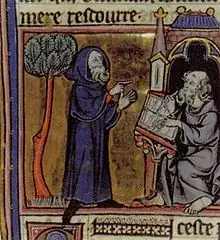
The earliest I found was based on the Arthurian legend, Merlin which was written in the 12th Century. The following is an image from the 13th-century of Merlin by Robert de Boron:

Merlin

I am not asking for a list, only for one piece of work which had a similar description of a wizard as I don't think the fantasy genre was very popular before Tolkien.

Wad Cheber
  • 69,816
  • 70
  • 523
  • 684
user35594
  • 11,237
  • 16
  • 60
  • 113
  • 5
    I haven't got an example so this is a comment not an answer, but it's worth noting that Tolkien based many of his characters on existing mythologies. Gandalf itself is a name from Norse myth, and literally means "Wand-elf", so it seems likely that the description comes from myth too. – Daniel Roseman Feb 15 '15 at 21:06
  • 2
    It's probably worth noting that Tolkien popularized many of what we consider to be modern fantasy tropes. –  Feb 15 '15 at 22:54
  • 7
    Maybe it should be noted that Gandalf's hat and cloak were not matching as implied in the question. "...an old man with a staff. He had a tall pointed blue hat, a long grey cloak, a silver scarf over which a white beard hung down below his waist, and immense black boots." – Lachlan Goodhew-Cook Feb 16 '15 at 00:38
  • 2
  • Who's we? This here is the iconic image of a wizard: old man, white beard, but no hat and no staff. – user14111 Feb 16 '15 at 05:33
  • It's probably also worth noting that there basically are no "wizards" in Tolkien's work. Gandalf, Sauron and Saruman are Maiar. Galadriel and Elrond are ring-bearers, the art of ring-making taught to the Elves by Sauron. The witch-king of Angmar doesn't actually do any magic in the scope of The Hobbit / LotR (at all?). ;-) – DevSolar Feb 16 '15 at 10:44
  • 11
    @DevSolar The narrators of both The Hobbit and The Lord of the Rings call him a wizard - as do many of the characters. "As is told in The Hobbit, there came one day to Bilbo's door the great Wizard, Gandalf the Grey" "That was Gandalf’s mark, of course, and the old man was Gandalf the Wizard, whose fame in the Shire was due mainly to his skill with fires, smokes, and lights." Chapter 1, Fellowship. – Cugel Feb 16 '15 at 12:07
  • @LachlanGoodhew-Cook - I did say "usually same colour" but I'll give you that. – user35594 Feb 18 '15 at 20:58

6 Answers6

66

Tolkien, by his own account, had traditional images of the norse god Odin in mind when creating Gandalf, as we can see from his letter to Sir Stanley Unwin 7 December 1946 (107 in the collection)

[On the subject of a German edition of The Hobbit..]

I continue to receive letters from poor Horus Engels about a German translation. He does not seem necessarily to propose himself as a translator. He has sent me some illustrations (of the Trolls and Gollum) which despite certain merits, such as one would expect of a German, are I fear too 'Disnified' for my taste: Bilbo with a dribbling nose, and Gandalf as a figure of vulgar fun rather than the Odinic wanderer that I think of. ….

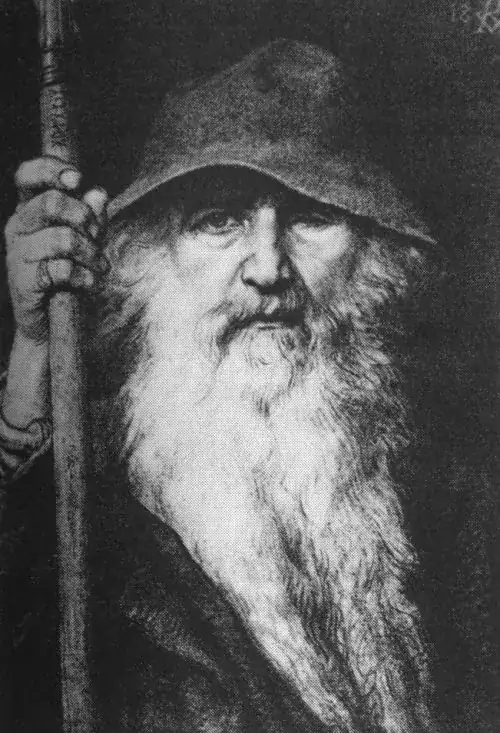
We can see from popular images of the wandering Odin that Gandalf is very similar:

Odin disguised as a wanderer Georg von Rosen: Oden som vandringsman, 1886 (Odin, the Wanderer)

Humphrey Carpenter gives an account in his biography of a postcard of a mountain spirit that Tolkien possessed on which he had written "Origin of Gandalf":

Der Berggeist

So while Gandalf has popularised this image of the wizard for today's generation, he is in a tradition of representations of Odin and wandering spirits/deities in the form of old men that go back for many hundreds of years, and can be found in a huge variety of literary and visual sources (particularly in Northern Europe).

If you want a specific example, go to the Eldar Edda from which most of our depictions of Odin can be traced (and which Tolkien used for inspiration).

Cugel
  • 2,806
  • 1
  • 21
  • 19
  • 4
    I was doing some research along this line as well, and I want to add that Odin is often described in the Sagas as a "sorcerer"; the Ynglinga Saga in particular describes some of his magical abilities, although I've struggled to find an exact quote describing the appearance of Odin's Wanderer guise – Jason Baker Feb 15 '15 at 23:09
  • 7
    @Jason Baker - This is from the Larousse Encyclopedia of Mythology describing how Odin came to Sigmund of the Volsungs: "Now one evening when Sigmund and other warriors were seated around the great fires in a vast hall, whose centre was supported by a huge tree-trunk, an unknown man entered. He was tall, already old, and blind in one eye. His head was covered with a broad-brimmed hat, his body was wrapped in a wide cloak." I don't have a copy with me, but I guess you'll find references there if you can get hold of one. – Cugel Feb 15 '15 at 23:15
  • 3
    @JasonBaker http://vsnrweb-publications.org.uk/Volsunga%20saga.pdf Here you go - check out page 20. The old man in the cloak and hat is Odin. He turns up a couple of other times too. – Cugel Feb 16 '15 at 00:01
  • kudos for that find. If I could give you another +1, I would – Jason Baker Feb 16 '15 at 00:46
  • 6
    Wow. Seventy years ago an author complained about an adaptation of his work being "Disneyfied." –  Feb 17 '15 at 02:42
  • That first image is just brilliant, many thanks for this awesome answer! The other answers are also fantastic but I will accept this as it was the first one. – user35594 Feb 18 '15 at 21:02
  • @Cugel - It is thought that Tolkien was wrong about the postcard- the image was created in 1920, a bit later than Tolkien began work on The Hobbit. See Tolkien Gateway – Wad Cheber Jun 11 '15 at 06:28
  • @WadCheber I doubt Tolkien could ever be "wrong" in this case - he'd know, after all. An assumption that the postcard itself is the origin of Gandalf might be wrong, but that's not what's being suggested here: the idea is that the subject of the painting might be, for Tolkien, the origin of Gandalf, Odin-like wandering spirits preceding this depiction by hundreds of years. – Cugel Aug 12 '15 at 21:54
  • @Cugel "While Carpenter stated Tolkien received the postcard in 1911, the artist's daughter was interviewed and stated the painting was most likely created in the mid to late 1920s. Carpenter notes that his statement was based on dated notes which accomopanied the postcard, therefore it is generally assumed the postcard was acquired sometime around the mid 1920s." – Wad Cheber Aug 12 '15 at 22:00
  • @Cugel - "Der Berggeist ("The Mountain-spirit") is the title of the painting by Josef Madlener which was the inspiration for Gandalf. Humphrey Carpenter describes how J.R.R. Tolkien stumbled upon the postcard during a 1911 (see below), holiday in Switzerland." – Wad Cheber Aug 12 '15 at 22:02
  • @Cugel -The implication is clearly that Carpenter (and possibly Tolkien) thought the image was "the inspiration for Gandalf", and since Gandalf existed before the painting did (according to the painter's daughter), the implication is obviously wrong. – Wad Cheber Aug 12 '15 at 22:04
  • @Cugel - "Tolkien preserved this postcard carefully, and long afterwards he wrote on the paper cover in which he kept it: 'Origin of Gandalf'." I think Tolkien was mistaken. He misremembered. – Wad Cheber Aug 12 '15 at 22:05
  • I don't repeat Carpenter's assertions (because I was already aware they were contentious), nor does this answer rely on them, so these comments aren't strictly relevant. Thanks for the clarification though, which I am sure will be useful to readers. – Cugel Aug 12 '15 at 22:10
  • The “Eldar Edda” is in context a brilliant play on words. – Janus Bahs Jacquet Jul 24 '16 at 06:59
40

Plausibly most aspects of Gandalf's look might derive from the depictions of Odin in the answer from @Cugel but it seems that Odin's hat was shown as having a short rounded top in those pictures, so I'll focus on where the idea of wizards wearing tall pointy hats came from, since Tolkien does specify in The Hobbit that Gandalf "wore a tall pointed blue hat".

This page has a depiction of a wizard from a late 19th century lantern slide:

enter image description here

(some other magic lantern slides with wizards/sorcerers can be found here and here)

It sort of seems like this guy is somewhere between the modern Merlin/Gandalf vision of a wizard and older depictions of the "renaissance magus" like the one shown here of Dr. Faustus from a 1620 edition of Faust:
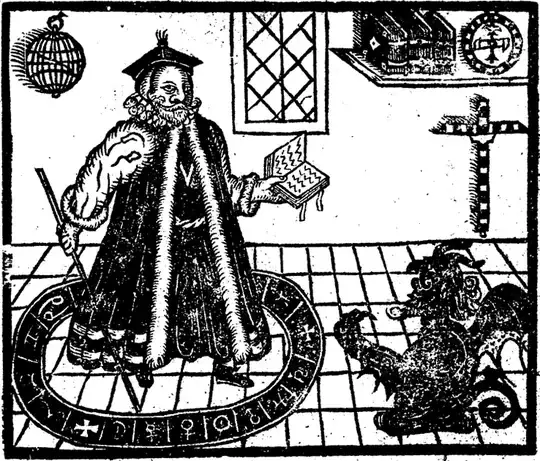
enter image description here

Another similar Dr. Faustus, found on this blog which features a lot of old witch & sorcerer imagery:

enter image description here

And here is an illustration of Merlin by Gustave Doré from 1868, you can see the image of the wizard already included the robes and the long white beard but perhaps the conical hat wasn't yet part of standard wizard regalia in the public imagination:

enter image description here

And this illustration of Merlin from the 1889 edition of Mark Twain's A Connecticut Yankee in King Arthur's Court has a short conical hat, but again not the really tall kind we now associate with wizards:
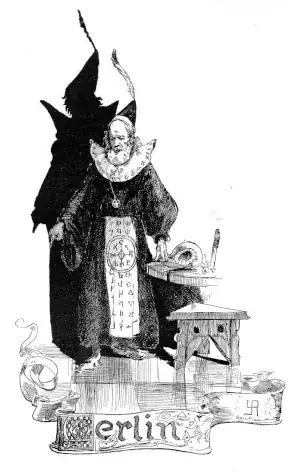
enter image description here

Some of the films of silent film pioneer Georges Méliès feature characters with robes and conical hats decorated with stars and crescent moons, as is common in depiction of wizards...earliest example on my Méliès DVD seems to be "The Magician" from 1898, below:

He also sometimes depicted astronomers in a similar costume, as in "The Astronomer's Dream" from 1898, and his most famous film, "A Trip to the Moon" from 1902:

He had a background in pantomime theater, so it's possible this type of costume was used in pantomimes to represent people who studied the heavens, whether for astrological magic or astronomy. The conical hat may be based on a type of hat used by the medieval philosopher Duns Scotus, which later became an object of mockery (and the basis for the 'dunce cap') as explained in this straight dope article:

What does this all have to do with those silly pointy hats?

Well, one of the more mystical things Duns accepted was the wearing of conical hats to increase learning. He noted that wizards supposedly wore such things; an apex was considered a symbol of knowledge and the hats were thought to "funnel" knowledge to the wearer. Once humanism gained the upper hand, Duns Scotus's teachings were despised and the "dunce cap" became identified with ignorance rather than learning. Humanists believed learning came from internal motivation rather than special hats, and used the public shame of having to wear a dunce cap to motivate slow learners to try harder.

Here is a cover to Twain's The Mysterious Stranger from 1916 which again features the pointed hat and stars-and-crescent-moons decorations (this page mentions that the image is of a character, "the astrologer", who was added to the first heavily-rewritten edition of the book and was not present in Twain's original text):

enter image description here

Perhaps the "The Sorceror's Apprentice" from Disney's Fantasia helped cement the modern iconic image of a wizard's hat in public consciousness (in the same way Wizard of Oz cemented the image of a witch, inventing the notion that they had green skin for example)--in this cartoon, Mickey gained temporary magic powers from "borrowing" the hat of his wizard master, which was pointed, blue, and had the star-and-crescent moon pattern often seen in later images of wizards. Fantasia came out in 1940, only 3 years after The Hobbit, so I don't know how likely it is that the Disney animators were influenced by Gandalf (especially since according to the "Design and Animation" section of the Fantasia wiki article, "Animation on The Sorcerer's Apprentice began on January 21, 1938", and this article says "Houghton Mifflin Co. of Boston and New York published the first American edition of The Hobbit in spring of 1938 following its September, 1937 debut in the United Kingdom from George Allen & Unwin LTD").

enter image description here

This page has some of the story of how Disney artists came up with that particular design for the hat:

For the actual filming of the animated classic, a well-known silent film star, Nigel de Brulier, was brought in to provide live-action reference footage for the character of the sorcerer. Disney writer Carl Fallberg went to the famous Hollywood costume rental house, Western Costume, to find the appropriate robe and pointed hat for the performer to wear during the shooting. Fallberg had to paste white stars and crescent moons onto the hat to get the look he wanted.

Hypnosifl
  • 56,783
  • 5
  • 191
  • 244
32

Merlyn from The Once and Future King does a pretty good job of hitting all your bullet points:

The old gentleman that Wart saw was a singular spectacle. He was dressed in a flowing gown with fur tippets which had the signs of the zodiac embroidered all over it, together with various cabalistic signs ... He had a pointed hat like a dunce's cap, or like the headgear worn by the ladies of that time, except that the ladies were accustomed to have a bit of veil floating from the top of it. He also had a wand of lignum vitae, which he had laid down in the grass beside him, and a pair of horn rimmed spectacles like those of King Pellinore.

...

Merlyn had a long white beard and long white moustache which hung down on either side of it, and close inspection shewed that he was far from clean.

Note that The Sword in the Stone (1938) was published a year after The Hobbit (1937), probably close enough in time that there's independent invention/borrowing from the same sources.

Micah
  • 21,806
  • 5
  • 94
  • 113
16

You might also consider Prospero from Shakespeare's "The Tempest". Although there's little description (as the part would have to be played by any suitable actor in a company), there's the staff, hat & cloak used as props. He's closer to my iconic wizard image/character than Gandalf - who, after all, is not entirely human.

jamesqf
  • 2,322
  • 13
  • 15
  • 7
    It may be of import that the robe was a VERY important part of being a magician for Prospero, symbolically. For instance, he take OFF the robe whenever he wants to do anything non-wizardy, even just to talk to his daughter, and makes quite a thing of it. – Mac Cooper Feb 16 '15 at 18:10
  • 6
    @MacCooper: “I take off my robe and wizard hat…” – PLL Feb 17 '15 at 14:14
2

This is just for the completeness because nobody mentioned this source:

Form the book of Saint Cyprian

I'm translating from the spanish version, chapter III (apologies in advance, my english isn't that good, thanks if somebody can improve it) it doesn't mention the pointy hat, but it mentions a hat, dark colored clothing, and ornaments of golden and silver stars:

"Chapter III: Sourcerer's Clothing and the way to Prepare it

The inner part must be made of white linen, the tunic and the hat must be made of wool, both the tunic and the hat must be black, it must have enbroidered with red silk the hebrew characters it has in its chest (the words Jehova, Adonay, Eloy, and Gibor), and must have enbroidered with thread made of gold and silver stars and other signs. Shoes must be made of the skin of a white lamb."

The text is probably a couple of centuries old and the scans are from a book printed on the second half of the XX century, but it was known enough to be part of the material used by modern authors to portray wizards.

Broken_Window
  • 649
  • 1
  • 5
  • 13
2

I feel that Tolkien based the image of a wizard from that of an old man, for the simple reason that an old man suggests wisdom, knowledge and the lay of the land. One would find it hard to believe that a young man could BE a wizard. And to answer your question, I highly doubt that Tolkien, when writing about Gandalf, was trying to glamorize his character. He actually followed the simple rules of life; the older you are, the more wise and powerful you become. So the older a person is the more knowledge they'd possess and in the case of a wizard, strength in magic. Therefore, he becomes Gandalf the White.

JMFB
  • 14,886
  • 14
  • 76
  • 162
jenni selman
  • 165
  • 6