96

In Chapter XVIII - The Return Journey of the book 'The Hobbit', Tolkien uses the word "guns".

'The roar of his voice was like drums and guns; and he tossed wolves and goblins from his path like straws and feathers'

As far as I know, guns are not used as a weapon in Middle-earth, and I don't remember them being mentioned neither in The Hobbit nor in LotR.

Was this a mistake on Tolkien's part or is there another explanation?

Rand al'Thor
  • 134,408
  • 65
  • 607
  • 854
bobbyalex
  • 1,010
  • 1
  • 7
  • 12
  • 2
    I haven't found some real proof yet, but I think it could theoretically be possible for guns to have existed. My point: The Uruk-Hai used a (probably) gunpowder bomb to breach Helms Deep. So it might be possible that they are mentioned somewhere or at least exist. – Louis Huppenbauer Dec 22 '14 at 07:28
  • 8
    "Then there was a crash and a flash of flame and smoke. The waters of the Deeping-stream poured out hissing and foaming: they were choked no longer, a gaping hole was blasted in the wall. A host of dark shapes poured in. 'Devilry of Saruman!' cried Aragorn. 'They have crept in the culvert again, while we talked, and they have lit the fire of Orthanc beneath our feet.'" – Foo Bar Dec 22 '14 at 13:02
  • 36
    The obvious explanation is that Tolkien was writing for a modern audience and he just used terminology that his modern audience would understand; it doesn't have to be taken as literally meaning that there were guns in Middle-earth. –  Dec 22 '14 at 13:08
  • 33
    Since the books are translated from middle earth langauges into english by someone of our world, I would say this is a freedom of the translator to use a fitting word from our world for a thing that exists only in their world that we would not know. – PlasmaHH Dec 22 '14 at 13:16
  • I like to think the Dwarves had guns & cannons but they were rare. That's just me. – Omegacron Dec 22 '14 at 16:55
  • 2
    Recently I came across a specific use of the word "bullet" in a story - which a character unfamiliar with modern weaponry translated the word as a sling-stone missile. It may be there is an older meaning for "gun", something that would cause the explosion-propelled missile launcher to be named "gun" instead of something else. And as long as whatever that is, is loud and crashing, it might fit the quote, in universe, without too much trouble. Of course, out of universe it may be a modern reference or mistake - but in universe it could be a term that has an older meaning than we think. – Megha Feb 21 '16 at 13:37
  • 3
    Tolkien is not saying that guns existed in Middle Earth, he is only describing a noise made by one of its characters as sounding like drums or guns (i.e. he is using a description familiar to the reader); he is not saying that the noise was made by drums and guns. – Ed999 Jul 18 '20 at 15:22
  • Much more of The Hobbit is written as the narrator telling a tale about Bilbo and his adventures, in contrast to the The Lord of the Rings which is presented as a direct translation of Bilbo's (and Frodo's) writings. Most anachronisms can be explained as being introduced by Tolkien as a description to the reader, not something that Bilbo would have originally written. – chepner Oct 04 '22 at 11:54
  • I prefer to think that the word translated as gun was the best option for something that employed explosives, otherwise Tolkien would have had to literally call it a "Boomstick". – Digital Jedi Oct 05 '22 at 11:47

6 Answers6

122

In-universe, the explanation is simple: The Hobbit was Tolkien's translation into English of the original material from Common Speech, since the plot device is that both The Hobbit and LOTR are the writings of Frodo and Bilbo, that he (Tolkien) had access to and translated.

The Common Speech, as the language of the Hobbits and their narratives, has inevitably been turned into modern English. In the process the difference between the varieties observable in the use of the Westron has been lessened. Some attempt has been made to represent these varieties by variations in the kind of English used ... (LOTR: The Return of the King, Appendix F, "II. On Translation")

As such, it's a common thing with the translators to employ idiomatic translations instead of literal - and as a linguist, Tolkien surely was familiar with translation techniques.

As other answers noted, both Tolkien himself, as well as his intended audience (English speaking people of 20th century) knew what "like drums and guns" sounded - probably a lot better than whatever idiom was used by Bilbo in the Common language. So, this is a very valid approach to the text.

DVK-on-Ahch-To
  • 342,451
  • 162
  • 1,520
  • 2,066
  • 5
    I can think of another out-of-character quote: “If you have ever seen a dragon in a pinch, you will realize that this was only poetical exaggeration applied to any hobbit, even to Old Took's great-granduncle Bullroarer, who was so huge (for a hobbit) that he could ride a horse. He charged the ranks of the goblins of Mount Gram in the Battle of the Green Fields, and knocked their king Golfibul's head clean off with a wooden club. It sailed a hundred yards through the air and went down a rabbit-hole, and in this way the battle was won and the game of Golf was invented at the same moment.” – Leonardo Herrera Dec 24 '14 at 02:50
  • 14
    @LeonardoHerrera or possibly the existence of a game called "golf" involving hitting a ball into a hall occurs spontaneously in many universes, just as The Hitchhiker's Guide To The Galaxy observes that 85% of world have a drink whose name sounds like "gin and tonic": http://hitchhikersguidequotes.tumblr.com/post/17319713714/it-is-a-curious-fact-and-one-to-which-no-one – glenatron Dec 24 '14 at 10:28
  • Tolkien was also a translator: https://en.wikipedia.org/wiki/Beowulf:_A_Translation_and_Commentary – PM 2Ring Oct 02 '22 at 22:16
29

One has indeed personally to come under the shadow of war to feel fully its oppression; but as the years go by it seems now often forgotten that to be caught in youth by 1914 was no less hideous an experience than to be involved in 1939 and the following years. By 1918, all but one of my close friends were dead.

— J.R.R. Tolkien, foreword to The Lord of the Rings

Even though it was a translation from the original, I am pretty sure this was only an image of speaking to make the modern people imagine how the roar really sounded like in his mind.

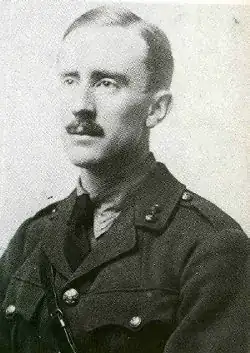
J.R.R. Tolkien’s service in the British Army during World War I may have influenced his fiction.

More here: JRR Tolkien and World War I

description below

J.R.R. Tolkien in uniform, 1916.

Mithical
  • 38,898
  • 17
  • 178
  • 229
Rocket
  • 3,502
  • 3
  • 26
  • 46
  • If this were true then we should has seen other examples of items that exists only in our world, in the novels but that doesn't seem to the case. – bobbyalex Dec 22 '14 at 07:33
  • 10
    @BobbyAlexander - there are actually many; see http://mathom.hubpages.com/hub/Anachronisms-in-The-Hobbit-and-Lord-of-the-Rings –  Dec 22 '14 at 07:46
  • Thank you very much for this comment Darth Satan... i was looking for a site like this one lol i knew ive read some more image of words like this one but i did not wanted to read all my tolkiens book again lol – Rocket Dec 22 '14 at 07:54
  • 4
    I think of it this way: Supposing that the book is a translation/adaptation of the one Bilbo himself wrote, the person adapting it (Tolkien) is trying to make a modern reader understand, not a contemporary of Bilbo. – George T Dec 22 '14 at 09:44
  • @Darth Satan That is a great resource: I feel like info from that link would be very very appropriate as a stand-alone answer to this question. – Shisa Dec 22 '14 at 09:59
  • @Shisa - I may pull something together into a more comprehensive answer later on. I'd really like to source a direct quote from Tolkien regarding use of anachronisms but for now the only one I can locate is relating to the blunderbuss in Farmer Giles. –  Dec 22 '14 at 11:19
  • 1
    A lot of the "anachronisms" in that post are understandable. Waistcoats, clarinets, clocks, umbrellas, golf, even telescopes and pop-guns... they don't feel out of place. Only the similes involving firearms (because only Saruman is meant to know the secret of gunpowder) and express-trains seem like they have to be "translation" artifacts. – Rawling Dec 22 '14 at 12:15
  • 1
    @Rawling. My point exactly. Of course middle earth would contain artefacts similar to our world. My point with my earlier comment was this: if there were other comparisons to things that existed only in our world but not in ME then it world make sense. For eg: The Orcs were a formidable presence, like tanks in the battlefield. – bobbyalex Dec 22 '14 at 13:00
  • Wouldn't nearly everything be an anachronism, though? It's prehistorical, set some 12,000(?) years before today. I think it's easier to think of it as, they developed things on their own and later they were lost and we redeveloped them recently. Even the references to guns there, but not in any combat, could easily be explained as: guns were so early/expensive that they weren't useful in battle yet. – Tim S. Dec 22 '14 at 13:26
  • "May have"?! The LoTR was practically an allegory for the war. – TylerH Dec 22 '14 at 15:01
  • 1
    @TylerH: Not this again! Tolkien has explicitly stated in the forward to the second edition that LotR was not meant as metaphor for World War 2. He explicitly stated that he hated it when people drew comparisons to it. – bobbyalex Dec 23 '14 at 04:09
  • @BobbyAlexander He can wish against it all he wants, but it walks like a duck and quacks like a duck. Though, I did say practically, not literally. There are countless parallels that can be drawn without really stretching the imagination (as in many fantasy epics). – TylerH Dec 23 '14 at 04:10
  • @TylerH: So you are saying Tolkien has no say over what he meant in a book he wrote? – bobbyalex Dec 23 '14 at 04:13
  • 2
    @BobbyAlexander He has no say over how other people choose to interpret it. – TylerH Dec 23 '14 at 04:13
  • 2
    @TylerH - just because you choose to interpret it as one doesn't mean that it is one. Also, I suggest that you re-read the paragraph starting with "The real war does not resemble the legendary war in its process or its conclusion" in the foreword. –  Dec 24 '14 at 10:56
  • @DarthSatan Yes, it does. You don't decide what something is for me, likewise Tolkien can't decide what his story is for others. – TylerH Dec 24 '14 at 18:34
8

I doubt this is what Tolkien had in mind, but the OED gives several obsolete meanings of "gun" which would make sense in a world with no firearms but does possess "blasting fire". The first is used to describe any large engine of war.

1689 R. Milward Selden's Table-talk 30 The word Gun was in use in England for an Engine to cast a thing from a man, long before there was any Gun-powder found out.

This would cover the tossing part, but not the roar. A better fit is used to describe a blasting device.

1753 Chambers's Cycl. Suppl. Gun is also a name given by the miners, to an instrument used in cleaving rocks with gunpowder. It is an iron cylinder..having..a hole drilled through it to communicate with the inside of the hole in the rock.

Schwern
  • 13,600
  • 4
  • 54
  • 73
  • 1
    The second example seems circular. What came first, the use of gun as explosive or gunpowder that it uses? –  Dec 28 '14 at 05:32
  • @user16696 OED says gunpowder is gun n. + powder n. Gun came first. – Schwern Nov 24 '18 at 23:05
8

A etymology search shows gun to come from gunne meaning war.

mid-14c., gunne "an engine of war that throws rocks, arrows or other missiles," probably a shortening of woman's name Gunilda, found in Middle English gonnilde "cannon" and in an Anglo-Latin reference to a specific gun from a 1330 munitions inventory of Windsor Castle ("...una magna balista de cornu quae Domina Gunilda ..."), from Old NorseGunnhildr, woman's name, from gunnr + hildr, both meaning "war, battle." First element from PIE *gwhen- "to strike, kill" (see bane); for second, see Hilda.

  A key meaning is siege engine, aka catapult, ballista, or trebuchet, whose munitions produce a large roar or crash on impact, and would be recognizable to middle earth inhabitants.

4

Gunpowder hadn't really taken hold in ME at this point but it was used at Helm's Deep by the forces of Saruman to breach the wall. This is opinion based of course but one could reasonably suspect that the word was used for the readers benefit in describing Beorn's assault on the platoon of Bolg.

2

'The Hobbit' is written in a very different style to LotR. When he was writing 'The Hobbit', Tolkien didn't yet have the details of Middle-Earth and its history worked out, nor had he yet adopted the flowing, almost archaic style of writing that still characterises fantasy literature to this day. He probably used the word because it was what came to his mind as a good description, without thinking about whether it fitted with the sort of world he was creating.

Rand al'Thor
  • 134,408
  • 65
  • 607
  • 854
  • 9
    "When he was writing 'The Hobbit', Tolkien didn't yet have the details of Middle-Earth and its history worked out, nor had he yet adopted the flowing, almost archaic style of writing that still characterises fantasy literature to this day" - actually he did and he had. The Silmarillion and the Annals were already in existence by that time, the Fall of Numenor and the Last Alliance had come in before the Hobbit was published, and most of the history was quite fixed (although certain details were changed and expanded in subsequent years). –  Dec 22 '14 at 13:12
  • @DarthSatan - From Wikipedia, "As Tolkien's work on LotR progressed, he made retrospective accommodations for it in The Hobbit. These few but significant changes were integrated into the second edition. Further editions followed with minor emendations, including those reflecting Tolkien's changing concept of the world into which Bilbo stumbled" (my italics). – Rand al'Thor Dec 22 '14 at 13:15
  • 3
    And none of that means that he hadn't got things worked out by the time he was writing the Hobbit. All of the evidence is there in the HoMe books and that trumps a Wikipedia claim any day. –  Dec 22 '14 at 13:16
  • @DarthSatan I should have known better than to try and post an answer on a site full of LoTR heads... :-( Just to show my ignorance, what does HoMe stand for? – Rand al'Thor Dec 22 '14 at 13:18
  • History of Middle-earth (and don't call it "the notes" because it's not ;) ) –  Dec 22 '14 at 13:20
  • @DarthSatan From my own memory, The Hobbit is written in a very different style to LotR. I'm very surprised that Tolkien had much of the Middle-Earth background worked out at that time. – Rand al'Thor Dec 22 '14 at 13:20
  • 1
    Since we're now getting into "extended discussion in comments" territory, I think that "how much of Middle-earth had Tolkien worked out when he wrote The Hobbit?" would make an excellent separate question. –  Dec 22 '14 at 13:51
  • 5
    @DarthSatan Tolkien had already worked out a lot of Middle-earth when he started work on The Hobbit. But The Hobbit was originally not intended to take place on Middle-earth. It was The Lord of the Rings that retroactively set TH to happen in the future of the world of the Silmarillion and other then-unpublished material, because Tolkien wanted to publish the Silmarillion but his editor wanted “more hobbits” so he wrote a new tale that mixed the two — LOTR. –  Dec 22 '14 at 14:10
  • I don't recall seeing exactly “how much of Middle-earth had Tolkien worked out when he wrote The Hobbit?”. We have some questions that touch on this, such as Why was Gandalf involved with the Dwarves mission to rob Smaug?, Was Gollum always a hobbit?, What are the revisions in the (Revised Edition) of The Hobbit? –  Dec 22 '14 at 14:12
  • 3
    @Gilles - it's important to realise though that Tolkien added elements from his mythology to The Hobbit. The Necromancer, the three Elven kindreds, the character of Elrond, Gondolin, etc - none of these were new inventions; they already existed in his Silmarillion writings. –  Dec 22 '14 at 14:14
  • @DarthSatan The Necromancer bears no clear relation to Sauron within the text of The Hobbit, nor are there clearly "three Elven kindreds" (and the Mirkwood elves in particular seem to be a far cry from the Mirkwood elves of LotR!). I don't remember Gondolin being specifically mentioned in the text, though I haven't read it in a while. And Tolkien could have changed Elrond's name (or even introduced him!) in The Silmarillion (which, as Gilles mentions, was unpublished at the time) after writing The Hobbit (I'd like to see a source either way, but can't find one at the moment). – Kyle Strand Dec 23 '14 at 16:46
  • 3
    The point is that Tolkien made it pretty clear that he did not originally conceive of The Hobbit as fitting into his existing mythology, so to some extent it doesn't matter how much of that mythology had been worked out when he wrote The Hobbit. – Kyle Strand Dec 23 '14 at 16:48
  • 1
    @KyleStrand - re: the Necromancer, see http://scifi.stackexchange.com/a/47768/8719 please. –  Dec 23 '14 at 17:13
  • 1
    @KyleStrand - "They are old swords, very old swords of the High Elves of the West, my kin. They were made in Gondolin for the Goblin-wars. They must have come from a dragon's hoard or goblin plunder, for dragons and goblins destroyed that city many ages ago. This, Thorin, the runes name Orcrist, the Goblin-cleaver in the ancient tongue of Gondolin; it was a famous blade. This, Gandalf, was Glamdring, Foe-hammer that the king of Gondolin once wore." –  Dec 23 '14 at 17:14
  • 1
    @KyleStrand - "There the Light-elves and the Deep-elves and the Sea-elves went and lived for ages, and grew fairer and wiser and more learned, and invented their magic and their cunning craft, in the making of beautiful and marvellous things, before some came back into the Wide World." –  Dec 23 '14 at 17:14
  • 1
    @KyleStrand - Elrond entered in the Sketch of the Mythology which was written in 1926/1927 - before the Hobbit was written. These are all published works and the evidence is there for all to see. –  Dec 23 '14 at 17:20
  • @DarthSatan Fair enough, though surprising (to me at least). – Kyle Strand Dec 23 '14 at 17:34