Why does the Star Trek franchise (produced in the USA) use Celsius for temperature and other units from SI, rather than Fahrenheit and units from the imperial system (still widely used in USA)? Eventually, as per Paul D. Waite's comment, the question can be, why don’t they use Kelvins?
Asked
Active
Viewed 2.1k times
55


11 Answers
166
Today, countries making up about 95% of the world's population use the metric system:
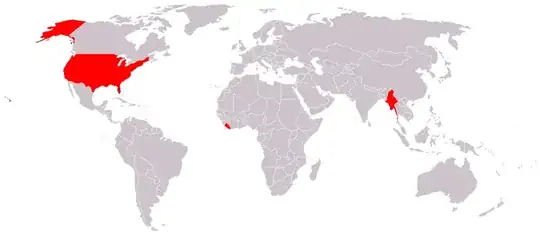
The holdouts are the USA, Liberia, and Myanmar.
If the Earth is peacefully united and sends missions to the stars -- as is the case in Star Trek -- the overwhelming majority of people would be metric users. Simple democracy would lead to the metric system being adopted.

Royal Canadian Bandit
- 36,854
- 8
- 120
- 142
-
18
I understand being passionate about how people measure stuff, but comments aren't the place for discussing it. – Dec 16 '14 at 15:35 -
11USA was supposedly supposed to switch at the same time Canada did, it was kind of like a mutual agreement made between neighbors. Then USA backed out just after Canada had already commited itself. Now all our cars have to have fine print MPH in the dash, and our construction materials are all still in the old imperial system because our number one export is to the USA. Now Canada is stuck in a type of limbo, half way between both systems... – ShemSeger Dec 16 '14 at 18:31
-
-
10Actually Myanmar (aka Burma) announced in 2013 of a full conversion to metric. That leaves only 2 countries! – Octopus Dec 17 '14 at 06:37
-
@NickT you're correct we use those imperial measurements. We just don't teach them at school :-) – matt freake Dec 17 '14 at 10:31
-
5@NickT - we (the UK) uses miles for distance, but a lot of stuff is metric: weight (grams), volume (litres), temperature (celsius, aka centigrade). Actually, weight and height is a bit more complicated - food is sold in grams (or kilograms), and furniture etc is described in metres/cm but when people talk about their own weight and height they use stones/pounds and feet/inches. – Max Williams Dec 17 '14 at 11:19
-
1USA uses some metric units, like grams of coke and 9mm handguns. Or even hybrid units like kilograms per inch. Very confusing. – Dennis_E Dec 17 '14 at 12:40
-
@NickT Plus, I believe, miles per gallon - while buying gas by the litre. – Christopher Creutzig Dec 18 '14 at 07:50
-
2Doesn't the whole Federation of Planets (or whatever it's called--sorry, I'm not a Trekkie) use the Earthian metric units? Why is that? Surely the Vulcans would have something less arbitrary and illogical. Seriously, "the duration of 9192631770 periods . . ."? – user14111 Dec 19 '14 at 06:55
-
@user14111: Fair point, although the Enterprise appears to be built and crewed mostly by humans. You could imagine trans-species units based on universal physical constants (and powers of 2 instead of 10), but metric is a lot more intelligible to the audience. – Royal Canadian Bandit Dec 19 '14 at 08:23
-
6@user14111 - I would assume the universal translator could handle basic unit conversions. – Scott Whitlock Jan 01 '15 at 17:59
-
It's also worth noting that even in the US, science classes (at least at the college level and above) generally use the metric system. – Hypnosifl Sep 24 '15 at 11:32
-
Question rebooted: What about United Kingdom? Why they're not marked on your map? – trejder Jul 28 '16 at 07:40
-
2@trejder Well, we do use the metric system in the UK, we just didn't stop using the Imperial system. So now it's a mess. The only area I've never used Imperial units for is temperature - I would say Fahrenheit is on track to be functionally extinct here in about thirty years. – tardigrade Jul 28 '16 at 08:21
78
Short answer? People feel that the future is the metric system. It's more endorsed by the scientific community. Many nations have adopted it as a universal measure. Thus, in a farflung science-heavy future, the assumption is that people will be using metric units exclusively, the same reason futurists thought people would all be speaking Esperanto in the future as seen in the Harry Harrison books.

FuzzyBoots
- 223,803
- 23
- 680
- 1,039
-
14
-
25You're on the right track, but the Esperanto comparison is not a good one -- hardly anyone speaks Esperanto, whereas 95% of the world's population uses metric. – Royal Canadian Bandit Dec 14 '14 at 17:24
-
5@RoyalCanadianBandit: Some fads catch on better than others. :) I originally had a joke line at the end of my answer about how, instead, everyone speaks English, proven to be the superior universal language, but it seemed too much like flamebait. – FuzzyBoots Dec 14 '14 at 17:39
-
4And by "more endorsed" you mean "endorsed whatsoever". Metric is an international standard. – Lightness Races in Orbit Dec 14 '14 at 18:47
-
1A side note. TV Tropes, you've linked to, is ten years old and I heard about it for the first time today. I spend 10 seconds on trying to understand, what purpose of existence that site has behind and failed. Also, I don't like ugly URLs... – trejder Dec 14 '14 at 20:33
-
7@trejder That's actually a pretty sane URL. As for the purpose of the site, it's an excellent documentation of literary tropes within a vast array of media. If you are at any point intending to write a story it is an invaluable resource. – Pharap Dec 14 '14 at 22:46
-
5But be careful! Once you've clicked, you'll never stop...... – Lightness Races in Orbit Dec 15 '14 at 00:30
-
1At the core level English is an utterly terrible language. The grammar is terrible. The spelling standards are terrible but somehow people like it. – Gusdor Dec 15 '14 at 08:30
-
1@trejder, this specific quote from the link is all you really need: "Thus, it's not surprising that the United States actually does use the metric system already, in military and scientific endeavors, as well as on pharmaceuticals and nutritional information." – Zano Dec 15 '14 at 09:53
-
-
2"It's more endorsed by the scientific community" means "Everybody, even in the US, does science in metric." – David Richerby Dec 15 '14 at 15:04
-
@Gusdor, the vast majority of languages are terrible; sometimes in similar ways to English, sometimes in different ways. That was the reason Esperanto was developed: to create a sane language with real rules. Nobody liked it. :) – Brian S Dec 15 '14 at 17:43
-
1@BrianS: We're getting to the point where this really probably ought to go to chat, but arguably, Esperanto failed for some of the same reasons the U.S. standard of measurements hasn't taken over from metric, namely price of change and the fact that any system carries biases from its point of origin. The way I understand it, Esperanto is relatively easy to learn if you grew up with a romance language, less so if you did not. – FuzzyBoots Dec 15 '14 at 17:58
-
2
-
-
@Mayo: Why not? It's all pretty arbitrary as to where you put 0. :) – FuzzyBoots Dec 17 '14 at 18:57
-
The temperature "outside" in space approaches 0 K. Wouldn't it make sense to have the range go from 0K to 5000+ for approaching stars. You would know that 273 is freezing water; 290-300K is a comfortable indoor temperature range; 373 is boiling water and you roast your chicken at 500K. Why would a temperature range based upon the freezing and boiling of water at sea level on earth translate well to life in a star ship? – Mayo Dec 17 '14 at 19:00
-
2@Gusdor: Two thousand years ago, the standard language everyone communicated in was Koine Greek. Then came Latin (at one point, the roman catholic church decided to use Latin for their mass - in order to make it easier(!) for people to follow). I'm not sure about the next couple of hundred years; at some point, scientists used mostly German and the noble society French. The current lingua franca(!) is English. It could well be that some of us are still alive when that switches again to something else. Maybe it's time for Spanish (or Mandarin, to finally get a non-European one)? – Christopher Creutzig Dec 18 '14 at 07:58
-
@ChristopherCreutzig: I heard a statistic over a decade ago, and apparently still true today, that English is the most common second language for lingua franca reasons. Second most common? French. Weird, huh? It may be a holdover from when French was the language of nobles. For the sake of trivia, Russian is apparently third. http://www.movehub.com/blog/global-second-languages – FuzzyBoots Feb 11 '15 at 16:29
-
2@christopher I was surprized to see (in 2008) that the highway signs (etc.) in China are written in English. Almost everything public is bilingual, in Mandarin and instruction-manual English. The French would declare war if they used en François that badly; but Englishnis open-source and free to fork. – JDługosz Apr 19 '15 at 05:39
-
Agreed with the logic in the answer. Part of Star Trek is based on futurology extrapolations. – Overmind Jul 28 '16 at 08:56
-
-
@JürgenA.Erhard: ^_^ Eyeh... time marches on. And statistics often ignore actual usage. For example, the United States is officially metric. So are Wales and Ireland. However, look at actual usage... – FuzzyBoots Aug 11 '17 at 04:47
-
So, Fuzzy, how many countries made the switch in the 14 minutes between your answer and that Canadian Bandit's? ;-) As to "officially"... no they aren't. At least if you take officially as a synonym of "legally mandated". Which most people would. – Jürgen A. Erhard Aug 11 '17 at 07:07
-
@JürgenA.Erhard: You know what, you're right that I probably ought to change my language. I was unaware at the time that it was that isolated because, well, traditional units are still alive and well in many countries despite those legal mandates, plus I was kind of busting peoples' chops. Almost everything in the U.S.A. is double labeled at this point with the big exception being street signs, the argument there generally being that we simply have so many signs to change, and the fear of potential confusion over things like speed limits. – FuzzyBoots Aug 11 '17 at 10:14
-
I have no particular dog in the fight, really. Metric has been on the cusp of being legally mandated since I was a little boy, but it's just never happened. I can use either set of units fairly well, but it's just natural to me to think of inches and pounds, or degrees Fahrenheit and when people use the other measurements, I just do the conversion. – FuzzyBoots Aug 11 '17 at 10:15
32
Because Star Trek is a show about a mission to explore space, and scientists -- yes, even in the United States -- use the metric system.

rbp
- 437
- 3
- 4
-
Yes, but it's also a largely American future with many of the crew coming from the US. – Valorum Dec 15 '14 at 10:12
-
1
-
@PeterHorvath - I'm unsure how that answers the question. In 24 hours, America will be one more day "into the future" but they'll still be using a mixture of metric and imperial. – Valorum Dec 15 '14 at 10:50
-
5@Richard The common people uses mainly imperial system in their everyday. The longterm tendency goes into the direction of the metric system. If we extrapolate from the history of the last 200 years, I think a prediction of a world-wide metric system can be considered strong. And sci-fi films are based mainly on extrapolations (social and technical). – Dec 15 '14 at 10:54
-
7They come mostly from the US because the program is made in the US. It's made clear in the series that it's a United Earth type idea, though.... the assumption is that the crews are far more balanced than in the TV series. Or in short, don't take the TV show as directly indicative of the fictional environment. – Jon Story Dec 15 '14 at 10:55
-
4I guess they come from the U.S., except for Chekov, Sulu, Uhuru, Spock, who are American actors representing Russia, Japan, Aftica, and Vulcan. – rbp Dec 15 '14 at 14:18
-
@rpb, Sulu was born in San Francisco. The character might have Japanese ancestry, but he was born in the US. – Brian S Dec 15 '14 at 17:49
-
3"Takei recalled Gene Roddenberry wanted the character to represent all of Asia, which symbolized the peace of the Trek universe in spite of the numerous wars in the continent." http://en.wikipedia.org/wiki/Hikaru_Sulu – rbp Dec 15 '14 at 17:54
-
1
-
2Are any of those characters coming from the U.S., or coming from territory that was once the U.S.? I don't think there's much evidence that the U.S. still exists as a political entity in the Star Trek universe. – PersonX Dec 16 '14 at 03:25
-
^ Well, perhaps the pollution and corruption of the world's other cultures by US entertainment media will by the 23rd Century have made people from other cultures into something like 1960's US actors pretending to be from those cultures! – Dronz Dec 16 '14 at 16:37
-
That's an insult to the actors, all of whom expressed pride in portraying their cultures. – rbp Dec 16 '14 at 18:35
-
@chris I think there's only The Federation., which transcends not only earth but much of the Galaxy. We know Kirk is a northerner and McCoy represents the South. All in all its meant to be a multi-cultural bridge. – rbp Dec 16 '14 at 23:22
20
You answered your question in the question - because Celsius is an SI unit (well it's not really, Kelvin is, but Celsius is just a constant offset so it is for the purposes of this question). There's no logic to a scientific organization in the future using anything other than what the scientific community use (Nasa used imperial for a while because it was US based).
Other people have mentioned the fact most of the world use Celsius, but this is irrelevant. While it's sensible for countries to use SI, even if no one used Celsius, it would still be adopted by any scientific organization. An example is acceleration, where no country (as far as I know) would quote acceleration in m/s^2 but that's what science uses.

sksamuel
- 358
- 2
- 7
-
7And as a result of using imperial units crashed a $125 million space ship into mars; http://edition.cnn.com/TECH/space/9909/30/mars.metric/. I'm wondering if thats when they went all metric – user20310 Dec 14 '14 at 21:47
-
10@user20310 It was an incorrect conversion between the two, not simply a result of using imperial units. – Izkata Dec 14 '14 at 22:00
-
6
-
5What do the countries use to measure acceleration? (I don't use this at all in everyday live.) – Paŭlo Ebermann Dec 15 '14 at 09:58
-
Most people don't measure acceleration at all in their normal life: the only typical place it's used is when buying a car, in which case we don't really measure acceleration but state the 0-60mph, 0-100kph, or 0-62mph times (62mph = 100kph, or as near as makes no difference, so the latter are equivalent) – Jon Story Dec 15 '14 at 10:32
-
4@PaŭloEbermann In any scientific context, acceleration is measured in meters per second per second (a.k.a. meters per second-squared). In non-scientific context, "g"s (i.e., multiples of the acceleration due to gravity) are commonly used. For example, a racing driver or fighter pilot might talk about a "5g turn", meaning a turn involving five times the acceleration of gravity. – David Richerby Dec 15 '14 at 15:07
-
3Actually, NASA never used Imperial: they used American customary units. They're not the same: American tons and gallons are substantially different (more than 10%) from Imperial tons and gallons. – David Richerby Dec 15 '14 at 15:08
-
@DavidRicherby Interesting. That'd explain the conversion difficulties mentioned by Izkata. – Sumyrda - remember Monica Dec 15 '14 at 17:06
-
@PaŭloEbermann About 32.2 feet per second per second, but it's only used in classrooms in highschool when teaching about what acceleration is and how it can be converted between units. After that unit is finished, we always use 9.8 meters per second per second – Izkata Dec 15 '14 at 20:23
-
1
-
Guys. Gravity is not 9.8 meters per second per second. It is -9.80665 meters per second per second. – geometrian Dec 17 '14 at 02:20
-
2@imallett I'm going to pick some nits. 'g' is the local gravitational force. It's a scalar value and has no sign. 'g' on the surface of earth is approximately 9.8 m/s^2. Funny thing is that this is called a constant, but actually varies according to location. Gravity, defined as the force exerted on an object by the planet, would be a vector value and would have a direction (toward the gravitational center of the earth). Frame of reference would determine whether it is + or - in that circumstance. – Xalorous Dec 22 '14 at 21:22
-
@Xalorous Gravity is vector-valued; for an observer on Earth's surface, it is most correct to say "9.80665ms^-2 downward", but using a negative is at least an improvement. As for the value itself, certainly IRL it varies. However, by standard, it is defined to be a constant 9.80665, and should be used instead of 9.8 or 9.81. – geometrian Dec 22 '14 at 22:22
-
@imallett: Firstly, gravity is a phenomenon, not a vector value.
gis used to represent "acceleration due to gravity", which is conventionally treated as an unsigned constant as Xalorous wrote. When using it in an equation, you might add it or subtract it or multiply it by -1, depending on your system and how gravity comes into play. But you never treat g by itself as a negative value as it's derived using g = G*Mearth/d^2, which is always positive. – Lèse majesté Jan 10 '15 at 06:46 -
@Lèsemajesté just because people are clumsy with signs is no excuse to ignore them. You can make adding height be decreasing numbers (by relativity), but students (I teach) find this somewhat odd when they think about it.¶ As to the rest, your formula is a magnitude. Just because people are clumsy with vector magnitude symbols is no reason to ignore those either. Physicists will often use the vector form. – geometrian Jan 10 '15 at 07:35
-
@imallett Ok, I managed to put into words what was bothering me here. Using the proper units, Gravity i.e. gravitational force exerted on a body, is measured in Newtons (1 N = 1kg*m/s^2) and gravitational constant is approx 9.8 m/s^2). The constant has no direction. The force is bi-directional, each body pulling on the other, and positive/negative depends on frame of reference. I favor introducing the concepts of vectors to students, however, I believe you should set the foundation using simpler example before using gravitational force as a vector, due to the bidirectionality of the force. – Xalorous Jan 12 '15 at 21:05
-
1@Xalorous: I wrote a snark piece a few months ago which writes out all the units and signs and vectors in their full, gory detail. You're not wrong; I think it just comes down to a difference of opinion in teaching. We lie to students through simplifications so much, I like to instead show students where these results come from in the first place. Once people understand that gravity doesn't pull "down", for example, then they understand intuitively that "down" is a useful perspective--not some fundamental law. – geometrian Jan 13 '15 at 02:58
9
The Federation is a utopian society derived from Earth. Such a utopian future world would use a consistent and planned measurement system. Thus they use Celsius. Because it is logical and simple. One Celsius degree is the same as one Kelvin which is 1/100th of the total range from the freezing point to the boiling point of water (at 1 atmosphere pressure). Fahrenheit is much more complicated scale (see here).
Kelvin are much more unwieldy at the temperatures that we are accustomed to. Warm summer day is 298K or 25 degrees C. Note, the size of the Kelvin is set as the same as the degree Celsius. Kelvin just starts at 'absolute zero' which is -273.15 deg C.
So Celsius was probably chosen because it is consistent, logical, simple, yet relatable by average audience (Americans in the Sixties), and it was also 'futuristic' to non-scientists at the time ST was invented.

-
1"Because it is logical..." (+1)! LOL! Do you have any Vulcan relatives? :> – trejder Dec 19 '14 at 06:44
-
Maybe...I am an analytical person, studied mechanical engineering and I work with computers. I like "logical". Always thought that the characters were archetypes, some of them out of proportion. Spock as the ultimate scientist, following logic like a cultmember. Bones as a grumpy old guy. Scotty as the epitome of an engineer (needs to drink more beer). Kirk as the dashing hero...women want him, men want to be him. – Xalorous Dec 22 '14 at 20:56
-
Good points, but if the units system were derived by scientists more advanced than those at the time of Napoleon, Kelvin would be used instead of Celsius. Celsius is a degree (sic) better than Fahrenheit, but of course still a historical artefact. Now we are stuck by using Celsius and Kelvin both as recognized metric units. Or Celsius should be (re)defined as Kelvin minus exactly 273.0000 . – Roland Dec 23 '14 at 22:40
-
In my old flat I updated my oven to read temperature in proper Kelvin. It's not that hard to get used to. – moopet Mar 17 '16 at 13:40
4
Here and there both systems are used - sometimes just I think because 'miles' and 'inches' are easier to grasp in the mind and feel more human. However look how metricated the whole mythos is at its core - from stardates to coordinates. Therefore it is very logical they should use Celcius as well.
Most importantly of all; Trek represents a utopian future where mankind has joined together without negative nationalism nor bigoted jingoism. In this single culture the sheer number of humans who do measure things in tens would massively outweigh those who don't. Logic - and therefore the metric system - would prevail through democracy just as @Royal says. Metric is also the measurement system of Science and Trek is a high Technocracy.
-
24Whether the imperial system is more intuitive is probably a matter of what was the first thing you learnt. Sweden has been metric since looong before I was born, so in my lifetime there hasn't even been a remnant of older systems. And although I have a basic understanding of the imperial system, the metric system is more intuitive to me. – Dec 14 '14 at 19:46
-
2Excellent point @Sixth. Britain switched in the early Seventies. Huge improvement, trust me - and I have had pretty equal chunks of experience with both. I still think about distances in terms of feet and yards, though. Strangely the same is not true for all the other measures whether currency or Temp. I do not know why. – Dec 14 '14 at 20:25
-
12@SixthOfFour Couldn't agree more! In SI, Water freezes at 0 and boils at 100. Atmospheric pressure is exactly 1atm. 1J of energy is the work done in moving 1C charge through 1V. Avogadro number belongs to SI. One could use any SI unit and scale it as they wish just by multiplying with powers of 10 - no need to change names or switch units. – Renae Lider Dec 14 '14 at 21:58
-
6"sometimes just I think because 'miles' and 'inches' are easier to grasp in the mind and feel more human" That's not strictly true, it depends what you've be taught to use. All my life the rulers (the measuring implements, not monarchs) in my country have always had both inches and centimetres, but because I've never had to use inches and never been told to use them, I never do and they feel incredibly unnatural. – Pharap Dec 14 '14 at 22:51
-
It gets worse when you try to measure in 16th's and 32nd's!!! Nonetheless think what an inch comes down to - supposedly the length of your thumb from the last knuckle. A foot is a foot-long... In idealized terms of course. This is the reason I personally find them more approachable I think. – Dec 14 '14 at 23:41
-
12I don't know where you're from, @GemmanAster, but around these parts people have different sized feet and thumbs – Jon Story Dec 15 '14 at 10:53
-
"Whether the imperial system is more intuitive is probably a matter of what was the first thing you learnt." Wrong. I'm born and raised in a metric country and experimented making estimates on imperial system (foots and inches) for 3 days and later converting. It was 3 months ago, and I'm still doing it to do mental estimates. – Fabricio Araujo Dec 15 '14 at 17:48
-
1@RenaeLider, unfortunately for your examples, the atmosphere is not an SI unit. The SI unit for pressure is the pascal, 1 atm is about 100 kPa. – The Photon Dec 15 '14 at 22:37
3
Gene Roddenberry was a visionary. I think he foresaw that future generations would be more likely to use metric units, which are already used by the scientific community (and by almost every nation on Earth outside the U.S.).


-
3Though your answer looks pretty much like a comment than a full-blown answer, I must admit, that I like its simplicity (+1) :> However (since you're new to this society), please read carefully Help section on how to ask a good question and how to add a great answer. And next time try a little bit more elaborated answers. Or else, anti-comment-like-answers-maniacs will simply crucify you or send you to the next mission to Very Deep Space Something station! :> – trejder Dec 19 '14 at 06:47
-
-
Actually, US uses metric, mostly. Try the nuts and bolts on your car, they're probably metric if your car is < 20 years old. Main place US hasn't converted, is consumer products. But they all have metric measurements on them. And I saw a 500ml bottled drink yesterday. My first comment was to ask if it was imported. Nope. Pepsi is evidently trying expanding its metric sized packaging. Also, you'll find metric is taught in Science and Engineering classes in colleges and that those disciplines use metric wherever possible in industry as well. The military uses metric for many things also. – Xalorous Dec 22 '14 at 21:10
-
-
metric...almost every nation on Earth: the issue for Star Trek is what system would most likely be used by 'almost every civilization in the Universe'. Is it a general evolutionary advantage to have 10 fingers / toes to count with? If another intelligent species would have a power of two fingers, that would match more with Imperial, with a unit of length divided in 2 parts, or 4, 8, 16, 32 etc. – Roland Dec 23 '14 at 22:32
-
TOS used an odd mishmash of US measurements and SI. I don't think it was until the movies or TNG that the show converted to SI (and usually got measurements wrong, as well) – Matthew Barclay Aug 16 '19 at 15:50
2
Star Trek is just a story. SI is just another future ideal world. The real world in fact produces a lot of incompatible systems, hard to use computers, etc., and uses imperial units in lots of places. I am talking here about the so-called metric world, e.g. The Netherlands. My bicycle has 28 inch wheels. Electronics goes in 19 inch racks. Spacing of integrated circuit leads are in 1/10 inch. (Ok, 1/10 is kind of metric.) Resolution of printers and photos is in dpi dots per inch. Examples of non-imperial, but also non-metric units used here: light year, oil production in barrels.

-
4SI is not another future ideal world. SI stands for Système International, and is the basis for a unified system of measurement that is used by the scientific community.
(And please, fix your Trak to Trek. Star Trak makes for very sad horta.)
– Timothy Winters Dec 19 '14 at 08:36 -
Are racks 19 inches exactly? Or maybe 19.6 inches (approx 0.5 meter). – Xalorous Dec 22 '14 at 21:11
-
@Xalorous Are you kidding me :-) ? Dividing an inch measurement in ten parts??? As far as I know, as an unbeliever, you could have meant 19.625 inches. But as for your question: 19 inch racks are characterized by front panels of 19.00 inches wide. – Roland Dec 23 '14 at 22:10
-
@Xalorous 0.5 meter ... At Brown Boveri (Switzerland) I worked with 19 inch racks that were actually 22 inches wide. These were nice to stuff in more modules horizontally, probably like that we in Europe prefer A4 paper size because it is just a bit wider than Letter sized paper. – Roland Dec 23 '14 at 22:18
-
Rack units were defined by the EIA, which was/is an American organization. So, yes, as long as the U.S. still mixes metric and imperial units, the rest of the world will probably also have to mix the two, though to a lesser extent, and many fields still use SI exclusively even in the U.S. – Lèse majesté Jan 10 '15 at 06:33
1
Your question isn't entirely accurate. Star Trek uses imperial measurements. :)
In Star Trek, the original series, they use imperial. E.g. Spock tells Kirk a temperature in Fahrenheit, and at some point they both look at Mudd's data file and it gives his height in feet.
They also use metric, sometimes in the exact same episode for the same measurements (e.g. distance). It's a big mix.
From a production standpoint this is presumably because the writers at the time didn't put much thought in and just wrote what they know.

Pod
- 299
- 3
- 9
1
I think the "universal translator" takes care of it, as does the specialized translators used for ships log entries etc.
If Spock were to use a cultural reference in his Officer's Log, and speak of "a hundred twenty eight squelm" in FedStandard (which is decendent from and rendered as English in the show) the metadata would automatically note the standard value in kelvin, and later when a sulfer-breathing admeral from Sarr reads it, it will be in his native language with the value in kelvin and a footnote explaining that the author likened it to the desert mesa whatever blooms are triggered, with links. Or, it may show a notation mapping to the normalized clement range of the author, so he knows without distraction if that is supposed to be hot or bitter cold or whatever. In the case of a human reading, Fahrenheit might be one of the configurable options of the normalized clemency perception scale.
Since Starfleet is primarily founded and organized by Terran and Vulcan world governments, whose to say SI is the end-all/be-all of measurements? They might use Vulcan-based Interplanetary Standard units.

JDługosz
- 2,656
- 14
- 30
0
For scientific purposes metric is the accepted standard, so for those above the Enterprise (all of whom have some degree of scientific expertise) it would simply be natural. On top of that, astronomical units of measurement are based in the metric system for example, we use Km to measure near planetary distances, it's only when we get up to interplanetary distances that we start to measure in AU (the distance from the Earth to the Sun), but gigametres are also interchangeable here. As we continue increasing in size above parsecs we have the kiloparsec and megaparsec which are all metric units of measurement.
As for why they don't use Kelvin - Kelvin has a straight conversion of just being 0 Celsius + 273.15 so the two are interchangeable. We can assume that they use the two interchangeably as the scientific community does, so for ambient temperatures will refer to 25C rather than 298.15K but when referring to the very cold might use Kelvin. So they probably do use Kelvin but it's all based on context, for example I don't say that my walk to the kitchen is 0.003Km from my sitting room, instead I just say it's 3m.

Alex Deas
- 149
- 1
-
-
1@Richard are you referring to why they would use metric? That's covered in the first paragraph, that for science (and astronomical units apply more directly) metric is the agreed standard. – Alex Deas Sep 24 '15 at 12:57
-
You've explained why some people in the real world use celcius/farenheit, not why the people in the trek universe use it. – Valorum Sep 24 '15 at 13:18
"temperature was quoted in degrees without specifying Fahrenheit or Celsius" is a bit problem...- Well, only most of the time... ;) – Izkata Apr 19 '15 at 06:37