2

What protects starships from being damaged by debris floating in space, such as comets and asteroids? Especially during warp travel it seems likely the chances the ship would run into something are high.

I don't think they always raise shields before engaging the warp drives, shields seem to be used sparingly and if they were left on by default there wouldn't be all those instances where the Captain ordered them to be raised.

Valorum
  • 689,072
  • 162
  • 4,636
  • 4,873
Celeritas
  • 3,186
  • 3
  • 24
  • 41
  • http://en.memory-alpha.org/wiki/Deflector_shield – Valorum Jun 27 '14 at 22:19
  • @Richard a starship doesn't always have it's (primary) deflector shields up, otherwise the captain would never have to order them up. – Celeritas Jun 27 '14 at 22:23
  • Are you asking about when the ship is in motion or when the ship is at rest/orbit? – Valorum Jun 27 '14 at 22:27
  • 1
    You're confusing the main shield with the deflector shield... – Valorum Jun 27 '14 at 22:28
  • Also see http://en.memory-alpha.org/wiki/Navigational_deflector ...as Richard says, this is distinct from defensive shields. – Hypnosifl Jun 27 '14 at 22:29
  • "Stars occupy minute areas of space. They are clustered a few billion here and a few billion there, as if seeking consolation in numbers. Space does not care." In other words: space is BIG and the debris you mention are SMALL. You've probably more chance of an airliner being hit by a bird during takeoff. –  Jun 27 '14 at 23:03
  • 1
    @JimmyShelter - At warp speed, the odds of hitting something big enough to destroy your ship are very very high. At warp 1 and above, a hydrogen molecule would plough through 10 metres of plating and/or create sufficient radiation to kill a man; http://www.newscientist.com/article/dn18532-starship-pilots-speed-kills-especially-warp-speed.html#.U636FvldWSo – Valorum Jun 27 '14 at 23:12
  • 1
    @Richard Due to the physics of warp fields, the ship isn't actually travelling that fast, and a collision isn't going to cause that much damage – Izkata Jun 27 '14 at 23:25

1 Answers1

13

You seem to be confusing the Deflector Shields (which are powerful and energy-hungry) with the Navigational Deflectors (which are relatively weak and low-powered).

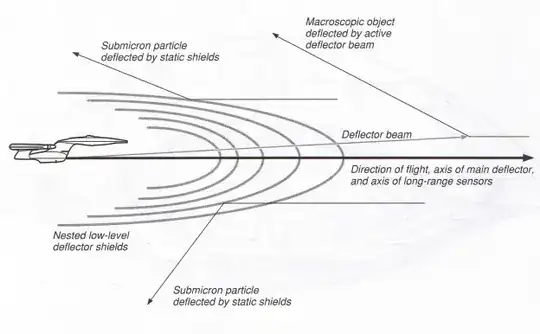
The Navigational Deflector is a series of nested shields that extend a huge distance from the ship and are used to divert small incoming particles from hitting the hull of the ship when the vessel enters warp.

This is opposed to the Ship's main Deflector Shield which is manually operated ("raise shields!") and is used to prevent larger items as well as energy beams and explosions from impacting the hull.

The (fully-canon) TNG Technical Manual offers a diagram of how the system operates:

enter image description here

And the (semi-canon) Voyager Technical Manual clarifies the key differences between the two systems:

enter image description here

Valorum
  • 689,072
  • 162
  • 4,636
  • 4,873
  • Sort of the reverse of a Bussard ramjet. – Xantec Jun 27 '14 at 22:38
  • @Xantec - Yes and no. The deflectors can also be configured to collect interstellar hydrogen as well as push it away; http://i.stack.imgur.com/WPRdv.png – Valorum Jun 27 '14 at 22:43
  • Note that a scene in the second "Year of Hell" episode from Voyager shows that sans the shields, the ship can be very vulnerable to debris like micro-asteroids. – joshbirk Jun 27 '14 at 22:44
  • @joshbirk - Yes, I was trying to work out whether it was worth adding to my answer. In the end, the lack of a good visual put me off; https://www.youtube.com/watch?v=ZYj5l0mGL-Y – Valorum Jun 27 '14 at 22:59
  • They only ever call it the deflector, deflectors or deflector field. Chances are it was the navigational deflector, rather than the shields. – Xantec Jun 28 '14 at 01:04
  • @Richard - I can see that, without the backstory that the ship is so damaged that it can't keep the Nav deflector up the scenes don't show much. Still, one of the better moments in VOY – joshbirk Jun 28 '14 at 06:04
  • In real-world warp theory, all objects are bent out of the way along with spacetime as an object moves through space. – Jason Jul 09 '14 at 00:07