I don't know if a technical manual for TOS or TNG states this, but is there any reference to how much energy is consumed in transporting a person (I expect this would vary from person to person, so base it on an average human being)?
Asked
Active
Viewed 1,297 times
4

Valorum
- 689,072
- 162
- 4,636
- 4,873

Often Right
- 69,181
- 37
- 312
- 542
-
1I suppose you are also limiting this to a transport from or to the transporter pad? I vaguely recall something about a site-to-site transport being double the time/energy. – Zoredache Apr 29 '14 at 02:35
-
@Zoredache: I would appreciate both answers if possible (although based on what you have just said, it seems that if the energy required to transport from pad to pad, that would be sufficient, as the other amount can then be calculated easily) – Often Right Apr 29 '14 at 02:36
-
I guess the downvote is due to the fact, that it seems you're are asking for a realistic scientific answer. Something like "200 MJ". Star Trek tends to avoid those numbers and prefers to invent its own scales (like Cochran). They do this, so that no-one can grab a calculator and go "Ha, Ha! You said 200 MJ - the real number is 4002.8 GJ! Star Trek is so stupid!" That's what I guess - but I'm not the downvoter, so actually I don't know. – Einer Apr 29 '14 at 04:59
-
@Einer thank you for your insight and to clarify, I am more than happy for an answer that uses some obscure Star Trek unit rather than a real world unit – Often Right Apr 29 '14 at 05:14
-
21.21 Jigawatt/seconds - Honestly that's as good of an answer as any. – James Christopher Apr 29 '14 at 07:46
-
The really impressive thing is not the energy consumption, but the energy buffer. We are told the transporter converts its subject from matter to energy, "beams" the energy somewhere else and reconstructs it as matter. From Einstein's E=mc^2, 80 kg of Commander Riker is about 7.2*10^21 joules, or the output of a 1000 MW nuclear power station for about 230,000 years. That energy has to be stored somewhere, at least briefly. Unless the energy consumption is even more mind-boggling, the transporter could sneakily remove a few milligrams of Riker in order to power itself. – Royal Canadian Bandit Apr 29 '14 at 08:51
-
@RoyalCanadianBandit Is that so? I always thought that beaming is more like scanning an object, destroying it and build an identical copy at the target-site. – Einer Apr 29 '14 at 09:04
-
@Einer: IIRC it's supposed to be energy conversion. The alternative is to disassemble Riker into 80 kg of carbon, hydrogen and oxygen plus trace elements, move those atoms somewhere else (how?) and then reassemble him. But if you can teleport matter, why bother disassembling him in the first place? Then again, Star Trek isn't always consistent on these issues. – Royal Canadian Bandit Apr 29 '14 at 09:21
-
@RoyalCanadianBandit What I meant was literally destroying it. Like kill Riker. Not transporting his matter anywhere but merely transporting the information on how a Riker is supposed to be build. I thought that's how Thomas Riker came into existence: He was not properly destroyed. Otherwise: Where did the energy came from to rebuild Will when the energy of Thomas remained on the surface? – Einer Apr 29 '14 at 09:26
-
1@Einar: You still have conservation of matter/energy. Just transmitting the information might work for going to another ship's transporter bay, but for the surface of a planet, where does the material for a new Riker come from? The local environment? I'm pretty sure they can beam into the vacuum of space where there isn't much carbon or water about. Presumably, the surplus energy for Thomas came from "subspace"/an unexpected quantum singularity/spontaneous handwavium. – Royal Canadian Bandit Apr 29 '14 at 09:39
-
The exact amount of energy it would take to produce a living human adult. So, 30 years of caloric intake, plus nine months of intrafetal nutrition, plus two candles, a bucket of rose petals, and 2 hours of passion. Give or take a few depending on the individuals. – Zibbobz Apr 29 '14 at 13:35
-
@einer - The original isn't destroyed, it's broken into individual particles, stored in the "transport buffer" (as energy) then sent as a "matter-stream" along an "anular confinement beam" to the target location where they're reconstituted into their original form. Tom Riker was created when extra energy was added to the beam coming upwards. That energy was then reflected back down to the surface again... – Valorum Apr 29 '14 at 20:52
2 Answers
3
The TNG Technical Manual would suggest that the power requirement to successfully convert a human into a matter-stream is between 32-37 mega-electronvolts (MeV).
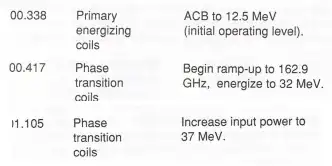
This, however is directly contradicted in Voy: "Eye of the Needle", where Kim needs to boosts transporter power to 37 megajoules (MJ) in order to get the transporter to work correctly. This works out to just over 2.5 MeV.
This disparity seems to be an outright error by the writers.
KIM: Phase transition coils.
(It still won't solidify.)
TORRES: Ramp the coils to thirty seven megajoules.
KIM: Thirty seven megajoules.
The manual also mention that the emergency transporters (and older transporter models) use a great deal less power in their operation but doesn't name a precise figure.
Valorum
- 689,072
- 162
- 4,636
- 4,873
-
6That's a trivially small amount of energy for a spacefaring civilization. It's about what you'd get from burning 1 litre of gasoline. Also, in terms of matter-energy conversion it's on the order of 10^(-15) Rikers. (One femtoriker?) So they really could divert a few atoms of Riker to power the thing. – Royal Canadian Bandit Apr 29 '14 at 20:47
-2
Another take would be to calculate the energy change before and after the entire process. Assume the Enterprise is in low Earth orbit (100 km), beaming a human of 100 kg (a bit overweight but makes the maths easier) to the equator. g is 10 m/s2 (actually about 9.8 on the surface and 9.5 in orbit). GPE=mgh gives an energy change of 108 J, or 100 MJ - pretty similar to the Voyager episode quoted.
But that's not all. At the equator, the human will have a speed of 464 m/s, but in orbit their speed was 7,859 m/s. Even orbiting in the same direction, they'll have to change their speed by over 7000 m/s; using E=(1/2)mv2 gives us about 2.5x10⁹ J, or 2.5 GJ.
Transportation takes roughly 5 seconds, so P=E/t gives an average power of 500 MW, or half a gigawatt - the power of a small city. Maybe 1.21 jigowatts isn't so far off!
Interestingly, it takes about 500 seconds to get to orbit via conventional rocket. The energy change per kilogram is the same, so P=E/t = 5 MW - the power of a small town.
All of this is based on a conservation of energy argument, giving a lower limit. In practice operating the machine (whether transporter or rocket) increases this energy and power.

cosmogoblin
- 80
- 1
-
1This is all well and dandy from an out of universe perspective, but this is 1 only a single example of a possible transport (LEO to surface) and 2. suggest transporting works the same as simply moving matter. – Edlothiad Jan 21 '18 at 18:59
-
@Edlothiad - Yup. Literally nothing about this answer ties in with what we know about how transporting works – Valorum Jan 21 '18 at 19:55