7

The 20th century brought us dozens, if not hundreds of fictional Super Heroes. Prior to the introduction of comic books, who is the first fictional Super Hero recognized by the public as being fictional? The answer to this question should exclude exclude heroes from Greek Mythology, since at one time, those myths were believed to be factual. I'm looking for the earliest example of a publicly known Super Hero character that was recognized by the public as being a fictional character.

Super Hero: a fictional character who has amazing powers (such as, but not limited to, the ability to fly)

b_jonas
  • 33,013
  • 23
  • 141
  • 380
Major Stackings
  • 63,524
  • 56
  • 275
  • 548
  • 2
    If you want to exclude mythological heroes, you may want to revise you question to that impact. "Fictional" as opposed to "mythological." (After all, George Washington fits a lot of the super hero tropes...) – DougM Feb 08 '14 at 01:49
  • 2
    Any powers, or unbelievable powers? Also is costume a must/ secret identity. –  Feb 08 '14 at 03:58
  • Is double exclude like double negation and cancels itself? – DVK-on-Ahch-To Feb 08 '14 at 16:54
  • 1
    Would someone like say Santa Claus fit into what you're looking for? – Monty129 Feb 09 '14 at 14:53

5 Answers5

19

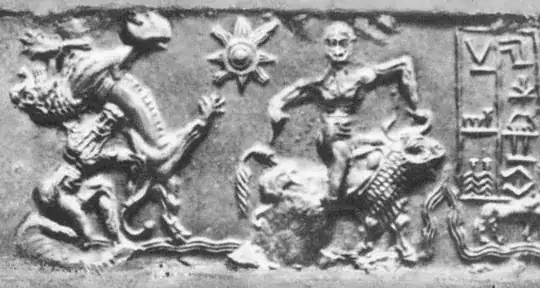
The first wholly fictional super-human character was Enkidu, from the "Epic of Gilgamesh" written in approximately 2150BC.

Whilst King Gilgamesh was almost certainly a real historical figure, Enkidu (described as a "shaggy man" created from clay by the Goddess Aruru) is unmistakeably fictitious.

As a modern-day superhero, Enkidu would actually be quite at home among the Marvel or DC universe given that he possesses super-strength, superhuman aggression, the ability to digest grass, superhuman sexual stamina(!) and the power of oneiromancy.

Enkidu

Valorum
  • 689,072
  • 162
  • 4,636
  • 4,873
  • 2
    @Major I would suspect that Enkidu is not more acceptable an answer than Hercules or other Greek heroes. At the time, all tales were more or less taken for real and part of the religious mythology. The constraint set by the OP most likely impose a rather modern character, from the last few centuries. But what was the meaning of "publicly recognized" two or three centuries ago ? – babou Feb 08 '14 at 23:29
  • 2
    No one could possibly mistake Enkidu for a real life figure. Even the poem makes that clear. – Valorum Feb 08 '14 at 23:47
  • 1
    @babou - if that's the case we should probably be voting to close as "too broad". –  Feb 09 '14 at 15:19
  • @JimmyShelter I fail to see why. The question is "who was the first publicly recognized Super Hero?". The answer to that question is Enkidu. He was publicly recognised, fictitious and possessed of super-human powers. – Valorum Feb 09 '14 at 15:23
  • @Richard - I'm not disputing Enkidu, I totally agree with your answer (I would have actually posted the same but you got there first). But either Enkidu is an acceptable answer (in which case your answer should be accepted because nobody's going to find an earlier work than Gilgamesh), or else the question as currently worded has too broad a scope for what the OP actually wants to know. –  Feb 09 '14 at 15:26
  • 1
    I thought of the Gilgamesh epic too, too late, but I do not know it enough, nor the culture of the time, to have an opinion on whether characters were perceived as fictitious. Another issue is that the role of superhero was characterized differently in others centuries. I am thinking of Sherlock Holmes, Arsène Lupin or Pantagruel (16th century) who were all undoubtedly publicly know and known as fictitious. I am not sure when people ceased to confuse myth and reality (do they today?), and I very naively and incompetently doubt that all thought Enkidu fictitious and none that Hercules was too. – babou Feb 09 '14 at 15:56
  • @JimmyShelter - I like your thinking. Either I'm right or the question gets obliterated. I shall wait on Major Stacking's pleasure :-) – Valorum Feb 09 '14 at 16:05
  • @babou - I think you've identified the problem with this question: we don't have a precise definition of what is meant by "superhero" (and that definition can change between different times and cultures). I'd even favour the "man in a cape who wears his underpants on the outside" approach, just for the sake of nailing down something specific. –  Feb 09 '14 at 16:49
  • @babou - I'm just disappointed that no-one asked me about his superhuman sexual prowess... – Valorum Feb 09 '14 at 19:48
  • @Richard Please, tell us about his superhuman sexual prowess... (I am somewhat fearful) – babou Feb 09 '14 at 20:03
  • @Babou; Shamhat unclutched her bosom, exposed her sex, and he took in her voluptuousness. She was not restrained, but took his energy. She spread out her robe and he lay upon her, she performed for the primitive the task of womankind. His lust groaned over her; for six days and seven nights Enkidu stayed aroused, and had intercourse with the harlot until he was sated with her charms. – Valorum Feb 09 '14 at 20:06
  • @Richard This definitely qualifies this question for Scifi-SE. – babou Feb 09 '14 at 20:29
  • 2
    @babou - Yes. That's nearly double the normal length of time... – Valorum Feb 09 '14 at 21:09
  • Why is Enkidu unmistakeably wholly fictional compared to Gilgamesh, and not a possibly historical companion of the historical King? As far as I can tell, the reason Gilgamesh himself is believed to be historical as opposed to fictional is the discovery of historical artifacts related to other kings mentioned to be his contemporaries in the Epic - we still have no direct historical proof of Gilgamesh himself, is that incorrect? – Shisa Oct 07 '14 at 16:39
  • @Shisa - The wiki link lists a variety of contemporaneous and near-contemporaneous sources that reference Gilgamesh as well as the other kings and nobles mentioned in the text. – Valorum Oct 12 '14 at 18:56
5

Since the question didn't specify supernatural abilities and powers; and since Batman is universally considered a Superhero with merely amazing intellect and technology, there are plenty of 19th century examples.

If you exclude ancient mythology:

  • (1844) Arguably, the Comte of Monte-Cristo may qualify (Batman equivalent - super billionair fighting bad guys, using his wits and sometimes technology, with an alter ego).

  • (1882) Captain Nemo certainly qualifies (he's Jules Verne's even closer equivalent of Batman; supergenius and rich son of Rajas with futuristic technology).

  • (1897) Abraham Van Helsing also may qualify. He even had a supervillain to match (Dracula).

  • (1919) Zorro is also Batman mould.

DVK-on-Ahch-To
  • 342,451
  • 162
  • 1,520
  • 2,066
2

This question does not lend itself to an easily correct answer because during the 1920s and 1930s there was an explosion of larger-than-life heroes whose powers and abilities bordered on the superhuman, including Doc Savage, Man of Bronze, (Doc Savage Magazine #1, Mar. 1933), and Mandrake the Magician (King Features Syndicate, June 11, 1934.)

Adding to this list would be the precursor heroes who preceded Doc Savage, including the Scarlet Pimpernel (1903), Tarzan of the Apes (1912), John Carter of Mars (1911) and Zorro (1919). While they were not superhuman, their feats were extraordinary in comparison to most mortal men.

One of the first superheroic characters of comicdom is the legendary Doctor Occult created by Jerry Siegel and Joe Shuster (More Fun Comics #6, 1935). Yes, the same two writers who would later produce the world's most famous superhero, Superman.
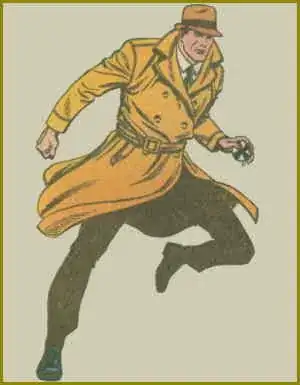
Dr. Occult

The character first appeared in New Fun Comics #6 in 1935. He was a supernatural detective, whose detecting style was very much in the style of Sam Spade, only with supernatural abilities. He was assisted by his butler Jenkins in one adventure. His girlfriend/partner called Rose Psychic appeared in his first adventure and then returned again later in the series.

He also appeared in Centaur Publications' The Comics Magazine #1 under the name "Dr. Mystic". This was the same character because his story, "The Koth and the Seven", began in The Comics Magazine and continued in DC's More Fun Comics #14-17 (issues also designated as vol. 2, #2-5). In this story, he travels to a mystic realm where he flies and wears a cape, making him the first caped comic book superhero. This story also introduced the Seven, a group of mystics who would later be retconned into having raised Richard Occult and Rose Psychic. Doctor Occult made his last original appearance in More Fun Comics #32 in 1938.

He later appeared in Crisis on Infinite Earths (1986), The Books of Magic (1991), Vertigo Visions: Dr. Occult (June 1994), and The Trenchcoat Brigade (1999).
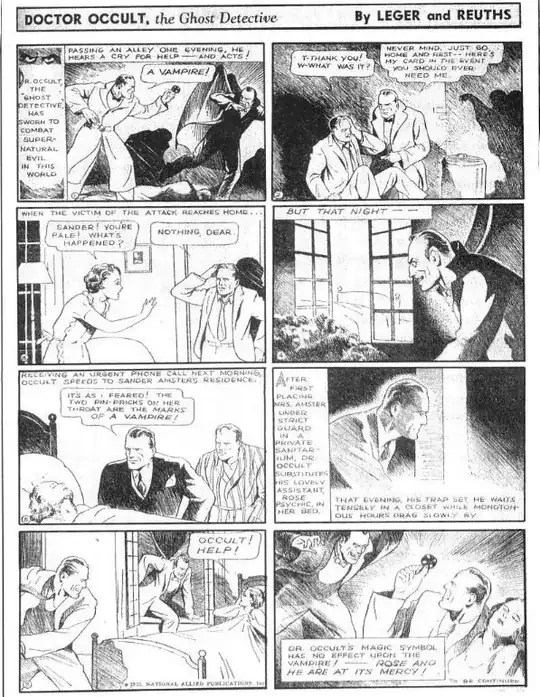
First black and white pages of Dr Occult.

To be fair, Mandrake the Magician appeared in a newspaper serial in 1934. But I started with the first comic appearance.

Mandrake the Magician is a syndicated newspaper comic strip, created by Lee Falk (before he created The Phantom). Its publication began June 11, 1934. Phil Davis soon took over as the strip's illustrator, while Falk continued to script. The strip is distributed by King Features Syndicate.
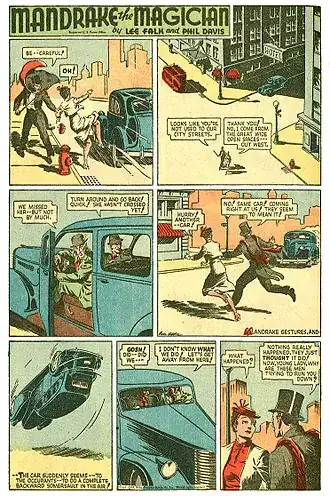
enter image description here

Thaddeus Howze
  • 212,750
  • 23
  • 708
  • 994
  • There are significantly earlier examples of popular superheroes – DVK-on-Ahch-To Feb 08 '14 at 16:59
  • Superhero is so loosely defined in this example as to be meaningless. It could be ANY legendary being who was not considered a god. That means Castor, Pollux, Achilles, and even Odysseus should be able to apply. – Thaddeus Howze Feb 08 '14 at 21:16
  • The question specifically excludes them: "The answer to this question should exclude exclude heroes from Greek Mythology, since at one time, those myths were believed to be factual". Whereas my earlier examples deserve the title at least as much as Batman does. – DVK-on-Ahch-To Feb 08 '14 at 21:41
2

I will add some more possibles to the list although they are not more arguably any more superhero then some of the other ones on this list prior to Superman, from whom I guess, we get the term.

  1. Radio heroes, who did not appear in print necessarily, these include the Lone Ranger (and Tanto) and The Shadow, who when played by Alec Baldwin was portrayed as being as very much of a superhero. From the Wikipedia page on the Shadow:

Gibson initially fashioned the character as a man with villainous characteristics, who used them to battle crime, and in this was archetypal of the superhero, complete with a stylized imagery, a stylized name, sidekicks, supervillains, and a secret identity.

They go on to say that they had to give the Shadow a power because of the shortness of time of the radio broadcast, which was to be really good at hiding:

In the radio drama, which debuted in 1930, The Shadow was an invisible avenger who had learned, while "traveling through East Asia," "the mysterious power to cloud men's minds, so they could not see him." This feature of the character was born out of necessity: time constraints of 1930s radio made it difficult to explain to listeners where The Shadow was hiding and how he was remaining concealed. Thus, the character was given the power to escape human sight. Voice effects were added to suggest The Shadow's seeming omnipresence. In order to explain this power, The Shadow was described as a master of hypnotism, as explicitly stated in several radio episodes.

  1. Tall tales heroes: Pall Bunyan the lumberjack, John Henry the railway engineer who could compete singlehandedly with a machine, Pecos Bill...etc which were early 1900's or before.
1

The earliest reference I could find was to "Spring-Heeled Jack", a batman-esque character based on the urban legend from London. The character debuted in 1867, but The Count of Monte Cristo might qualify also (and he came 23 years earlier). Both characters wore a disguise and fought villainy, but whereas the Count only appeared in a single novel, Jack had a more episodic, comic-book feel via the penny dreadfuls bought at the store.

Ultimately, the answer will rely on your definition of "superhero". The first Batman-type character would be one of these two. The first one to introduce a supernatural or "powers" element would be The Shadow (introduced via radio in 1930). The first full-on superhero would be Superman in 1938.

Omegacron
  • 63,111
  • 18
  • 213
  • 388