60

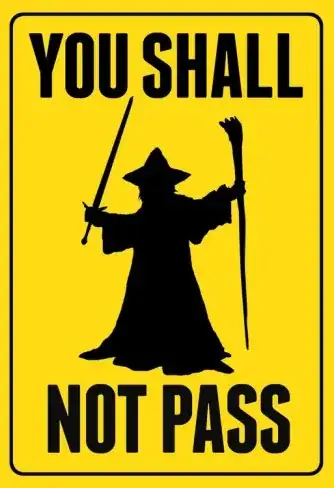
One of the most memorable lines from the Lord of the Rings movies is when Gandalf stands before the Balrog and says "you cannot pass". It's commonly quoted as "you shall not pass" because he says that afterwards.

A satirical road sign that says YOU SHALL NOT PASS with a picture of Gandalf.

He doesn't actually say that in the book.

In The Fellowship of the Ring, Gandalf blocks the Balrog saying:

You cannot pass....I am a servant of the Secret Fire, wielder of the flame of Anor. You cannot pass. The dark fire will not avail you, flame of Udûn. Go back to the Shadow! You cannot pass.

What is the reason for the shift?

Mithical
  • 38,898
  • 17
  • 178
  • 229
3nafish
  • 1,521
  • 1
  • 10
  • 21
  • 37
    I think the answer to this probably could be demonstrated by having someone with a good Gandalf voice say equally forcefully, "You cannot pass" and "You shall not pass" - the first seems really weak and lame compared to the latter. I imagine this was a theatrical improvement to make the language sound cooler. – enderland May 07 '13 at 22:24
  • 17
    Likewise, Beam me up, Scotty has never appeared in any Star Trek series or movie. – Izkata May 07 '13 at 23:11
  • 3
    And Morpheus never actually says, "What if I told you..." – phantom42 May 07 '13 at 23:29
  • @phantom42 is that true?? I can almost hear him saying it in my head...god I spend too much time on Reddit haha – im so confused May 08 '13 at 14:59
  • 2
  • 9
    Maybe it is a paraphrase on "None Shall Pass" said by the Black Knight in Monty Python's Holy Grail – Zottek May 23 '13 at 11:39
  • 11
    @enderland it's the difference between telling a child 'you cannot fly. flapping your arms up and down will not avail you' and 'you shall not sit on the floor and sulk'. In the book Gandalf is asserting that the Balrog has no power to pass if the light Gandalf serves prevent him. In movies, it's all about conflict and risk between characters. – Pete Kirkham Jul 04 '14 at 23:27
  • 4
    @PeteKirkham: you're bringing up an excellent point there. I think that's precisely the difference between ‘you cannot pass’ (not a command; Gandalf himself isn't really in the position to give another Maia commands) and Aragorn's order to Beregond ‘you shall be [the White Company's] captain’. – leftaroundabout Oct 24 '14 at 00:42
  • 2
    In that context it's interesting how Gandalf talks to defeated Saruman. He gives direct orders at that point (‘Come back, Saruman!’, ‘I cast you from the order’, ‘Go!’), probably because he has explicitly been "promoted" above Saruman by then. Still he again uses that more indirect "you cannot" mode for what I consider the most impressive line: ‘Saruman, your staff is broken.’ – leftaroundabout Oct 24 '14 at 00:56
  • How do you know he didn't just screw up the line and everyone liked the mistake more? – Kai Qing Nov 03 '16 at 20:28
  • He does actually say "you shall not pass" at the end of his speech, i.e. the second "you cannot pass" is changed to "you shall not pass". I'm not sure why this is. Perhaps they felt it sounded more defiant...prescriptive rather than descriptive.

    It took me several viewings to realize they'd made the change. If you're expecting to hear "you cannot pass" twice, that's probably what you'll hear.

    – Kaitain Feb 09 '19 at 21:48

4 Answers4

62

J.R.R. Tolkien was a noted prescriptivist, regarding Shakespearean neologisms as a bastardization of English and attempting to prescribe specific rules for the usage of his own invented languages.

The guide to prescriptivist English, The Elements of Style says:

Shall, Will. In formal writing, the future tense requires shall for the first person, will for the second and third. The formula to express the speaker's belief regarding a future action or state is I shall; I will expresses determination or consent. A swimmer in distress cries, "I shall drown; no one will save me!" A suicide puts it the other way: "I will drown; no one shall save me!"

Thus, saying "you shall not pass" would be saying "you do not want to pass" which is false.* That Balrog really wanted to pass.

*...unless we take the alternate explanation that Gandalf was using some sort of Jedi mind trick.

The modern film-makers were less prescriptivistic than Tolkien so they had no objection to using shall in the more modern manner of it being an archaic-sounding command, similar to the modern must. Thus, we get the popular saying "you shall not pass!" even though it didn't exist in the original text.

3nafish
  • 1,521
  • 1
  • 10
  • 21
  • 2
    I'm not so sure I agree with your interpretation of the quoted part. It could easily mean Gandalf was speaking of his own belief, rather than his intention. Kind of like Yoda's "there is no 'try'". – Izkata May 07 '13 at 23:15
  • 1
    @Izkata: I agree as far as “the speaker's belief regarding a future action or state” goes, but the quote does also say that in, formal writing, “shall” is just for the first-person (i.e. “I shall” is fine, but “you shall” is not). Of course, that’s formal writing. Gandalf was speaking. – Paul D. Waite May 07 '13 at 23:31
  • @PaulD.Waite Yes, but Tolkien was writing....and obsessively prescriptivistic in his word choice. – 3nafish May 07 '13 at 23:34
  • @Izkata The prescriptivist rule is that "I will" means "I want to"; "I shall" means "I am going to." For other people (you/he/she/they), the rule's reversed: "you will" means "you are going to"; "you shall" means "you want to." – 3nafish May 07 '13 at 23:38
  • 18
    "Thus, saying "you shall not pass" would be saying "you do not want to pass"" - what!? That is not what that definition is saying at all. According to your quoted passage, the phrase should technically be "You will not pass." It has absolutely nothing to do with the desire of the people he's speaking to... – BlueRaja - Danny Pflughoeft May 08 '13 at 00:08
  • 2
    @3nafish But that's opposite the suicider example - you're saying that he's stating "No one wants to save me", while the suicider's intent is "I command no one to save me" - using "shall". Sounds like Gandalf's usage to me. – Izkata May 08 '13 at 00:09
  • @Izkata No it's not. Read it again. (Keep in mind that the rule for 'I/we' is backwards from the rule for any other person. The drowning person says "I am going to drown; no one is going to save me"; the suicide says "I want to drown; no one wants to save me.") – 3nafish May 08 '13 at 00:15
  • 2
    @3nafish ...Perhaps you need to re-read the definition of "suicide"? A person committing suicide would be commanding others not to save them. Nothing else makes sense for that half of the quote. – Izkata May 08 '13 at 00:21
  • @Izkata Not unless they were an uncommonly frantic suicide. If they were depressed instead of frantic (which seems the more common case) they would be killing themselves because they thought no one else cared about them. They would want to drown and would believe that no one wanted to save them. – 3nafish May 08 '13 at 00:25
  • 4
    Hang on a minute: Tolkien used try and, and changed it back when his editor tried to correct it to try to. I challenge your assertion that he was always a prescriptivist. He had an excellent ear for natural language. – TRiG May 08 '13 at 01:00
  • 26
    I think you're misreading Strunk & White, but in any case they're too American to be a very good guide to Tolkien's language. The OED -- which he actually worked on -- notes that "shall" "[i]n the second and third persons, express[es] the speaker's determination to bring about (or, with negative, to prevent) some action, event, or state of things in the future", which is exactly the meaning of Gandalf's phrase. Certainly Tolkien didn't write it that way, but I have a hard time believing that he couldn't have, at least not for the reasons you're suggesting. – Micah May 08 '13 at 01:04
  • 1
    (Note also that the OED has cites for this particular definition of "shall" going back as far as the 10th century. I don't know where you're getting the idea that it's not a legitimate archaic usage.) – Micah May 08 '13 at 01:30
  • 13
    In fact, Tolkien uses "you shall" as a command. Do a Google Books search for "you shall" in LotR and you come up with things like, "But the King said: 'So it must be, for you are appointed to the White Company, the Guard of Faramir, Prince of Ithilien, and you shall be its captain and dwell in Emyn Arnen in honour and peace...'" Not to mention that he really likes the construction "you shall [do X], if you will/desire", which would be tautologous nonsense under your interpretation. – Micah May 08 '13 at 01:47
  • 1
    @Micah Good call. You may be right that the usage in The Elements of Style is strictly American. I didn't find any usage in the OED corresponding with the example from the Strunk and White quotation, although the American Heritage Dictionary says "The use of will in the first person and of shall in the second and third may express determination, promise, obligation, or permission, depending on the context." I'm going to accept mh01's answer because it's highly insightful, and because mine may be making some erroneous assumptions about a British author following an American grammar. – 3nafish May 08 '13 at 01:48
  • 1
    Aargh, my S&W is not here. But you're only quoting the 1st person usage, the others (2nd and 3rd) are inverted, as I'm pretty sure he states outright. – sq33G May 08 '13 at 09:33
  • 7
    I always thought S&W was Stylistic Plutonium: highly poisonous even in small doses. Many of its assertions are Not Even Wrong, and they fail to follow their own advice within the book itself. (see for instance: http://languagelog.ldc.upenn.edu/nll/?p=1369 ). TLDNR; Don't pin the blame for S&W on Americans – horatio May 08 '13 at 15:17
  • Thus, saying "you shall not pass" would be saying "you do not want to pass" - that is the opposite of what The Elements of Style is saying there. – Misha R Jan 24 '18 at 04:20
37

It was most likely a conflation with “they shall not pass”, which the Wikipedia article notes:

was most famously used during the Battle of Verdun in World War I by French General Robert Nivelle. It appears on propaganda posters, such as that by Maurice Neumont after the Second Battle of the Marne, which was later adopted on uniform badges by units manning the Maginot Line. Later during the war, it also was used by Romanian soldiers during the Battle of Mărășești.

This opens the possibility that Tolkien himself was quite well aware of that form of the phrase and may have even been inspired by it.

It was also used during the Spanish Civil War and has since been used by various anti-fascist groups worldwide, as well as by the Sandinistas (according to the same Wikipedia article).

The timeline of it's usage, especially by the Sandinistas, makes it most likely that the conflation comes from the 60s counter-cultural movements, when their usage of it would have been well known and when popularity of LotR was really starting to take off (particularly in the US). Of course, someone who was around at the time would be needed to confirm that.
törzsmókus
  • 105
  • 3
  • Indeed “they shall not pass” was an anti-fascist slogan at the London battle of Cable Street, which Tolkien would have been familiar with. – Graham Lee Jul 06 '21 at 16:11
  • I think this does not answer the question. The question is "why did the movie change Galdalf's lines?", because Galdalf never says "you shall not pass" in the books --- the OP explicitly says so. Therefore, whether Tolkien was familiar or not with those anti-fascist slogans is irrelevant. They would only matter if Peter Jackson and his team were influenced by them in 2000... which I personally see rather unlikely. – sergut Oct 28 '23 at 19:25
15

My personal opinion, Ian McKellen has such a great theatrical voice that the line was re-written for him. He was able to set a mood and tone with that particular line that makes a huge impact on the scene. He delivers the line so well. It's amazing how a well trained Shakespearean actor can make a scene such as that one.

Kim
  • 151
  • 3
  • 10
    Yeah, if it was Nicholas Cage playing Gandalf they had probably changed the line to "Go away!" – Junuxx May 27 '13 at 15:56
  • 4
    As well researched and well reasoned as the other answers are, this seems to be the most likely actual case. I highly doubt Jackson was niggling that much...though I appreciate his use of the largely on tact quote from the book. – Matt Jul 05 '14 at 14:25
  • 3
    Well, you are the closest to the right answer. Ian McKellen actually changed it himself by mistake or by preference : https://youtu.be/ZWY7Fndhhqw?t=1920 ("I got it wrong") – Tristan Dec 29 '19 at 23:42
  • 1
    McKellen himself says it was a flubbed line. https://www.youtube.com/watch?v=Cjn6uwHryes – JohnHunt Aug 24 '22 at 20:40
  • 1
    +1 Tristan's comment (Dec 29, 2019 at 23:42) should be an answer in itself, and the accepted one. Ian McKellen got the line wrong but it looked so good on camera that Peter Jackson decided to keep it as-is ("and now I am stuck with it", says McKellen). – sergut Oct 28 '23 at 19:59
-2

I shall return. Douglas MacArthur

I'll be back. The Terminator

Which sounds more determined? "I shall return." It meant no obstacle was going to stop General MacArthur's return to the Philippines.

"You shall not pass" probably sounded determined more than "You cannot pass."

Harold F
  • 161
  • 1
  • 4
  • 1
    This is an unlikely answer. If something sounded better or more determined, it would have been Tolkien's choice, who was notoriously fussy about language. (As an aside, this is just unsupported speculation, not a proper answer!). – Andres F. Dec 26 '23 at 13:03