10

Possible Duplicate:
Why are there so few robots in Star Trek?

I would say that the relative lack of onscreen robots had to do with show budgets, but even some of the cheesiest science fiction shows have depicted them quite commonly (Lost in Space, Doctor Who, etc). And clearly in later years Star Trek would be able to afford even animatronic props or decent rendered footage of them. So what gives? Did I just miss these episodes? I'm fairly certain that I've seen all of TOS and TNG (and the movies), so I expect that if there are such they are DS9, Voyager, or Enterprise.

Can anyone point me in the right direction?

John O
  • 17,296
  • 10
  • 77
  • 127
  • Uhm ... do the Borg count? – bitmask Oct 05 '12 at 21:02
  • @bitmask No. Even if you figure that they are robotic in nature, a humanoid robot is properly an "android". The androids that Mudd had with him in TOS aren't non-android robots. – John O Oct 05 '12 at 21:22
  • @JohnO: Well, an android is a robot that is designed to resemble humans. If you grant that the Borg are robots in the broadest sense, they are no androids as they are not meant (in-universe) to simulate humanoids. They just happen to make use of humanoids as raw materials and thus look a bit like humanoid biological organisms. – bitmask Oct 05 '12 at 22:02
  • 1
    Does the ships computer count? I mean, it has full automatic control of piloting the ship and running various systems. AI is not a requirement for a "robot". – ewanm89 Oct 05 '12 at 23:57

4 Answers4

13

This question might be closed as a dup, but here goes:

Robot: A robot is a machine that automatically performs a set of usually pre-programmed tasks and has limited autonomy.

TOS:

TNG:

I say the Enterprise because it decided to create Moriarty as a sentient holo program. It also probably does a lot of things on its own.

Additionally I will say the that Enterprise-D (and really all starships and space stations from TNG and onward) acted as butlers. Via voice command you could request food and drink, entertainment, call up friends, and control the conditions of your quarters.

DS9:

On Runabouts, they can perform autonomous tasks, such as take evasive manuevers and return fire.

Voyager:

There may be more examples in Voyager, I've never watched more than a handful of episodes.

Enterprise:

Moves:

Jack B Nimble
  • 114,812
  • 63
  • 435
  • 724
  • Your definition mentions machines. Is Moriarty a machine? – Junuxx Oct 06 '12 at 01:07
  • 2
    @Junuxx: No, he's software. – jwodder Oct 06 '12 at 01:19
  • I would offer that Moriarty is tangible, he can touch and be touched. This means he is literally substantial. The matter he is composed of may be exotic and quite mutable, but it's still matter (in the form of exotic particles). Still, being humanoid that would mean he was an android. One might argue that he is an avatar also (or instead). – John O Oct 06 '12 at 01:30
  • @Junuxx I think the Enterprise has some robot qualities, but I would classify Moriarty and the Doctor as androids. – Jack B Nimble Oct 06 '12 at 01:58
  • What about that warhead in Voyager? It was intelligent and had subspace propulsion (so it was mobile, in a sense). I don't remember the episode, though. – bitmask Oct 06 '12 at 16:13
  • 1
    How silly of me, the episode was actually called Warhead. – bitmask Oct 06 '12 at 16:14
  • Moriarty was a hologram, a being who was essentially just light contained within a holomatrix. He had no material form and was pretty much just a program given a 3 dimensional image and the capacity to touch other holographic objects (much like how a sprite in a game can touch other elements in the game). A robot, as a machine, requires a material presence which is made of matter. Arguing that the Doctor, Moriarty, or any other hologram is an android is like saying that any projection of light could be counted as being the physical objects they represent. – Robo Stalin Jul 09 '13 at 12:26
  • Also, it might be important to note that Moriarty, like all holograms EXCEPT for the Doctor. Had their existence limited to anyplace where there was a holographic projector. They could not exist independent of their light source. Even the one exception, the Doctor and his mobile emitter, still operated under the principle that without the projection device, the Doctor would simply not exist (at least not as a perceptible being and instead as a program in storage). – Robo Stalin Jul 09 '13 at 12:32
7

Yes, there were. The first example to come to mind are the Exocomps seen in TNG The Quality of Life (6x09).

Exocomp

Xantec
  • 61,649
  • 46
  • 259
  • 438
3

I suppose it depends on how you define "robot".

I'd say that Flint's M-4 from the TOS episode "Requiem for Methuselah" and Nomad from "The Changeling" both qualify (even though Nomad was primarily a space probe).

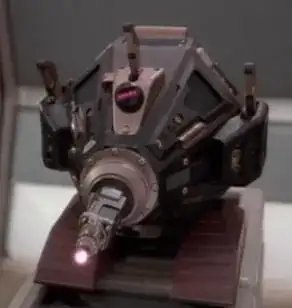
M-4: M-4 Nomad: Nomad

(Note that both props use some of the same pieces; I presume there's no good in-universe explanation for that. Nomad's "head" was also used in the Romulan Cloaking device in "The Enterprise Incident".)

More examples: V'Ger (Voyager 6) from Star Trek: The Motion Picture, and a brief appearance of the Mars Pathfinder Sojourner rover in the opening credits of Star Trek: Enterprise. (That last one is iffy.)

I don't recall seeing any robot-like machines that move on the ground, either by walking or using wheels, as most robots in other shows usually do.

Keith Thompson
  • 8,527
  • 4
  • 49
  • 59
  • I had forgotten about these, but now that you mention it both must be robots by any decent definition. Just never connected the dots before now I guess. – John O Oct 05 '12 at 21:23
  • 1
    Don't forget "The Doomsday Machine". Spock: "[The Constellation] was attacked by what appears to be essentially a robot; an automated weapon of immense size and power." – Beta Oct 05 '12 at 23:52
3

Two more are Satan's Robot on Voyager's holodeck in Night and "Automated personnel unit 3947" together with a whole robot race from Voyager's Prototype.

APU 3947:

enter image description here

Satan's Robot:

enter image description here

Junuxx
  • 2,675
  • 21
  • 29