10

The 2009 Star Trek movie and its pending sequels are based on the concept of parallel realities introduced in the season 7 Next Generation episode "Parallels," laying out that anything that could happen has happened in a parallel universe. The Enterprise and its crew from the most recent movie are part of a parallel reality that was created when Nero and Spock came back through the black hole created by red matter in an attempt to stem the destruction caused by a supernova. For clarification, this crew will be referred to as Chris Pine's and the older movies as Shatner's.

In the movie Star Trek IV: The Voyage Home, a probe shows up in 2286 at Earth looking for whales that had disappeared decades before. Shatner's crew is faced with travelling back in time to try and retrieve two humpback whales in order to stop the cylindrical probe from destroying Earth. They do this using a Klingon Bird-of-Prey that was stolen in the previous movie, going back to 1986 to find the whales.

I think it's safe to assume that in Pine's reality, the probe will probably make an appearance again, since the destruction of whales probably wouldn't change. So Pine's crew will also be faced with the dilemma of travelling back to find humpbacks (although probably without using a Klingon ship).

If Pine's crew also goes back to the same instant in 1986 as Shatner's crew to find whales (which seems highly improbable given that hitting the same time period as Shatner would be ridiculous), would they run into Shatner's crew or would it create another parallel reality stemming from 1986? If it created another reality, that seems like some kind of backwards causality since the event that would be causing the new stem wouldn't be the instant before the ships arrived but an event in the future. Would time travel trump the parallel universe and both Kirks would be there at the same time?

ThePopMachine
  • 59,504
  • 42
  • 247
  • 519
SocioMatt
  • 1,730
  • 1
  • 16
  • 25

5 Answers5

8

It depends on how far the Trek 2009 team go back in time.

  • The TOS timeline had a time-travel event to the 1900s
  • The 2009 Movie causes a split in the timeline in the 2100s.
    • Therefore, the 2009 Movie and TOS share the timeline prior to the 2100s.
  • Therefore, the TOS team is a part of the 2009 Movie's timeline, back in the 1900s.

We can agree up to this point, right?

There are 6 possible ways to arrive in the past, with 3 possible outcomes:

Case 1:

TOS:      |--------|
2009:               |-----|

In this case, they do not encounter each other (obviously), and 2009 causes a timeline split of its own, such that their appearance in the past does not happen in the TOS timeline.

Case 2:

TOS:      |-----------|
2009:        |------------|

In this case, they have the potential for an encounter. As established above, the TOS crew is in the 2009's history. However, this would cause a timeline split such that the TOS crew would be unable to return to their own timeline, because the 2009 crew were not recorded in the TOS history.

Case 3:

TOS:      |-----------|
2009: |-------------------|

The 2009 crew cause a timeline divergence before the TOS crew arrive. While the times overlap, they have no chance of meeting each other. And because this causes the timelines to diverge, the TOS crew no longer return to the 2009 timeline's occurrence during this event (If they go further back than when 2009 arrived, that turns in to Case 1 or 2, because TOS's history was written already when 2009 happens). The 2009 crew have accidentally rewritten their history such that the TOS crew are no longer in it.

Case 4:

TOS:  |-------------------|
2009:     |-----------|

The end result is the same as in Case 2, because the timeline divergence would happen when they arrive, not when they leave.

Case 5:

TOS:      |-----------|
2009: |-----------|

The end result is the same as in Case 3, because of when the timeline divergence happens. Neither team can meet the other.

Case 6:

TOS:         |--------|
2009: |-----|

The end result is the same as in Case 3, because of when the timeline divergence happens.

However, the timeline in Star Trek seems to be pretty elastic. With regards to Case 2, if the 2009 team has not caused the timeline to diverge too much, the TOS team's timeline may get modified slightly instead of causing a divergence into the 2009 team's timeline. (Which does have precedent) This however would cause the question of how the 2009 team will return home.

Izkata
  • 60,194
  • 14
  • 205
  • 303
5

I'm not sure if this is actually a parallel reality or a new timeline. The difference between the two I must admit goes over my head right now. However there is two main differences in the Pine Line (I'm coining that phrase) one events have been changed drastically; technology is more advanced and with the destruction of Vulcan certain elements of stories will not play out the same. That being said you are right the Entity that speaks whale is most likely sure to return which brings me to the second point. Old Spock is there and knows all about this.

I can't find a date for the whales extinction but if they are still around I'm sure he will make a priority of saving them. If they are not he knows advanced technology and will be able to give ample warning to the Pine Line to prepare and maybe even bring back the whales from the past. After all the Earth was under attack last time which is why the Shatner Line was saved by the Enterprise crew who were on exile on the planet Vulcan which is no more.

One of the advantages of the Pine Line is that it actually gets to retell the story without dismissing the original fan loved series or movies. However many things are changed and Nimoy Spock can be sort of a McGuffin used to fix or explain away serious consistences such as what will happen when the whales come.

Kevin Howell
  • 11,634
  • 13
  • 54
  • 81
  • I believe, for Multiverses that have diverging timelines, each timeline is a parallel universe. There are other theorized multiverse structures that do not have diverging timelines, but may have parallelisms - similarities - between parallel universes. See the Keith Laumer novel Worlds of the Imperium. – Donald.McLean May 08 '12 at 14:58
  • @Donald.McLean: Is it possible to structure an answer around the concept that the past is cloned when a reality diverges? That might help clarify the whole thing, and that seems like an answer to the OP. – SocioMatt May 08 '12 at 15:05
  • @Donald.McLean I thought the difference between a parallel universe and a divergent timeline is that in a parallel the coin that is flipped lands on heads instead of tails as it would in ours. However a timeline is affected by a change in the timeline from a future or past point. But here is where I get fuzzy on the distinction because a divergent timeline is basically a parallel universe as well. Especially in the Pine Line as Nimoy Spock is not erased from existence as an anomaly but is essentially a parallel Spock. – Kevin Howell May 08 '12 at 15:24
  • @KevinHowell: All of this stuff is conjectural and the language constructs for describing it are manufactured at need. So, many of the concepts are not fully fleshed out and term usage can be horribly inconsistent from place to place. Generally speaking, if the multiverse theory in place has divergent timelines then every instance of time travel would have to create a divergent timeline (or many of them). The opposite case would be parallel universes with self contained timelines where time travel would affect the events of that timeline and divergence would never occur. – Donald.McLean May 08 '12 at 15:34
  • The idea behind ST IV was that the whales were long gone, I'm guessing as part of 20th/21st century pollution and hunting. So if Old Spock told Pine's Kirk to get some whales, that means Pine's Kirk would have to go back in time. I'm sure Spock has figured it out and told Pine to go back to 1988, just to make sure. – MPelletier May 08 '12 at 15:49
  • @MPelletier Yeah that's exactly my point Nimoy Spock would be able to figure out what adventures would happen despite the changes in Pine Line and set about making sure that they happened or were prepared for it and that there would be no conflicts such as Pine Kirk and Shatner Kirk trying to take the same whale. I know the question that's asked is could they show up to take the same whale but really since Nimoy Spock is there they would never have to. – Kevin Howell May 08 '12 at 17:24
  • Up-voted for coining Pine Line, in addition to having a great answer. – Sonny Ordell Jan 26 '15 at 19:21
5

Since the point of diversion is in the 23rd century, it makes sense (in Star Trek physics) that any point before would be in the same universe/timeline/reality.

There are other points where various characters have travelled back in time, where the two "timelines" are the same and thus Pine's Kirk and Shatner's Kirk could meet:

Then again, with time travel, one could meet oneself any number of times. Kirk et al. have travelled through time so much they could have met themselves. As the same actors, even!

MPelletier
  • 11,240
  • 6
  • 44
  • 67
1

Parallel realities would have their own timelines. Going back in time in Pine's reality would still be in a different reality from going back in time in Shatner's reality, even if both destination times were the "same" year: 1986. It would be the same year in different parallel realities, which isn't really the same year at all.

  • 1
    They share the same past prior to the point when Nero and Spock showed up in Pine's newly created reality. 1986 would be the same for both Shatner and Pine because it would not have been impacted by the events starting in 2233. – SocioMatt May 08 '12 at 14:12
  • If two realities share the same past, they aren't really parallel then, are they? – FishBasketGordo May 08 '12 at 14:14
  • It works like a tree. 1986 would be part of the trunk, but the different futures would be branches. The realities only start being parallel at the point where a different event occurs. In the Star Trek explanation, the past could be common for two different realities based on when the split happened. I think it's safe to say 1986 was before 2233. – SocioMatt May 08 '12 at 14:17
  • @SocioMatt: Has the exact mechanism behind parallel reality formation actually been explained somewhere? This seems more like your own personal conjecture. Sure it is one possible explanation, but hardly the only one or even the most widely accepted one. In fact, I've been reading SF for a while now and have never heard of a tree theory for parallel realities where the branches actually share the same past. – Donald.McLean May 08 '12 at 14:36
  • Where is there canon Star Trek commentary that two parallel timelines that share a common point in the past must share the same past timeline? – GetSet May 08 '12 at 14:36
  • @Donald.McLean: So getting into crazy theoretics, if new realities are created whenever there is a choice, one for each outcome, then the past wouldn't be effected. For example, if I have a choice between a sandwich or soup for lunch, and each outcome leads to another reality, then what I did five minutes ago would not be effected by the choice of a sandwich or soup. Future decisions don't change the past except where time travel is involved. Does that seem logical? – SocioMatt May 08 '12 at 14:40
  • 2
    @SocioMatt: I'm not arguing that the past would be unaffected by the split. The question is - do the branches share a common past, as you have proposed, or do they get a cloned past that is identical in appearance, but not the same. – Donald.McLean May 08 '12 at 14:43
  • 1
    @Donald.McLean: That's an interesting idea. That has probably not been laid out explicitly anywhere. – SocioMatt May 08 '12 at 14:45
  • Or an alternate way to think of it is two parallel train tracks. Jumping from one to the other and then going backwards on the second track doesn't put you on your original track. – Xantec May 08 '12 at 18:14
  • Back to SocioMatt's very first comment, if Nero and Spock showing up created an alternate/parallel reality, then Pine going back in time to 1986 would also create another reality, would it not? Whether you think of new realities as different branches of a tree or parallel train tracks, the time lines for each are still unique from one another. – FishBasketGordo May 08 '12 at 18:18
  • @FishBasketGordo You're right. If going back in time created a new reality when Spock and Nero did it, every time anybody time travelled it would create a new reality. So then how do you ever change the future of your reality? – SocioMatt May 08 '12 at 18:31
  • 1
    Furthermore, if you go back in time and create a new reality, how do you get back to your original timeline at all? It would seem that the new reality is a copy of your original with everything the same prior to your arrival, and when you "return", you're simply moving forward in the new reality. The future of the new reality would bear a great resemblance to your original reality, excepting the details that you changed when you went "back". It's time travel! Does it ever make complete sense? :) – FishBasketGordo May 08 '12 at 18:42
  • @FishBasketGordo: I suppose the conclusion here would be that the creation of a parallel reality trumps time travel. – SocioMatt May 08 '12 at 18:56
  • Non-canonical of course, but who says that time travel isn't actually travelling between parallel universes which are initially identically, and just happen to be time offset by tiny amounts. – Andy May 14 '22 at 23:56
1

This interview with Robert Orci, co-writer of the 2009 movie, muddies the waters a bit with regards to the question about STIV (I came across it when Richard linked to it in a comment on this similar question). First Orci talks about how the 2009 movie uses the theory of multiple parallel timelines, saying that he thinks this is the most realistic version of time travel in terms of real-world physics (he follows many physicists in favoring the many-worlds interpretation of quantum mechanics), and also justifying the use of this theory in the Trek universe by pointing to the TNG episode "Parallels". Then he's asked about past episodes where it appears that "new timelines overwrite previous timelines" rather than creating parallel timelines, like "City on the Edge of Forever" and "Yesterday's Enterprise", and in his response he brings up STIV:

We have to deal with it, with the fact that Star Trek episodes that don’t conform to our theory of it, also do not conform to the latest greatest, most highly tested scientific theory in human history. So I would default that it is the science that counts. And say in the case of "Star Trek IV," it could go either way. They cross over to a parallel universe and grab some whales and bring them back and save their own universe.

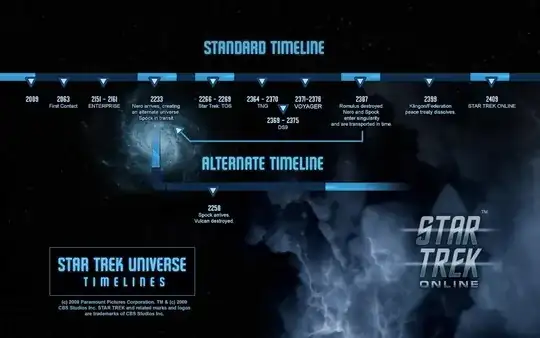
It seems like what he's suggesting is that in STIV, Kirk & co. start off in the 2286 of what we might call the "Prime" timeline, then when they travel back to 1986, they end up in a parallel timeline that diverges from the 1986 of the Prime timeline, call this the "Whalenapped" timeline. And then he's saying that somehow, when they travel forward in time to 2286 with the whales and Gillian Taylor in tow, they end up back in the 2286 of the Prime timeline, not the 2286 of the Whalenapped timeline. Once they had returned to the 2286 of the Prime timeline, if they were to check the historical records in 2286 this theory would imply they'd find that Gillian Taylor had still been around in 1987 and onwards, even though the Gillian Taylor of the Whalenapped timeline had disappeared in 1986. In other words, this theory is saying that the 1986 of the Prime timeline did not include Kirk & co. appearing from the future, and this would also imply that according to Orci's theory, if the timeline of the 2009 movie only diverged from the Prime timeline in 2233 when Nero arrived (according to the nice chart from Star Trek Online posted below by Keen in this answer), then the 1986 of the new timeline created by Nero's arrival shouldn't include Kirk & co. appearing from the future.

enter image description here

Hypnosifl
  • 56,783
  • 5
  • 191
  • 244