25

Where in known fiction entailing magic—including written and oral forms predating the novel—did the concept of a magical sword first appear? Answers should clearly distinguish between any magic of the wielder and the magic of the sword itself.

Clarification: In response to a point made in chat by @Axelrod, I am using the "history-of" tag because I am interested in the history of the idea or trope of the magic sword, not in any history of actual magic swords.

Lexible
  • 21,386
  • 5
  • 72
  • 134
  • 1
    Looks like there's going to be a lengthy discussion for this one, so I set up a chatroom for it. Please continue to discuss the question's scope and what sort of answers are acceptable there instead. – Rand al'Thor May 05 '16 at 21:15
  • 8
    If you hadn't specifically asked for a sword, I would've suggested Sharur, the talking mace of the ancient Sumerian god-hero Ninurta. Although, looking at the original Sumerian (which, yes, I can read a little), the various words for weapons used in it are so vague and poorly understood that it's hard to be sure what specific kind of weapons they refer to. So for all I know, it could've been a sword (or something like one). – Ilmari Karonen May 05 '16 at 23:51
  • 2
    Gilgamesh beheaded Humbaba with a single stroke of his sword. Using bronze-age technology this is nothing short of magical, but I don't know that the text supports it being the sword that was special rather than Gilgamesh or narrative convenience. Also, an answer below has just been deleted on the basis that religious texts apparently are strictly forbidden to be considered fiction on this site. This would presumably rule out Ninurta's story from consideration, and perhaps also that of Gilgamesh. – Steve Jessop May 06 '16 at 10:13
  • 4
    I'm honestly tempted to flag this, because it's virtually impossible to "answer" this "question" - I'm with Scott's reasoning on this one: the first swords created were most probably considered "magical" by the savages, the very same way ordinary fire was considered "magical" when first people learned how to make it. As such, you're basically asking about such ancient fiction that it's almost impossible to say if that 1st actual sword text still exists - probably not, as 3000 BC is, IMO not by coincidence, the rough date when both bronze swords and a proper written language appeared. –  May 06 '16 at 10:35
  • 1
    @vaxquis Nope, pay close attention to the title of the question "What is the first WORK..." He's asking for a particular piece of literature. – Matt May 06 '16 at 13:22
  • @vaxquis I'll grant that it's not literature, but he's still looking for a particular WORK, not a story we don't have record of. – Matt May 06 '16 at 13:35
  • @vaxquis I'm not convinced that it's as unclear as you're trying to make it. – Matt May 06 '16 at 13:38
  • 2
    I'm actually kind of inclined to agree with @vaxquis: as written, this question is basically unanswerable. On one hand, the fiction/religion dichotomy really isn't well defined in ancient mythology. Take Thor and his hammer Mjöllnir, for example: which of their myriad depictions, from the ancient sagas to modern-day Marvel Comics, should we consider properly fictional? [...] – Ilmari Karonen May 07 '16 at 10:09
  • 3
    [...] Also, on the other hand, the first story to mention a magic sword was almost certainly some ancient oral legend that has not survived to modern day. The Ninurta legends I mentioned above, for example, might well be the oldest known surviving written stories featuring a magic weapon (even if it might not be a sword), but they're pretty clearly based on a much older oral tradition that we know nothing about, except through the few surviving written records. – Ilmari Karonen May 07 '16 at 10:11
  • @IlmariKaronen Good point. I have edited to say "first known." – Lexible May 07 '16 at 18:28

4 Answers4

36

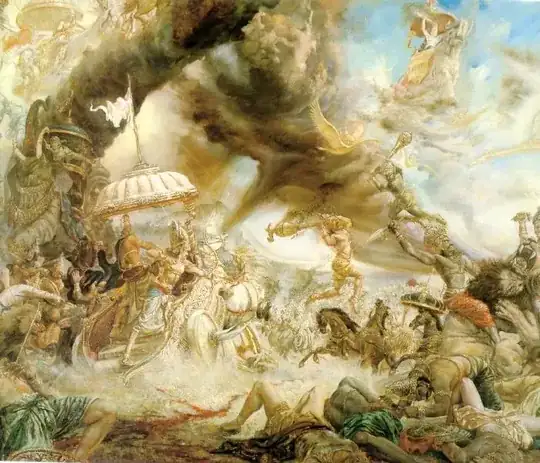
The earliest magical sword I could find was Asi, from the Mahabharata

The sword Asi, the first sword ever created, was supposedly made by Brahma (the creator of the universe in the Mahabharata) in a fire sacrifice ritual next to the Himalaya, as a tool for the Devas to fight back against the Asuras. It was a sentient weapon, derived from a being described in section CLXVI:

His complexion was dark like that of the petals of the blue lotus. His teeth were keen. His stomach was lean. His stature was tall. He seemed to be irresistible and possessed of exceeding energy. Upon the appearance of that being, the earth trembled.

That (clearly magical) being then turned into a sword:

That being then, abandoning the form he had first assumed, took the shape of a sword of great splendour, highly polished, sharp-edged, risen like the all-destructive Being at the end of the Yuga.

The Mahabharata itself dates from 400 BC, but the epic form it was based on appears to have an origin around the 9th century BC. That places it at roughly 1800 years older than Beowulf.

Mahabharata

  • 3
    I'd take the written date as the more definitive date, as we have no clue when in the preceding 8 centuries the magic sword was added to the oral tradition, or if it was original (it could well be original. The Aryan/Vedic people were likely the people who introduced iron working to the subcontinent. That strongly implies sword use.) – T.E.D. May 05 '16 at 20:31
  • 1
    Isn't the Mahabharata a religious text? – Matt May 05 '16 at 20:44
  • 3
    @Matt Yep. And thus it fits under Legend. –  May 05 '16 at 21:03
  • 1
    @anaranjada Then someone can flag it, though I've already got a Hindu.SE admin on my upvote list. The original question was about the first instance of a magic sword, period. –  May 05 '16 at 21:07
  • 2
    IF the original question was about the first instance PERIOD, then it didn't belong on this site, and shouldn't be answered on this site. HOWEVER I'm fairly certain that the OP knows what they wanted to ask, and has successfully (after an attempt or two) asked it. Consequently, the OP is only asking about fictional references.

    Regardless this answer is neither appropriate for this site (regarding the original form of the question), nor is it an answer to the current form of this question.

    – Matt May 05 '16 at 21:27
  • 2
    @Matt Until there's a Literature.SE, no. That can't be the case with any questions about depiction of fantastic elements in literature or it disqualifies all of them. –  May 05 '16 at 21:29
  • 2
    There's not a MarineBiology.SE either... that doens't mean those answers go here. – Matt May 05 '16 at 21:33
  • 11
    Mahabharata has been mentioned multiple times on this site and has never been considered inappropriate. http://scifi.stackexchange.com/questions/117891/what-was-the-first-story-to-be-set-in-the-future/117893#117893 http://scifi.stackexchange.com/questions/75839/first-use-of-time-travel-in-fiction/75847#75847 – Ghostship May 05 '16 at 21:33
  • 2
    @Ghostship It's important to know if that's because of what the policy SAYS, or how the policy is ENFORCED. – Matt May 05 '16 at 21:34
  • @Matt, Axelrod, Ghostship: please take this conversation to the chatroom I set up for discussing this question and its answers. – Rand al'Thor May 05 '16 at 23:05
  • 1
    Apologies if this seems a dense question, but: I feel this answer is very close to acceptable, however, while Asi is of divine/magical origin, its sentience and, indeed, its magicalness, are unclear: what makes Asi a magical sword, rather than simple the best (non-magical) sword (which was created by divine magic). That is, does it float through the air, fighting on its own? Does it whisper secrets or grant wishes to its wielder? Does it go PEW-PEW! (I did read the three links you provided.) – Lexible Jan 08 '20 at 18:38
  • @Lexible Aside from being a polymorphed magical sentient being, wielded by a god to slaughter an entire magical race, and being worshipped in its time the sword is described as the foremost of all weapons. "whoever holds this weapon obtains sure victory and have absloute power over any weapon ever created since asi is the primordial source of energy behind all weapons". I can add these notes if needed. –  Jan 08 '20 at 20:59
  • @CarpeCMisanti-corruption Yes. Aside from (1) created by divine magical means (mundane things can be created, c.f. D&D); (2) a god so tall his head literally touches the sun slaughtering a race of demons does not imply "magic sword", it implies "Holy crap! That dude's 93 million miles tall!"; (3) "foremost of all weapons", right: why is that not simply The Best™ mundane weapon?; (4) closer, but still: is that simply divine prophecy (e.g., about millions-miles-tall wielders), rather than magic inherent to the sword? (PS: am asking in good faith. :) – Lexible Jan 08 '20 at 23:06
  • @Lexible A sword that can turn into a magical being is not inherently magical? To 4... was Narsil a magic sword? –  Jan 09 '20 at 15:15
  • @CarpeCMcandothisallday None of the sources you say indicate the sword can do any such thing: a magical being, Asi, turned into the sword: not the other way around (the 93M mile god was Rudra, not Asi). No: Narsil is not a magical sword; its significance is in its symbolism ("Cut yer ring of once, MFer! Come at me!," as the Aragon quote goes ;). Contrast with Sting and emitting light when near orcs. Anyway, Narsil is besides the point. – Lexible Jan 10 '20 at 01:45
  • @Lexible Just to figure out the criteria. Aside from it being said to be the source of the power of all weapons and wielding it would assure victory, I have nothing else to point to. Just as Narsil/Andùril had its prophecy tied to the kingship. –  Jan 13 '20 at 12:26
  • @CarpeCMisOverjoyed It's a really good answer... am just right along the fence, and want to feel unabiguous before I accept it. :) – Lexible Jan 14 '20 at 00:33
  • @Lexible Yeah, sorry that's all I've got. The Hindu texts are full of standalone pieces like this. It makes sense given that it's a religion formed from the patching together of many, unfortunately coinciding with a time when almost no one was literate. –  Jan 14 '20 at 12:59
23

There are almost certainly much older examples, but this was the one I first thought of- slightly older than the stories of Excalibur:

The sword Beowulf uses to kill Grendel's mother.

According to wikipedia:

c. 700–1000 CE (date of poem), c. 975–1010 CE (date of manuscript)

As readable on Project Gutenburg (chapters XXIII - XXIV), Beowulf goes to slay Grendel's mother, but discovers that his (normal) sword was not powerful enough to harm the monster.

(XXIII 48-54)

The stranger perceived then
The sword will not bite.
The sword would not bite, her life would not injure,
But the falchion failed the folk-prince when straitened:
Erst had it often onsets encountered,
Oft cloven the helmet, the fated one’s armor:
’Twas the first time that ever the excellent jewel
Had failed of its fame.

Beowulf despairs and tries to fight her without his sword, and is protected from her dagger by his armour, and would have died "had God most holy not awarded the victory"

(XXIII 75-82)

Ecgtheow’s son there
Had fatally journeyed, champion of Geatmen,
In the arms of the ocean, had the armor not given,
Close-woven corslet, comfort and succor,
God arranged for his escape.
And had God most holy not awarded the victory,
All-knowing Lord; easily did heaven’s
Ruler most righteous arrange it with justice;
Uprose he erect ready for battle. (End of Chapter)

He then sees (delivered through divine intervention/deus ex machina?) a giant and magical (?) sword, more powerful than his own (very high quality yet not magical) sword and successfully uses it to penetrate the monster's skin and kill her.

(XXIV 1-6)

Then he saw mid the war-gems a weapon of victory,
An ancient giant-sword, of edges a-doughty,
Glory of warriors: of weapons ’twas choicest,
Only ’twas larger than any man else was
Able to bear to the battle-encounter,
The good and splendid work of the giants.

Extra, fun note: her blood was so hot and poisonous that it dissolves the blade of the giant sword, and Beowulf can only bring the hilt back.

(XIV 57-59)

The brand early melted, burnt was the weapon:
So hot was the blood, the strange-spirit poisonous
The hero swims back to the realms of day.
That in it did perish

It is debatable whether the giant sword is actually "magical" or just giant, but on later inspection later in the book, it is definitely supernatural-not made by normal humans and possessing a greater power than normal humans could have infused it with.

(XXV 26-47)

To the age-hoary man then,
The famous sword is presented to Hrothgar.
The gray-haired chieftain, the gold-fashioned sword-hilt,
Old-work of giants, was thereupon given;
Since the fall of the fiends, it fell to the keeping
Of the wielder of Danemen, the wonder-smith’s labor,
And the bad-mooded being abandoned this world then,
Opponent of God, victim of murder,
And also his mother; it went to the keeping
Of the best of the world-kings, where waters encircle,
Who the scot divided in Scylding dominion.
Hrothgar discoursed, the hilt he regarded,
The ancient heirloom where an old-time contention’s
Beginning was graven: the gurgling currents,
The flood slew thereafter the race of the giants,
They had proved themselves daring: that people was loth to
The Lord everlasting, through lash of the billows
The Father gave them final requital.
So in letters of rune on the clasp of the handle
Gleaming and golden, ’twas graven exactly,
Set forth and said, whom that sword had been made for,
Finest of irons, who first it was wrought for,
Wreathed at its handle and gleaming with serpents.

Tyrannosaur
  • 437
  • 2
  • 6
  • 1
    It's a sword crafted by giants. –  May 05 '16 at 16:45
  • 1
    It is also a giant sword- made by giants to be used by giants- as in the 3rd quotation "Only ’twas larger than any man else was Able to bear to the battle-encounter, The good and splendid work of the giants." – Tyrannosaur May 05 '16 at 16:47
  • 2
    I think the concept of magic has changed since the writing. It was clearly a superior weapon with intrinsic value higher than just being a large sword. –  May 05 '16 at 16:49
  • 4
    Hrunting, the sword Beowulf used first, was also magical. It was just weaker than the giant sword. –  May 05 '16 at 17:08
  • 1
    None of the quotes give the sword more power than a high quality smith could bestow. The sword was exceptionally large and well crafted. – Trisped May 05 '16 at 19:42
  • @Trisped -- From the Epic, "Old-work of giants". -- Since when were giants (of old) who worked iron a real thing? ;) -- If a magic giant creates a sword, wrought like none other among men, is it not a magical blade? – user23715 May 05 '16 at 20:36
  • 1
    @user23715 No, because the sword itself must have supernatural powers to be magic. – Trisped May 06 '16 at 00:36
  • @user23715 If a man who is on fire makes a sword, does the blade automatically become a burning blade? Unless the creator of a thing actively infuses the thing with a property, it won't have the property just because the creator has it ;) – Cronax May 06 '16 at 07:57
  • 1
    @Cronax -- You're overlooking that the 'Giants of Old' were things who can do things that can't be done in our mundane times. Like the work of Titans in Greek myth, Norse/Saxon myth had creatures capable of making "normal" stuff (to them) that is ipso facto "magical" to us mere humans. – user23715 May 13 '16 at 15:37
  • @user23715 All I'm saying is that the creator being magical doesn't automatically mean the item they create is magical. They should be perfectly capable of making a mundane item even if they themselves are magical beings. This doesn't mean they ever did make mundane items. – Cronax May 17 '16 at 07:35
  • 1
    @Cronax -- Both you and the @ Trisped patently ignore the emphasis in the saga. Perhaps because it is translated into modern-ish English. -- Doesn't matter. -- My point is that because of its maker these objects are ipso facto magical. Not merely neato but truly wondrous (note the term "wonder-smith" and use the Internet to look up the archaic roots of "wonder"). -- Speaking of which, and to put it another way, like the Vorpal sword in Wonderland, these items crafted by giants were imbued with power not available to mere human smiths. Make sense? – user23715 May 26 '16 at 19:59
  • @user23715 I'm still not convinced, but I can see your point. It could be a property of the maker that anything they make is always magical. Or they could simply be magical beings themselves without that property affecting anything they do. I suppose we'll have to agree to disagree, since the information provided by the saga is insufficient to swing things one way or the other. We can at least agree that in this instance, the item produced was of wondrous (magical) quality and that's really the entire point here, the rest is just me being pedantic. – Cronax May 27 '16 at 06:26
  • @Cronax -- Agree to disagree? I'm fine with that. ;)-- Reading the saga as a whole though, particularly a version that has helpful commentary as footnotes, will show you the strength of my position. -- Things giants could do were frankly incredible unless one understood them to be the work of giants (or the gods; which might be the same thing depending on the mythos); and the giants we know to be only "of old" since they were wiped out in the cataclysm. -- Hmm, I can be pedantic too I guess! :D – user23715 Jun 28 '16 at 18:43
14

I can beat Asi by 2599 years with a fairly boring answer.

Wikipedia states (without citation) that "It is probable that the roots of the sentient weapon myths stem from ancient peoples belief that sword making and metallurgy was in fact a magical process."

This is reinforced by claims made in this paper (top of page 9), which seems to know what it is talking about and states that people of the time thought that metallurgy was magic - that is, any sword made of metal, is magic.

That means, that we are looking for the first story, written or oral, that contains a metal sword, which likely dates from several months or years after the invention of the sword, in roughly 3100 BC. That is to say, in the minds of the author and reader (or speaker and listener), the swords they describe are magical, even if you and I wouldn't think of them as magical in the sense of glowing when Orcs are present.

Unfortunately, that means that almost certainly, the first story of a magical sword is no longer remembered or recorded, same for the 2nd oldest, hundredth oldest and so on. This question is unanswerable.

https://en.wikipedia.org/wiki/Sword#Ancient_history

ApproachingDarknessFish
  • 17,056
  • 9
  • 88
  • 108
Scott
  • 4,567
  • 17
  • 25
  • 5
    Actually, most famous real-world swords (that still exist today) were considered magical. Not that people believed that they could shoot lasers or anything but that such famous swords can either not be defeated or are always victorious (there's a subtle difference). Such swords seem to exist in almost every culture I know. – slebetman May 06 '16 at 04:32
  • 2
    I imagine the first iron swords encountered by enemies who only held bronze/copper weapons, struck fear into people and quickly entered into legends as unbeatable weapons, associated with powers granted by pagan gods and magical spirits of the time. Very possibly, such stories were told way before written word, and some of them entered the written legends (after being embellished and transformed by maybe 100 generations). – orion May 06 '16 at 09:03
  • 6
    The question asked for a first "work", which - at least to me - implies an actual defined work (specific legend), not general vague concepts and ideas. – DVK-on-Ahch-To May 06 '16 at 13:06
  • 3
    @DVK-in-exile agreed, it implies that - yet it still makes the question itself that of a little sense; discussing ca. 3000 BC works makes no sense in scifi/fantasy context - it is a completely valid question for an archaeologist, a linguist or a historian, but here on scifi it will only bring either unsourced, arguable, context-dependent answers, or just plainly original research on the matter - bringing it down to being, again, either unsourced, arguable or context-dependent. Asking about "first work" in such ancient context won't work well on scifi IMO. –  May 06 '16 at 20:15
  • @ DVK - sorry, I did forget to add my conclusion, editing now – Scott May 08 '16 at 06:40
  • This doesn't directly answer the question, but it's interesting and useful, so +1. – DCShannon May 09 '16 at 22:02
  • The question specifically asks for "oldest known" (i.e. documented), not first, and is therefore answerable. – Lexible Feb 07 '17 at 00:25
4

Earliest I know of is Genesis 3.24 - God places an angel with a flaming sword at the gates to the Garden of Eden. The Mahabarata example seems like a better bet.

Jon B
  • 2,961
  • 19
  • 20