10

I know this question would usually raise other questions as to what is considered a separate language (e.g. Qenya/Quenya, Gnomish/Sindarin, etc.).

The thing is that somewhere there is an official list. Quoting from the flap of Sauron Defeated:

Closely associated with the Papers is a new version of the Númenórean legend, The Drowning of Anadûnê, which constitutes the third part of the book. At this time the language of the Men of the West, Adûnaic, was first devised - Tolkien's fifteenth invented language. The book concludes with an elaborate account of the structure of this language by Arundel Lowdham, a member of the Notion Club, who learned it in his dreams.

Note: accents added to source which incorrectly strips them on both Amazon and Google books; accents are correct in the title, so this is undoubtedly inadvertent.

So there is an official list. What were the first fourteen? How many were made after Adûnaic?

What is the official order that makes Adûnaic Tolkien's "fifteenth invented language"?

In case this isn't clear, I'm looking for an official statement or indication as to which list Christopher employs. I'm not looking for speculative opinion-based answers.

DavidW
  • 128,443
  • 29
  • 545
  • 685
ibid
  • 93,732
  • 37
  • 488
  • 567
  • An ideal answer would contain Christopher Tolkien's list with a source. – ibid Mar 10 '16 at 08:51
  • 4
    The description of the book on the flap of the dust jacket wasn't necessarily (and probably wasn't) written by Christopher Tolkien, but by the publisher. Unless you have a reference in the book itself to Adunaic being the 15th language, I wouldn't even assume it's strictly true, let alone backed by a list you can reference. – chepner Mar 14 '16 at 19:35
  • @chepner - The flaps on HoME usually showed a pretty through knowledge of the material. Even it wasn't written by CT, there should still be a list that whoever did write it had. (Also, if you have a comment which answers the question asked better than the existing answer, please post it as an answer, not a comment.) – ibid Mar 14 '16 at 19:44
  • 2
    I don't, because I agree that the posted answer is as close as you're going to get. I'm not trying to answer the question, but to temper your expectations. – chepner Mar 14 '16 at 19:46
  • @chepner - But your comment more directly addresses the question. – ibid Mar 14 '16 at 19:49
  • 2
    When you assume the answer in the asking of a question, that is the opening to a logical fallacy. (See the "have you stopped beating your wife" illustration of that kind of fallacy. Begging the question is another name for it). – KorvinStarmast Dec 05 '16 at 13:48
  • @KorvinStarmast - I'm not assuming the answer. I'm making an observation and asking for clarification. A good answer will explain why my observation is either correct or incorrect. – ibid Dec 05 '16 at 14:18
  • 2
    The way you worded the question, it assumes there is an official order. You'd be better off asking if there ever was "an official order" because you assume 1) JRR was that organized and 2) CT made an official list. You assume that there was one due to his remark, and as I noted in the comment below the current answer, people don't and didn't necessarily speak with that kind of intent and precision all of the time. (We weren't as anal retentive about 40-50 years ago, socially). Your question is as much of an anachronism as Bilbo's clock. – KorvinStarmast Dec 05 '16 at 14:22
  • @KorvinStarmast - It's more of a "and if yes, then..." series of questions. Nevertheless, you seem to have an answer and should post it as such. – ibid Dec 05 '16 at 14:28
  • 2
    Don't have enough information for an answer, given what is already posted. This comment was triggered by the discussion below the current answer. On the SE family of sites, there's a thing called a frame challenge, and I think that the answer given is along those lines. If I had something definitive, it would already be an answer. – KorvinStarmast Dec 05 '16 at 16:48

1 Answers1

33

The original listing of these languages is so much more complicated than this, because Tolkien always changed or created new dialects.

Tolkien's glossopoeia has two temporal dimensions: the internal (fictional) timeline of events described in The Silmarillion and other writings, and the external timeline of Tolkien's own life during which he continually revised and refined his languages and their fictional history. He constantly devised and changed the languages and their chronological order changes in real time.

  • 1910–1930: Primitive Quendian the proto-language, Common Eldarin, Quenya and Goldogrin.
  • 1935–1955: Goldogrin had significantly changed and was now Noldorin, joined by Telerin, Ilkorin, Doriathrin and the Avarin.
  • The late and mature stage dispensed with Ilkorin and Doriathrin. Noldorin matured into Sindarin.

Tolkien had worked out much of the etymological background of his Elvish languages during the 1930s (collected in the form of The Etymologies). In 1937, he wrote the Lhammas, a linguistic treatise addressing the relationship of not just the Elvish languages, but of all languages spoken in Middle-earth during the First Age.

  • 1940s, while working on Lord of the Rings, Tolkien invested great effort into detailing the linguistics of Middle-earth.
  • Mannish languages and Dwarvish was created between 1940 and 1945.
  • However, in 1945, Tolkien devised the language known as Adûnaic. Its development began with The Notion Club Papers (written in 1945). It is there that the most extensive sample of the language is found.
  • Tolkien remained undecided whether the language of the Men of Númenor should be derived from the original Mannish language (as in Adûnaic), or if it should be derived from "the Elvish Noldorin" (i.e. Sindarin) instead.

But first creation of these languages (which makes the chronological order in some sense) looks like this:
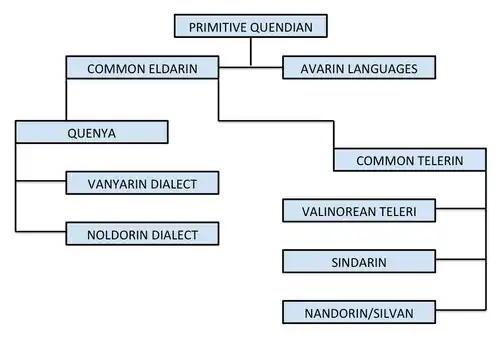
Tree of languages deriving from Primitive Quendian (the listing is reproduced below)

The listing:

  1. Primitive Quendian
  2. Common Eldarin
  3. Avarin (6 languages)
  4. Quenya
  5. Goldogrin
  6. Vanyarin
  7. Goldorin >> Noldorin
  8. Ilkorin
  9. Doriathrin
  10. (Common)Telerin (has dialects)
  11. Noldorin >> Sindarin
  12. Nandorin
  13. Northern Mannish
  14. Taliska (2 dialects)
  15. Adûnaic (there is a tricky part)

Most of the "first 15" include sub-languages and dialects as well. So if you include them all, Adûnaic cannot be listed as the 15th language because it is a sub-language-like language that was derived from the Hadorian tongue. It is under Taliska language branch but I listed it as the 15th. Because even if it's a sub-language or a dialect, if it's talked by masses it is considered as a language.

The language of the House of Beor eventually was almost extinct, both because of the adoption of Sindarin and because the House was mostly annihilated after the Dagor Bragollach. On the other hand, the House of Hador did not wholly abandon their language, it survived the War of Wrath and was still spoken when the Edain migrated to Elenna. Thus it later became Adûnaic.

Adûnaic, the language of Númenor, developed in 1946 while he was finishing up Lord of the Rings, was said to be his fifteenth invented language.
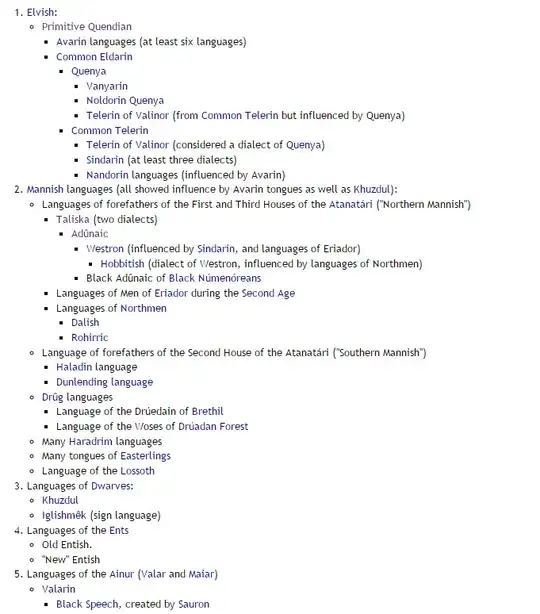
List of languages grouped by peoples

You can see the language tree here.

Creation of languages didn't happen in chronological order of the stories and books. Tolkien simply did that when he was in need of a new language.

Adûnaic

Adûnaic was generally considered to be a language of less prestige than the Elven tongues. Most locations of Númenor, and most of the lords and ladies of the Dúnedain, had also Quenya or Sindarin names beside their native ones. Even most commoners knew Sindarin to some degree.

Adûnaic was derived from the Hadorian tongue, related to the Bëorian—collectively called Taliska. It was more distantly related to the languages of the Middle Men of the east, such as the Northmen.

During the First Age these languages were much influenced by Khuzdul, Avarin, but also by the languages of the Eldar, as the Elf-friends spoke Sindarin.

Taliska was not related to the Haladin tongue at all, therefore when the Númenóreans returned to Middle-earth in the Second Age, they did not recognise the peoples of Enedwaith and Minhiriath as their distant kin, who spoke unrelated languages.

You can visit here for a language analysis of the 15th language.

Sources

  1. Part from Sauron Defeated by C. Tolkien:

When The Lord of the Rings had still a long way to go - during the halt that lasted through 1945 and extended into 1946, The Return of the King being then scarcely begun - my father had embarked on a work of a very different nature: The Notion Club Papers; and from this had emerged a new language, Adunaic, and a new and remarkable version of the Númenórean legend, The Drowning of Anadûnê, the development of which was closely entwined with that of The Notion Club Papers.

Sauron Defeated, HoME 9, "Foreward"

How is all this to be equated with his statement in the letter to Stanley Unwin in July 1946 that 'three parts' of the work were written in a fortnight at the end of 1945? Obviously it cannot be, not even on the supposition that when he said 'a fortnight' he greatly underestimated the time. Though not demonstrable, an extremely probable explanation, as it seems to me, is that at the end of that fortnight he stopped work in the middle of writing the manuscript E, at the point where The Notion Club Papers end, and at which time Adunaic had not yet arisen. Very probably Part One was at the stage of the manuscript B.4 On this view, the further development of what had then been achieved of Part One, and more especially of Part Two (closely associated with that of the Adunaic language and the writing of The Drowning of Anadûnê), belongs to the following year, the earlier part of 1946.

Sauron Defeated, HoME 9, Introduction to The Notion Club Papers

  1. You can find most of the above in J.R.R. Tolkien, Christopher Tolkien (ed.), The War of the Jewels, Part Four "Quendi and Eldar": Appendix D: *Kwen, Quenya, and the Elvish (especially Ñoldorin) words for 'Language': Note on the 'Language of the Valar', p.397.

Addition: Since the OP insists on the existence of a chronological list of invented languages, made by Christopher Tolkien, I double-checked my copy of the volume. Couldn't find one (if you find any, please share it with a page number or some sort of referable source). But the book examines and tells the story of a newly discovered language called Adûnaic.

How was it counted as the 15th invented language if there isn't a list in Christopher Tolkien's hand? I believe Christopher Tolkien simply counted the early 14 and added this one as the 15th.

Because, Tolkien.

DavidW
  • 128,443
  • 29
  • 545
  • 685
burcu
  • 7,944
  • 1
  • 31
  • 53
  • So your answer is based off of speculation? Or do you have any evidence that CT used that order? – ibid Mar 10 '16 at 08:48
  • I'm going to assume that you're not done editing, as your answer contains large sections that are completely irrelevant. – ibid Mar 10 '16 at 08:54
  • 2
    @ibid 1st >> Those sections are not irrelevant at all. I suggest you to re-read them. 2nd >> I don't think there will be any better answer than this. Even C. Tolkien is not very sure about what's going on. Did you really read Sauron Defeated? C.T. is somehow lost in between lines. His father was a genius at inventing literary milestones but not very good at keeping track of his own work. – burcu Mar 10 '16 at 09:15
  • 1st >> I did, and I still don't see why you need seven paragraphs about the in-universe history of Andunaic. 2nd >> CT seems pretty clear that he has a list. I'm asking for a source as to what that was. If you don't know, that's ok, let someone who does know answer. – ibid Mar 10 '16 at 13:03
  • 2
    @ibid I accept it is long. And I will remove the language's history part. I do not accept the irrelevance part. "CT seems pretty clear that he has a list." I haven't seen any listing and I'm not forbidding anyone from answering your question. – burcu Mar 10 '16 at 13:11
  • Long answers attract upvotes . Upvoted answers remove questions from the unanswered tab. While usually new questions get enough attention, mine is one that's sufficiently harder to answer than most. CT indicates that he has a list in the flap. The whole question was centered around that point. – ibid Mar 10 '16 at 13:17
  • 2
    I'm not gonna apologize because you don't like it gets upvotes. Nothing I can do. I've been trying to find the list you claim to see or be so sure that it exists in Sauron Defetead, and cannot find it. I don't have it in my copy of the volume. So I went and made an entire list with real-life cronological order to answer you. And you still want the claimed CT list. So wait and see if anyone finds it. – burcu Mar 10 '16 at 13:37
  • Without an official source, any list would be purely speculative and opinion-based. There are earlier languages that you apparently decided not to include, and there are ones you listed that one can argue are not distinct languages. Do you have any evidence that your list was used by CT? – ibid Mar 10 '16 at 14:41
  • 2
    @ibid I included my sources in the post. If I were to include every little piece of rough version of Tolkien's early inventions, the list would consist of hundreds of languages. About your "you didn't include earlier ones" complaint. Read here: http://folk.uib.no/hnohf/howmany.htm I simply listed the 14 mostly used and acknowledged ones by cronological order and Adûnaic gets to be the 15th because of the way it was discovered. I already said I don't have a list in my copy of the volume. I said so in the answer. So I'm done answering you, wait and see if others can find it. – burcu Mar 10 '16 at 14:53
  • That's the problem. I'm not asking you to create your own list. I'm asking for which list CT used. Please try answering the question that was asked. – ibid Mar 10 '16 at 14:56
  • 5
    @ibid just because he said it was the 15th doesn't mean there is a list, certainly not one in a definitive order. It easily was just the number that he could count up to at that time. CT is easily so familiar with them that he knows how he arrived at 15, but has not needed to make such a specific list. Your OP must allow for the possibility the answer is "there is no official ordered list, but here are the 15" – Joshua Mar 22 '16 at 14:44
  • @JoshuaBigbee - I would accept such an answer that did just that a clear concise way. Maybe make an answer yourself? – ibid Mar 22 '16 at 14:47
  • 7
    @ibid I see no way to improve on this one. It is not groundless speculation. It gives numerous sources and official information on the languages. I'm sorry but CT simply is not indicating there is a list by what he says. That is not the natural reading of his quote at all. You'll just need to decide for yourself how many people it is going to take telling you the same thing before you will accept it. You misinterpreted the sentence. It's OK. – Joshua Mar 22 '16 at 14:56
  • @JoshuaBigbee - The answer as it stands is 80% extraneous material, and isn't written in a way that clearly addresses the question. I don't accept long posts that happen to have the answer buried in it somewhere towards the bottom. (Also, I disagree with his list as he omits a couple of Tolkien's early non-Middle-earth languages.) – ibid Mar 22 '16 at 15:00
  • 4
    @ibid your assumption that how you perceive that comment on a book jacket cover is somehow a precise description of something may be erroneous. Both Tolkein's were raised in a different generation than you, and used language differently than you do .. to include sometimes making remarks that were not intended to withstand cross examination in a court of law. This is a decent answer. You assumed an answer in your question that may not actually exist. The mind reading questions on this and other SE's create internal problems. – KorvinStarmast Dec 05 '16 at 13:47
  • @KorvinStarmast - It's a decent answer, but not for this question. Regardless of whether one thinks it's a good question or not an answer should be addressing it, not doing whatever else this answer is doing. – ibid Dec 05 '16 at 14:25
  • 2
    @ibid my comments on 'frame challenge' under your question's comments answers this as well. – KorvinStarmast Dec 05 '16 at 16:49
  • Superb answer! I think that many of the curiosities, mysteries and anomalies that so exercise some people are answered by your exquisitely short final comment, "Because, Tolkien." Genius can be baffling to the rest of us. – Mark Olson May 03 '22 at 21:12