9

I have heard the phrase hollow world several times, but seeing the question "Does the Song of Ice and Fire take place in a hollow world?," inspired me to finally Google the topic. This led to a TV Trope page about hollow worlds explaining:

When science started to switch over to the modern view of Earth's composition the idea of the hollow earth became a Discredited Trope, but later generations of Speculative Fiction writers took up the concept and revitalized it.

Adding various world types: ring worlds, dyson spheres, artificially constructed worlds, etc. Which confused the matter further. Unfortunately, I guess I don't truly understand the concept of a hollow world. Is it as simple as the world is hollow? Or is there something more conceptual at play?

ahsteele
  • 2,125
  • 4
  • 23
  • 35
  • On another type of hollow world, the planet Mesklin that appears in Hal Clement's works, see http://scifi.stackexchange.com/a/96703/4918 "Story set inside a sphere" – b_jonas Jul 27 '15 at 20:53

2 Answers2

13

Yes, the fundamental quality of a hollow world is that it is a large, hollow, more-or-less spherical object, and creatures live on the inside surface of it.

What's on the outside of the object (or even if it has an outside) may vary. There could be creatures living on the outside, or it could be bare, or the object could fill the entire universe (and thus have no outside).

Of course the science problem is that gravity as we know it can't hold objects to the inside of a sphere, which is why this is now mostly a fantasy concept. If the world is cylindrical, though, centrifugal force could be used to press the inhabitants to the surface.

cjm
  • 6,971
  • 4
  • 39
  • 38
  • See The Algebraist and Matter, both by Iain Banks. – tchrist Feb 20 '12 at 17:49
  • The world Virga in Karl Schroeder's Sun of Suns (http://www.amazon.com/Sun-Suns-Book-One-Virga/dp/0765354535) is an interesting modern example of a hollow world. It is gravity-less. – HNL Feb 21 '12 at 04:41
  • 2
    "What is the force due to gravity inside a hollow sphere" is actually a problem that's frequently worked out in introductory physics-with-calculus courses. The derivation is (imo) very interesting, but that's really more a subject for physics.se :) – Tacroy Feb 22 '12 at 00:00
  • @HNL I discussed this concept on PhysicsSE. http://physics.stackexchange.com/questions/21298/keeping-air-in-a-giant-gravitationally-bound-space-balloon This is very interesting, but I hope that it doesn't use physics described here http://www.orbitalvector.com/Megastructures/BALLOON%20WORLDS.htm which is wrought with disappointing outright errors. Unfortunately, it seems that the 2m thick Carbon nanotube wall already indicates disregard for physics by the author http://www.kschroeder.com/my-books/sun-of-suns/engineering-virga – AlanSE Nov 19 '12 at 01:56
4

To add more color to cjm's excellent answer, the "Hollow Earth" Wiki has a whole big list of historical theories, from ancient world and primitive tribes, to 17-18th century, up through 21st.

It also mentions "megastructures that have some similarities to a hollow Earth – Dyson sphere and Globus Cassus" which your question mentioned.

Among the most interesting ideas are "Concave hollow Earths" as well as "Multiple concentric shells", both of which actually contradict cjm's statement that the fundamental quality of a hollow world is that it is a large, hollow, more-or-less spherical object, and creatures live on the inside surface of it:


As far as concentric spheres, Edmond Halley (the astronomer of the Halley's Coment fame):

... in 1692 put forth the idea of Earth consisting of a hollow shell about 800 km (500 mi) thick, two inner concentric shells and an innermost core, about the diameters of the planets Venus, Mars, and Mercury. Atmospheres separate these shells, and each shell has its own magnetic poles. The spheres rotate at different speeds. Halley proposed this scheme in order to explain anomalous compass readings.

enter image description here


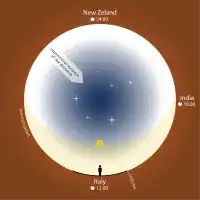
Also, another curious theory had us living on the inside of the sphere:

Instead of saying that humans live on the outside surface of a hollow planet, sometimes called a "convex" hollow-Earth hypothesis, some have claimed that our universe itself lies in the interior of a hollow world, calling this a "concave" hollow-Earth hypothesis. The surface of the Earth, according to such a view, might resemble the interior shell of a sphere.
enter image description here

Aside from its weirdness/elegance, this latter theory is notable for this website since it was the basis of the worldview of an alien world in one of the most famous Soviet SciFi novels, "Inhabited Island"

DVK-on-Ahch-To
  • 342,451
  • 162
  • 1,520
  • 2,066