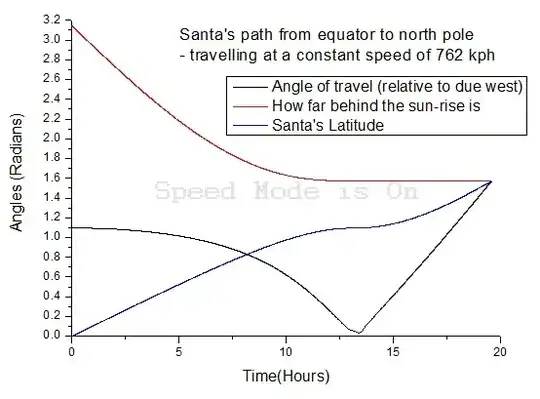
Santa can travel at approximately 761.15 kph all the way. At 18:00 GMT he leaves hugging the line of sunset (momentarily he will be travelling directly south, but as he drops to lower latitude he has to fly at an increasing angle towards the west so viewed from above the north pole his progress would vaguely resemble a spiral). Eventually, at a latitude of approximately 62.8 N, Santa will find he is travelling almost due west, and can only just keep up with the line of sunset. At that point, he starts to swing gently south (at any particular latitude L, he wants to follow a direction d = 270 - acos(0.46*cos(L)) - this points in a more southerly direction as he gets closer to the equator). Initially he will only slowly fall back from the line of sunset, but the further south he goes the more local time he loses until, as he crosses the equator (at a heading ~ 207 degrees), the local time will be midnight. He then "mirrors" his course so far in the southern hemisphere. If his heading is correct he will finally get to the south pole just on local sunrise. Any minor mistakes and Santa is toast.
Santa can only calculate his exact minimal speed by accurately solving an integral equation (if he has similar maths skills as me he will have to do this numerically), so he could reduce his speed a little below my estimate with a more accurate calculation. But the closer to the limiting speed he travels at the longer the journey will take (at 762 kph it already takes him about 20 days to make the trip), so unless he has lots of time to spare he may want to travel a little faster than the limit. Also, if he does decide to travel as close as possible to the limiting speed he will need to take into account the fact that the orientation of the sun to the north-south pole line will be changing during his trip, so he will need to solve an even more complicated integral (and leave the pole some time before the spring solstice).
The path near the pole is simple - he can just follow the sunset line (this part is reminiscent of the lake-monster problem). But the next section is a bit more complicated. Consider his passage between some latitude L and L-dL, the optimal angle to cross that latitude will be that which, for any specific speed he is travelling, loses him the least of his head-start to the murderous sunrise. Locally, this can be modeled by solving the equations below. I think that shows that the optimal path after the break-away is not a straight line but a vaguely s-shaped curve.
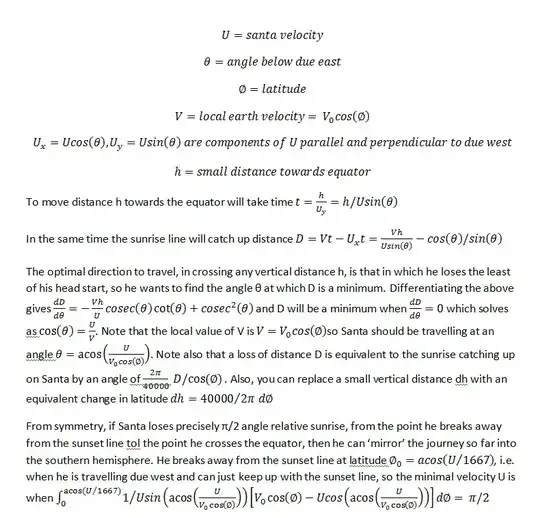
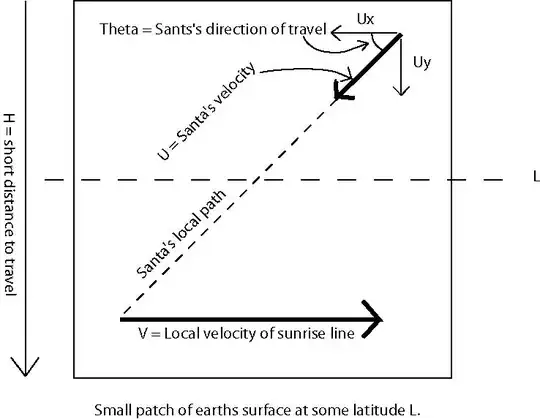
I am adding a plot showing Santa's path (I have reversed the route so he is going from the equator to the north pole, 'cos that's the way i did the maths). Note that at 762 kph, the sunrise line catches up by pi/2 = 6 hours over the route. So he can mirror the route to do the complete passage from north to south. Takes approximately 20 hours, but he can take as long as he wants circling in the vicinity of latitude ~1.09 radians=63 North


zis the north pole, and Santa start at the point markedy, then he is exactly 10000 km from any point on the circle that goes throughxandz, that circle also happens to mark the longitude that is exactly 6 hours away. So there is absolutely no way for Santa to gain more than 6 hours in 10000 km starting from the equator. – aaaaaaaaaaaa Sep 17 '14 at 06:50