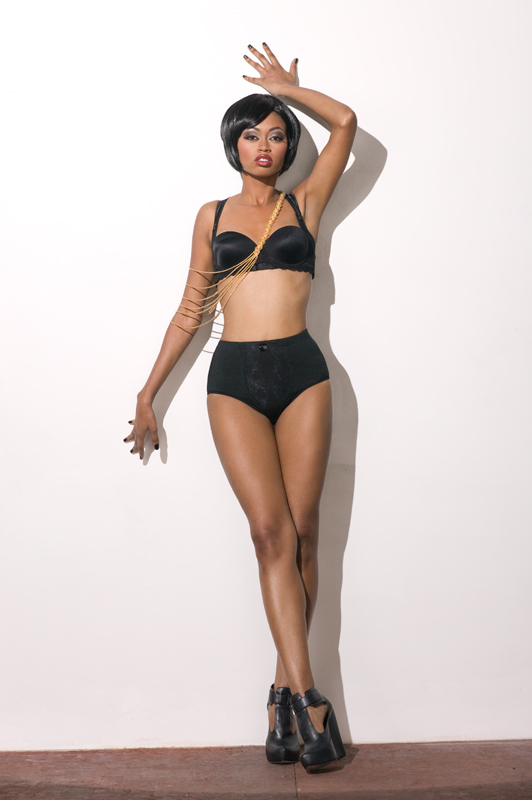
The actual type of the main light isn't important at all. As long as it's far enough from the subject and small enough to cast hard shadows, you're in business. Just happening to have a 5K or 12K HMI Fresnel hanging around the studio makes it an easy go-to tool since it will allow you to keep the shutter speeds high and won't be easily overpowered by the flash you may decide to use as secondary lighting at those shutter speeds. If you don't happen to have an HMI spot (or one of the new high-wattage LED spots) floating around, you can use studio flash or even a speedlight.
Where you go from there depends on the overall quality of the light you are looking for. In the example photo you linked, the main light could have been the sun on a cloudless day (and probably was; it reminds me a lot of something I saw in a book once, I think by Rick Sammon) — precisely the sort of light that the books and tutorials spend so much time trying to tell you to avoid. The reason why we're generally told to avoid hard light is because it is hard, not in the sense that the shadows are hard, but in the sense that getting pleasing results means a lot of attention to detail. For that reason, having at the very least something with a coincident (or very nearly coincident) modelling light will make things go a lot more smoothly. You need to know where the shadows will be, how they shape the subject and how they contribute to the line of the image as a whole, unless you're willing to work in the hope that one or two of many, many shots will be a happy accident. A continuous source makes it easy, a studio flash with a modelling light (especially if both are under a frosted dome) is usually pretty darned close to right, but a bright, small source that is very close to a speedlight, provided that both are far enough away from the subject, will have little enough difference from "the truth" for it not to matter in any significant way.
But getting the light too far away from the model, though it helps with getting the hardness of line and shadow, can do bad things to the "punch". One of the big advantages and one of the big problems with sunlight is that there is no fall-off. You can fake it, to a degree, in post, but it won't be quite the same thing. Moving the main light too far from the model has a similar effect. Here, the characteristics of a spotlight can help a lot. A simple grid can allow you to feather the main light to get something like the fall-off of a tighter light. Note that if you decide to go the speedlight-plus-pilot-light route, you don't need to worry about gridding the modeling light source; you can visualize the fall-off much more easily than you can visualize shadows.
As for the fill, you just need it to be large enough that it doesn't cast distinct, hard-edged shadows of its own, while being small enough not to completely soften away the hard shadows and specular highlights that the main is there to give. And you want to make sure that it is "down" enough to keep the shadows deep. (You may also want to restrict the area of fill with a grid to allow areas outside of the spotlight to actually go to black. That's an artistic decision.)
You could, in fact, do the whole thing with a bare bulb on a lightstand in a room of the right size without involving any modifiers at all.
The lesson here, if there is to be one, is that we should never get fixated on the equipment somebody uses for a shot unless and until we can determine that what was used did something unique for the shot that would be difficult or impossible to achieve another way. When dealing with hard light, it will always be better (when there is a choice) to be able to see the shadows before we press the shutter release, but once that's out of the way, we have to ask, "did the specific light source the photographer used do something another light source could not have done?" The answer is usually, "probably not." Sometimes the "right" equipment makes it easier (usually the case when there's an off-the-shelf version of something you'd otherwise have to bodge together); sometimes it happens to be what the photographer had handy.