22

How many stops can a digital camera capture?

Additionally, does anybody know what the dynamic range is for negative and positive film, the human eye, computer monitor, the television, etc...

Saaru Lindestøkke
  • 8,648
  • 3
  • 39
  • 94
Aristos
  • 1,496
  • 1
  • 20
  • 25
  • 7
    For anyone not familiar with this concept (and who missed the question tags), this is called "dynamic range". – Craig Walker Jul 22 '10 at 19:22
  • It depends on the camera. There are some (really cool) specialized video cameras that have a measured DR of 17(!) stops. Most single-sensor devices are about 9-10, though. – Fake Name Sep 15 '11 at 22:11

6 Answers6

21

The answer will most probably change in time.

Current top cameras are said to capture around 10-11 stops at base ISO, less at higher ISOs, see DPReview tests of Nikon D3X for example. As a sidenote - you won't probably like the pictures that are processed to measure the maximum dynamic range, they'll simply lack contrast you'd expect from "normal" picture.

Negative film is said to have up to 9-10 stops of latitude and reversal film around 5-6 stops. What you're actually able to see also depends on the medium used to present the picture - prints from negatives are usually limited to what the paper can reproduce, slides to what can be projected and digital images to what the monitor is able to show.

Update: I've made a DR test on my 5D (the old one, not mk2) and with default settings I get 9 stops of usable range, with special processing 11+ (and there is probably more room on the shadows' side):
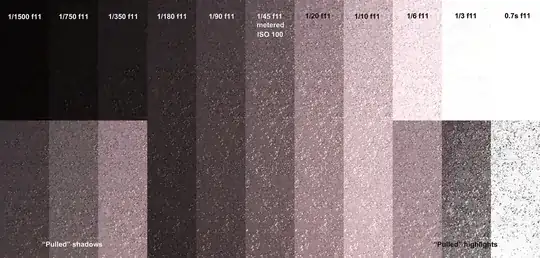
enter image description here

It's not meant to show the theoretical maximum, but rather that 13-14 is not out of this world, if sensor from 2005 can capture 11+ stops.

Karel
  • 10,729
  • 6
  • 48
  • 78
  • 1
    I think 13-14 stops is a gross overestimate. If you read a few reviews on DPReview, the average usable range of stops is about 9 at the lowest ISO, but thats pushing the sensor to its limits. Dynamic range drops as ISO is increased. Only the most top-end camera bodies with larger sensors are capable of a larger dynamic range, but "maximum" and "average" mean to very different things from a practical use perspective. – jrista Jul 23 '10 at 03:41
  • 1
    Sure, the actual practical usable range is less, but it's not my estimate here, but an actual measurement done by DXO. If you look at DPReview's ACR best curve in 14-bit mode for Nikon D3x, then it's over 11 stops. So I don't see anything wrong with the answer. – Karel Jul 23 '10 at 04:24
  • @Karel: The ACR "best" curve is the widest workable dynamic range once a RAW file has been imported into Photoshop, but that is not a gauge of the sensor's actual real-world range. That is representative of the RAW "headroom", not real-world usable DR. If you read the DPReview review thoroughly, you'll find the tables that list the "Usable range", which is 8.4EV@ISO100, and peaks at 9.3EV@ISO3200. The tone curves from actual images range from about -4.9EV in the shadows to about 3.7EV in the highlights on average...which is about 8.5-8.6 stops of usable DR. – jrista Jul 23 '10 at 07:13
  • I read the DXO review, and I am rather skeptical about the results. They do not explain how they arrive at their results, and the charts do not seem particularly logical. They list the highest DR of 13.65ev was taken from a "normalized print" from Photoshop, but they do not explain exactly what was done with the image. They state that the D3X has a better dynamic range than the Sony A900, which is contrary to every other review of those two cameras that I've ever read, all of which were more thorough and provided detailed insight into the testing methods and more logical conclusions. – jrista Jul 23 '10 at 07:24
  • 1
    @jrista - my understanding is that the question is not about average or real-world usable or widest workable dynamic range. It's about the sensor maximum, even if it's theoretical. What you actually get from a real scene will depend on a lot of other factors in addition to sensors max.

    I don't understand your RAW headroom comment, it seems like it would be something in addition to what the sensor can capture. My understanding is that almost every step from the capture will reduce the range, including tone curves. There won't be anything to pull once the pixel is saturated.

    – Karel Jul 23 '10 at 08:09
  • I don't have enough information to argue regarding DXO results and have thus edited my answer to link to DPReview for now. – Karel Jul 23 '10 at 08:14
  • @Karel: RAW headroom refers to the ability to capture information beyond what can be visually represented at a single time. The best example is with photographic highlights in RAW images. You can capture enough highlight information such that your highlights can be recovered, and the same goes for deep shadows. However, the process of recovering extended highlights or shadows has an effect of reducing the overall contrast range of the image. Even though the highlights and shadows are there, they are not usable until recovered, hence the reason "effective DR" is not the same as "maximum DR". – jrista Jul 23 '10 at 17:22
  • I've removed my down vote, as your answer is much better now. :) I still think that 10-11 stops is pushing it for the D3X, and 8-9 stops would be more realistic. – jrista Jul 23 '10 at 17:24
  • @jrista, DxO are a respected organisation that have built up a large business around photographic testing. If we want to discard their results we need stronger arguments than essentially - 'I don't like their results'. DxO have gained a lot of acceptance. It is OK (and even good) to question but when you call their result a 'gross overestimate' you need to give real facts and references. – labnut Mar 28 '11 at 21:55
  • I think I referenced DPReview's tests. You can go on DPReview and look at tests for any camera tested by DxO, and see the difference. DPReviews test quite is standardized and based on real-world scenarios. They have never demonstrated a camera that is actually able to capture 11 stops of DR, let alone 14 stops. Is that not sufficient? – jrista Mar 28 '11 at 22:10
  • @latnut: BTW, my own answer to this question, down a ways, has links to two specific reviews, with DR curves and EV results for the D3X and Canon 1D IV. Both cameras clocked in at less than 10 EV worth of DR in real-world tests, and averaged around 8-9. – jrista Mar 28 '11 at 22:14
  • @jrista, DPR results, astonishingly, are from jpegs. The real dynamic range can be obtained from RAW results, which is the way DxO do it. Why on earth would anyone use jpeg results to judge a professional level camera? Secondly we must define the goal of the measurements. Is it maximum measured dynamic range? Or is it 'usable dynamic range'? DxO give the maximum measured dynamic range whereas DPR seemingly give, what is, in their judgement, the 'usable dynamic range'. Both are useful goals. But 'usable dynamic range' introduces a subjective element, namely, 'usable'. – labnut Mar 29 '11 at 08:34
  • @jrista, Now your definition of 'usable' and my definition of 'usable' might be two entirely different things. When one does rigorous comparative tests it is very necessary to remove the subjective element as much as possible. DPR concede that RAW measurements give greater dynamic range. For anyone that works in RAW, this is what matters and this is the real dynamic range. In fact, if you add what they call the RAW headroom to the jpeg results you come to a result not very different from that of DxO. The remaining difference can be put down to test methods. – labnut Mar 29 '11 at 08:44
  • @jrista, so I stand by my assertion - to call the DxO measurement a 'gross overestimate' is unwarranted. It is not an estimate, it is a careful and accurate measurement. They work from RAW, not jpegs. The goals of their measurements are not the same as DPR. They remove the subjective element from their measurements. – labnut Mar 29 '11 at 08:50
  • @labnut: I think you are mistaken about DPR results. They test both JPEG, as well as RAW, and that is clear because they are using ACR to process the RAW files. – jrista Mar 29 '11 at 16:52
  • @labnut: As for dynamic range and the definition of usable. You can only realize the "full" dynamic range when you do not attenuate your images with a tone curve. That is certainly possible, however I encourage you to take a look at an unattenuated image...they look terrible. The moment you apply a tone curve, you immediately lose visible definition between tones in the shadows and highlights ranges. That is what I am referring to when I say "usable" dynamic range. The foot and the head of the tonal range are compressed, which reduces the effective DR in a useful image. – jrista Mar 29 '11 at 16:56
  • @labnut: I don't deny that DxO measures actual dynamic range, and I also agree it is a useful way to compare cameras from a pure hardware perspective. The problem I have is that different cameras and different image processing chips apply different tone curves that are tuned to each sensor to produce the best results for that particular camera. In the end, the dynamic range of IMAGES output by a camera (RAW or JPEG) is lower than the physical, hardware maximum DR. Thats what I mean by usable, real-world DR, vs. hardware DR. I guess both measurements are valid, but which is most useful? – jrista Mar 29 '11 at 16:58
  • @jrista, I am glad to see we are in agreement. DxO and DPR conduct different measurements to achieve different goals, each valid for its intended purpose. DxO conduct rigorous testing to make accurate comparison of systems possible. DPR conduct tests that give camera users a useful indication of the performance that can be realized by them with their camera. Two answers to two questions. Which is most useful depends on which question you are asking. – labnut Mar 29 '11 at 17:33
  • @Karel re: your update, in the first row you're actually measuring the dynamic range of the camera, raw converter and monitor. As your second example shows there's more detail captured it's just either the conversion or computer monitor can't display it. If you're talking about the sensor, it makes no sense to refer to the "usable dynamic range" it's got nothing to do with the sensor if you can't use or display the range it captures! – Matt Grum Sep 15 '11 at 13:38
  • Lets remove it then. – Karel Sep 15 '11 at 16:53
  • @Karel I don't think it needs to be removed (the second row backs up what you're saying) I just think it needs to be made clear that DxO measures the DR of the sensor itself, which is why the value they get is higher than what people seem to call "usable" as they are considering the DR of the system. I think many of the arguments in the comments of this answer could be resolved by making this distinction. – Matt Grum Sep 15 '11 at 16:57
  • Since this answer was originally written over a year ago, I'm really curious about how if any the situation has changed since then. – mattdm Sep 16 '11 at 12:17
  • It seems like DXO is now more accepted source than it was by the time of original answer when I had to edit it out because of the downvotes;) – Karel Sep 16 '11 at 12:28
12

Most digital cameras use a 10 to 14-bit A/D converter, and so their theoretical maximum dynamic range is 10-14 stops. However, this high bit depth only helps minimize image posterization since total dynamic range is usually limited by noise levels. Similar to how a high bit depth image does not necessarily mean that image contains more colors, if a digital camera has a high precision A/D converter it does not necessarily mean it can record a greater dynamic range. In practice, the dynamic range of a digital camera does not even approach the A/D converter's theoretical maximum; 5-9 stops is generally all one can expect from the camera.

From: cambridgeincolour.com

chills42
  • 23,657
  • 7
  • 85
  • 136
  • 2
    I would be doubful if it depth had anything to do directly with dynamic range. Simplistically you might think so, but in reality the manufacturers would use many different tricks to get around this. – Mark Underwood Jul 23 '10 at 06:55
  • 3
    Bit depth is only directly proportional to dynamic range when applying a linear tone curve, and even then you are limited by noise. Most cameras and software apply a non-linear tone curve when processing RAW images, so the effective real-world dynamic range is less than the theoretical maximum, and ultimately determined by the tone curve applied to the image. – jrista Jul 23 '10 at 07:31
  • The bit depth indicates how many shades of colour can the camera capture, not how far apart are the darkest and brightest shades... – fortran Jul 05 '13 at 09:45
7

There is an easy trick: "measure" for yourself:

take your camera.

  1. Take your camera
  2. switch to manual mode
  3. close the aperture or short time until the picture of some uniform surface is pitch black
  4. Now open the aperture one full stop (2-3 clicks depending on cam) or double time
  5. Take another picture
  6. Repeat from step 4 until your picture is all white
  7. count the number of pictures it took from all black to all white
  8. voila, you got the # of stops your cam can differ in the current settings.

Of course the result depends on your jpg settings (contrast etc) in cam, but it is probably more realistic than the marketing numbers from the cam maker.

Sam
  • 3,146
  • 1
  • 21
  • 34
  • I like the way you think, ok this is for the digital camera, even if I am not 100% sure that this is absolute correct because you always see something on photo, Now how about human eyes, how many stops we see ? and how about monitors ? how many stop range they have ? – Aristos Jul 23 '10 at 05:17
  • @jrista, sorry, english is not my first language, and sometimes it shows.
    I thought Highlight Tone Priority just underexposes the image if blown highlights are in the picture, and raises the dark parts - so it does not really extend DR, it just rescues a bit more of the RAW DR in jpegs.
    – Sam Jul 23 '10 at 06:21
  • @aristos, I always wondered how the correct DR is defined or measured. And I'm not sure a DR for eyes could really be compared to a cam. – Sam Jul 23 '10 at 06:25
  • 1
    Highlight Tone Priority does extend DR a bit. If you check the actual tone curves w/ and w/o HTP, you can see slight loss on the shadow side but fairly considerable gain on the highlight side when HTP is active. It does this by slightly underexposing, adjusting ISO, and adjusting other settings based on the metered light. – jrista Jul 23 '10 at 07:17
2

When talking about dynamic range for digital sensors, its best to look at real-world tests. There is a very wide variety of digital sensors on the market these days, ranging from smaller entry-level DSLR sensors to the advanced full-frame sensors in top of the line camera bodies. When reading about a camera, you'll often come across terms like "maximum dynamic range", which for current FF bodies may range up to 13 or 14 stops. Take these values with a grain of salt, however, as real-world performance in common scenarios tends to differ.

The "average" dynamic range is a more useful value. Most of the reviews at dpreview.com include a dynamic range test. These tests include comparisons of the tone curves of real photographs to compute the average real-world dynamic range. Most current digital cameras have probably 6-9 stops of DR, which falls off as you increase ISO. Top of the line camera bodies often provide more even DR throughout their standard ISO range, but tend to rapidly fall off as you use extended higher ISO settings.

The full theoretical maximum dynamic range of a sensor can only be achieved by reducing signal-to-noise ratio to a baseline (usually ISO 100), and by applying a linear tone curve when processing the RAW data. Applying a linear tone curve results in flat, dull, low-contrast images, so most all cameras and software that support RAW apply non-linear tone curves, which effectively reduces the the usable dynamic range. (Think of it like taking a piece of string...pulled strait between two points, the points can be farther apart than if you add a curve to the string between those two points.)

I recommend reading the Nikon D3X and Canon 1D IV DR studies to get an idea of the usable dynamic range these cameras offer. Read the studies carefully, and note that artifacts like noise in higher ISO settings have an effect on the resulting images. They can often reduce the effective usable dynamic range depending on the scenario (i.e. low-light shots often suffer greater degradation from high ISO noise, loosing DR.)

jrista
  • 70,728
  • 15
  • 163
  • 313
1

The exposure latitude, as it referred, is generally about +/- 5 stops for digital cameras (so 10 stops overall). There are techniques, such as HDR, that artificially increase the range.

Traditional film is generally considered to have a slightly wider latitude, and this does very not only on the type of film, but brand, age, etc. Generally it's more forgiving, and you can rescue an over exposed roll by under developing, for example.

The ranges used tend to follow the average human eyesight (which again will have different performance based on age and genetics), which is why photographs appear to be realistic.

Rowland Shaw
  • 16,027
  • 12
  • 68
  • 127
0

Now consider this though: that photographers often place certain criteria firmly in mind before shooting or fuming about the lack of dynamic range in the camera they are carrying around. For one, they will jot down the media that will finally display the image.

Newsprint on pressed newspaper pulp without any glossy coating have a hard time showing shades of gray or shades of color.

Highly compressed JPEGs is not often blamed for throwing away absolute levels but will throw away intermediate levels of shades, making photos look digitized and unnatural. But that's outside of discussion here, just mentioned for completeness.

Web visitors are an important demographic of viewers. And widely visited websites often have to consider that the mass majority of the viewership are using LCD screens that are probably somewhat aged and in all likelihood not truly capable of showing 256 shades of RGB. LCDs and plasmas actually capable of representing shades that are near pitch black are often high end home theater components that costs thousands--well out of the reach of the masses.

Even highly regarded fine art giclee photographic paper designed to be used with the highest grade of piezo electric inj-jet printers have limitations. They can be coated with a metal- or pearl- like sheen and it still won't bridge the considerable gap.

So if you want dynamic range, you'll want it because you want to capture both the sun shining through the canopies of a lush central american rainforest but also the dimly lit fern at the forest floor all in the same picture. That's nuts. And not possible. [Actually it's well within the realm of the possible, just not fun. Think lots of ND filters. Think specialized one-time-fire-and-then-dispose flashes that can light up the entire forest--crazy! That's if the mosquitoes don't get to you first.]

And not printable. I don't know, maybe with OLED displays and more fancy technologies we can start getting close. Maybe sparks of electricity suggesting how that image might look like to our brain using a Matrix-like jack-in would work and our brain would be capable of imagining infinite dynamic range. But thanks to the limitation of output devices and output media--you really are safe.

I guess this is a long winded way of saying don't worry, hang loose.