3

Despite some great answers to The Plague of Darkness and Plague of darkness: if he was standing, he was unable to sit? I still have a question.

If the darkness was so thick that they couldn't move, how were they able to breathe? It's not possible to survive 3 days (or even 3 minutes) without breathing.

To clarify, based on the comments: The verse (Shmot 10:23) clearly states that nobody got up for 3 days. לֹא רָאוּ אִישׁ אֶת אָחִיו וְלֹא קָמוּ אִישׁ מִתַּחְתָּיו שְׁלֹשֶׁת יָמִים. Even in the darkest darkness one can move. Even blind people move around. What was stopping them from moving and how did it allow them to breathe?

Danny Schoemann
  • 43,259
  • 5
  • 76
  • 197
  • 1
    perhaps there was also air as e. g. there is air in a fibrous matter – kouty Feb 06 '17 at 10:02
  • 1
    Whats wrong with saying that it was 'thick' in a metaphorical sense? i.e. they couldn't move but could breathe? – bondonk Feb 06 '17 at 10:31
  • @bondonk - let me clarify the question - the Pasuk clearly says that couldn't get up. – Danny Schoemann Feb 06 '17 at 13:15
  • @kouty - that's interesting - I wonder if there's anybody who talks about it. – Danny Schoemann Feb 06 '17 at 13:24
  • 1
    Its a miraculous darkness with no analogue in nature... Why cant it just make them not see/stand up but let them breathe? – bondonk Feb 06 '17 at 13:40
  • @bondonk - I'm fine with that if you can source it. – Danny Schoemann Feb 06 '17 at 13:53
  • I think you would need to equally source that miraculous darkness is thick/non-breathable/liquid-like? – bondonk Feb 06 '17 at 13:54
  • @bondonk - I never said that. All I know for sure (based on Psukim) is that they didn't get up for 3 days and that it was dark. Even in the darkest darkness one can move. Even blind people move around. What was stopping them from moving and how did it allow them to breathe? – Danny Schoemann Feb 06 '17 at 14:01
  • 2
    Miracle darkness stopped them moving and they breathed. – bondonk Feb 06 '17 at 14:03
  • I'm puzzled by some premise in your question. One can sit in one place and still breathe. How do you infer that they weren't able to breathe? – DanF Feb 06 '17 at 18:26
  • The question takes for granted that breathing is a form of movement. Does anyone here disagree with that premise? – Chaim Feb 06 '17 at 23:37
  • @DanF - I didn't say they couldn't breathe - I am trying to figure out what caused them to sit in one place - and how come that "stopper" didn't suffocate them. – Danny Schoemann Feb 07 '17 at 09:13
  • @Chaim - how did you get to that conclusion? I am trying to figure out what caused them to sit in one place - and how come that "stopper" didn't suffocate them. – Danny Schoemann Feb 07 '17 at 09:13
  • Even with that idea, how does sitting in one place, even for days, suffocate you - unless you're a hospital patient or bored ;-) ? – DanF Feb 07 '17 at 14:31
  • Refer to the Yalkut Meam Loez – Dov Apr 06 '22 at 19:49

5 Answers5

8

I'll assume from your comments you will find the following a possible answer.

Torah Temimah in chapter 10 #2 raises a few points.

  • Chazzal said the darkness was as thick as a dinar. What can that mean?

  • According to Rashi there was no daytime, only night. This however changes sedder bereishis and Hashem already assured Noach that day and night would not stop.

To answer this he would suggest (if not for fear of inventing something new) that the darkness was not in the air, but rather something tangible upon the eyes of the Egyptians. It's thickness was a dinar.

On a less radical note, Rav Hirsch in 7 15 explains the subjugation of the plague of darkness was an imprisonment which caused them to go hungry for three days. To quote him:

God requires no chains or cages to imprison men. God imprisoned them by Night so that they dared not move from the spot where they happened to be, and there they sat, chained to the spot, and went hungry until God gave them light again.

The inability to move was a paralyzing fear according to this. Not a physical creation.

According to these opinions, air for breathing was readily available.

user6591
  • 33,638
  • 2
  • 39
  • 81
  • Rashi is not in contradiction. Hashem changes Seider Bereishis for Chizkiyohu HaMelech in Yeshaya 38:8 – ezra Feb 06 '17 at 17:09
  • See ralbag there and by yehoshua. He refuses to accept the sun actually standing still. This was called heresy by Rivash. Your point is a bitter old argument. – user6591 Feb 06 '17 at 17:14
  • Yehoshua 10? I'll look into the Ralbag there like you've suggested. – ezra Feb 06 '17 at 18:03
  • Wow, Ralbag has quite a lot to say. I can't translate quite all of it...Do you happen to have a link to a translation? Also, who says everyone must hold by Gersonides? Couldn't we go by Rashi and say that the Plague of Darkness was continuous nighttime? – ezra Feb 06 '17 at 18:12
  • Nope sorry. His basic argument iirc was that Hashem makes miracles by controlling nature. He does not upend it completely. Making the sun stand still would have been a complete upending of nature. More so than krias yam suf. If the subject interests you, I would suggest putting in some elbow grease (Jastrow dictionary or the like). It will be worth it. Maybe I'm remembering something wrong and you can get back to me. The Rivash was tshuva #45, again iirc. Very brief, but also interesting to see. He had choice words against the moreh nevuchim there too. – user6591 Feb 06 '17 at 18:16
  • I don't think everyone believes that miracles can only be performed through natural occurrences. That also seems to be the view of Maimonides, but I doubt everyone agrees that miracles occur only through nature. – ezra Feb 06 '17 at 18:21
  • True. The Rivash I pointed out says ralbag is wrong. It's a machlokes. – user6591 Feb 06 '17 at 18:22
  • So it would be wise to not write as if Gersonides has stated a fact. There are many that argue with his point, which was the purpose of my first comment. Case closed. – ezra Feb 06 '17 at 18:28
  • No. Case opened as per my first response. We can assume T.T. Agrees with ralbag that is exactly why he said stopping the day night process could not happen. – user6591 Feb 06 '17 at 18:30
4

As usual, the Geonim and Rishonim contain the answer.

Rashbam explains that the simple reading of the verse means that they were confined to their houses:

מתחתיו - מביתו לפי פשוטו, שלא ידעו היכן ילכו.

Ibn Ezra writes the exact same thing:

ולא קמו איש מתחתיו. מביתו. כמו שבו איש תחתיו. כי אנה ילכו בלא אור

If I understand correctly, this is the understanding of Rav Saadya Gaon as well.

That being the case, the entire question is obviated.

Interestingly, some Rishonim agree with the Midrashic interpretation of מתחתיו, as meaning sitting, rather than to the pashtanic view of it meaning confinement to a house, but nevertheless understand that it doesn't means sitting for three days straight, but rather, spending three days mostly sitting to avoid injuring themselves, however they were not paralyzed.

This is stated explicitly by the Midrash Sekhel Tov:

ולא קמו איש מתחתיו שלשת ימים. שאם היה מצרי עומד ממקומו להלך היה נופל וניזוק

Similarly, Ramban writes that they would have lit candles, were the fog not so thick as to extinguish them. Evidently, he too understands that they weren't paralyzed.

כלומר איד עב מאד שירד מן השמים...והיתה מכבה כל נר, כאשר בכל החפירות העמוקות ובכל מקומות החשך העצום לא יתקיים הנר, וכן העוברים בהרי חשך לא יעמד להם שם הנר ולא האש כלל...ואלמלא כן היו משתמשין בנרות


In summary, to answer The verse (Shmot 10:23) clearly states that nobody got up for 3 days., that is true. But if you mean the darkness was so thick that they couldn't move, that is not "clearly true" and is in fact rejected by Rassag, Rashbam, Ibn Ezra, Ramban, Midrash Sekhel Tov, and others (such as HaKtav V'HaKabbalah).

Accordingly, there is no reason to imagine that they would have had any difficulty breathing.

See also https://judaism.stackexchange.com/a/71244/8775.

mevaqesh
  • 35,599
  • 2
  • 98
  • 176
  • Like (nearly) all the Pashtanim, Seforno too seems to understand that the immobility was not due to paralyzing miracle fog, but instead due to illness: ספורנו שמות פרק ט פסוק יד: כי גם אחרי כן תרגישו בהזק נמשך ממנה בקלקול הצמחים והמזונות ובחולי הגוף, כמכת החשך שקלקלה מזג האויר בלי ספק, ושלא קמו איש מתחתיו, שנמשכו אליהם חלאים רעים בלי ספק – mevaqesh Feb 06 '17 at 16:36
4

Well according to the Ralbag they really couldnt breathe:

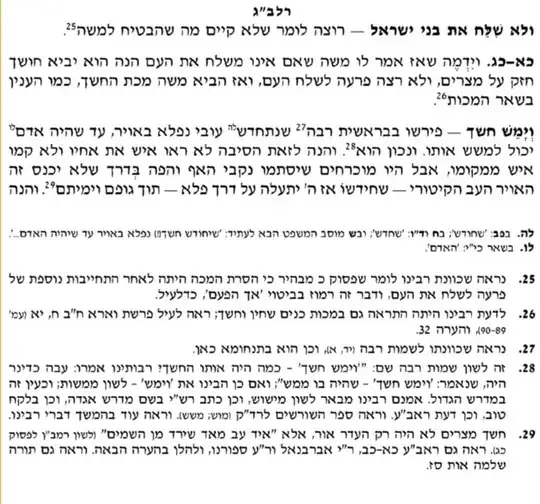
The Ralbag on Choshech quotes the Medrash about the darkness being a golden coin thick and explains that the darkness was tangible and so strong that the Mitzrim were forced to plug their nostrils and mouths up and it caused a tremendous suffering. If the air would enter their bodies they could die.

The Bal Kesav V’hakebbalah takes issue with this pshat and asks how it is possible to survive with their nostrils and mouths plugged up for three days.

enter image description here

sam
  • 41,686
  • 4
  • 80
  • 141
  • 2
    +1 this is good. I checked Ralbag, but I think he is saying something slightly different. In order to breath they had to block their mouths and noses so that the thick smokey(?) air wouldn't enter. It seems it was kind of like covering one's mouth with a cloth when walking through polluted air. Haven't checked kv'k yet, but I think ralbag makes sense. This is somewhat a side point though, no? We don't know if he understood the not getting up as literal result of the thickness of choshech do we? The fact that they couldn't breath can be independent of that understanding. +1 in any case. – user6591 Feb 06 '17 at 17:54
  • The Ralbag on Choshech quotes the Medrash about the darkness being a golden coin thick I don't see that in my Ralbag. Could you indicate where he quotes this Midrash? – mevaqesh Feb 06 '17 at 18:34
  • @user6591 We don't know if he understood the not getting up as literal result of the thickness of choshech do we As noted Rassag, Rashbam, Ibn Ezra, and many others don't understand it to meant paralysis. It would be very surprising if Ralbag, usually the first reject fantastical Midrashim, would break from the tradition of the pashtanim. This strengthens your point that "This is somewhat a side point though" and not actually an answer. – mevaqesh Feb 06 '17 at 18:39
  • @mevaqesh,thatstl the Medrash he is referring to,I dont know what your issue is – sam Feb 06 '17 at 18:46
  • @mevaqesh true. But I didn't think it deserved a downvote. The reason I upvoted it was because had the question been phrased slightly differently, which it easily could have been, this would have been a great answer. Imagine the question as did choshech affect breathing, the reason I ask is because it was so thick etc. the fact that the OP chose to ask it from a different angle doesn't take away from the basic idea of how did they breath during choshech. Answers Ralbag with cloths over their mouths and noses. – user6591 Feb 06 '17 at 18:58
  • @sam My point was very simple that all he references is that it had substance; not that it was as thick as a dinar. While texts of Midrashim varied wildly, so we don't know if Ralbag even had such a text mentioning the thickness, even if he had our texts, it is still a jump to state that he references that Midrash. Not a big jump, but a jump nonetheless. Lastly, it should be noted that the idea of the darkness having substance is present elsewhere in the Midrash, e.g. 14:3, where the dinnar thickness is not mentioned. – mevaqesh Feb 06 '17 at 19:17
1

R' Avigdor Miller, in his commentary Atem Eidei on Shemos, writes the following; "the land was suffocated; breathing was possible only under a blanket, but even blankets were blackened by the heavy soot". It is evident that this was R' Miller's understanding of Ralbag, as suggested by user6591 above.

shimshon
  • 21
  • 2
1

There is no reason to assume that a miraculous form of darkness was analogous to something in nature. If you're looking for some liquid that is breathable then there is no such thing in nature.

You could equally, however, posit 'invisible straps' that made people not be able to move, or 'invisible cement up to the Egyptains' necks', etc. By this point its much easier to assume that the plagues are digressions from nature, rather than being natural.

Furthermore, no natural explanation would be able to explain why only Egyptains, not Jews, were affected. So to suggest that 'because they cannot move, it therefore must have been difficult for them to breath in an invisible liquid' does not seem logical. Unless there is reason to believe that the Egyptains were in an invisible liquid, requiring some other miracle for them to breath...

bondonk
  • 10,280
  • 2
  • 26
  • 76
  • So you're back to the question: What precisely was going on? According to this answer an entire array of open miracles were at play and nobody told us about them. – Danny Schoemann Feb 07 '17 at 09:16