The Gemara on 7b states: אמר אביי רבי ור’ יאשיה ורבי יהודה ורבי שמעון ורבן גמליאל ובית שמאי ורבי אליעזר ואחרים כולהו סבירא להו סוכה דירת קבע בעינן. Each one of the Tannaim listed holds that a sukkah needs a particular aspect of קבע in order for a sukkah to be valid. However, if Rebbi Yehuda simply allows a sukkah to be either above 20 amos in height, where it would be a דירת קבע, or below 20 amos where it would be דירת עראי, he would not belong on this list of Tannaim that maintain that a sukkah must be a דירת קבע בעינן.
Therefore in accordance with the Meiri commenting on Gemara 2b, Rebbi Yehuda maintains that the קבע requirement of a sukkah can be satisfied either on the basis of the dimension of height or on the basis of length and width. And this approach would be consistent with the Baraisa on 3b that a dwelling is considered to be a דירת קבע if it is greater than 4×4 amos in length and width. Likewise, this is also similar to Rebbe’s opinion on 7b which defines the קבע of a sukkah solely in the terms of length and width at 4×4 amos. Therefore, the difference between the two Tannaim is that Rebbi Yehuda utilizes height or length and width in defining a דירת קבע.
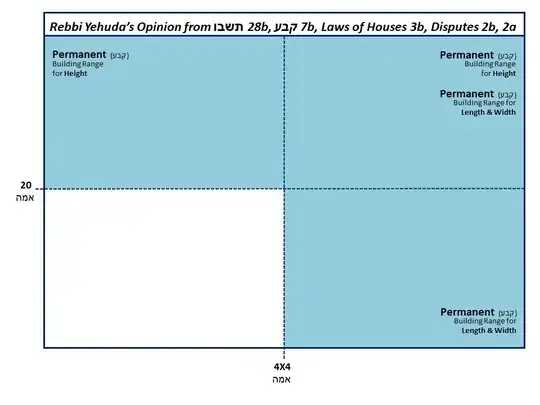
In an attempt to answer this same question, some may assert an alternative understanding of Rebbi Yehuda’s opinion by stating that perhaps Rebbi Yehuda could accept the קבע requirements of the other Tannaim. However, this approach would not be consistent with how the Ritva and Ran understand the Gemara’s use of the term כולהו סבירא להו, which they understand to mean that each disputant is in disagreement with his fellow in some aspect of the halacha.
This conclusion is further supported by the fact that Rebbi Yehuda can be seen to dispute R’ Shimon’s קבע requirement for a fourth wall in that he is in agreement with Mishna 2a that states: ושאין לה שלשה דפנות … פסולה. Therefore, a sukkah that has three walls is valid.
Likewise, Rebbi Yehuda can be shown to oppose Rabban Gamliel’s understanding of the קבע requirement of a sukkah in that it cannot be a mobile sukkah such as one that sits atop a wagon. This is observed in Gemara 23a which states that Rebbi Yehuda’s reason for invalidating a sukkah built on the back of an animal is on the basis of the verse that states: חג הסוכות תעשה לך שבעת ימים, The festival of Succos you shall make for seven days. Rebbi Yehuda does not invalidate the sukkah because it is a mobile sukkah, rather because a sukkah atop an animal cannot be used in such as manner on Yom Tov and consequently cannot be utilized for all seven days. Therefore, it is only for the fact that this sukkah cannot be used on the one day of Yom Tov that Rebbi Yehuda invalidates the sukkah. The implication is that the Gemara understands that had it not been for the one day of Yom Tov Rebbi Yehuda would permit a sukkah to be built on top of the back of an animal. Therefore, Rebbi Yehuda would permit a sukkah to be built on top of a wagon since its use would not be forbidden on Yom Tov.
Furthermore, while Rebbi Yehuda allows a sukkah to be greater than 4×4 amos in length to qualify as a דירת קבע, in accordance with the understanding of the Ritvah and Ran, Rebbi Yehuda disputes Rebbe’s absolute requirement of 4×4 amos when he validates a sukkah of less than that measurement. This is clearly seen on 2b where in the name of Rav, Rav Huna and Rav Chanan bar Rabbah state that the argument between the Tanna Kamma and Rebbi Yehuda is in a sukkah above 20 amos in height which is less than 4×4 amos in length and width.
More context than can be provided here is needed to explain how Rebbi Yehuda disputes Beis Shammai’s קבע requirement of ראשו ורובו ושולחנו. Suffice it to say here that he does.

