0

I observed someone praying shacharis who had covered with his tallis both his head and also his forehead down to his eyes.

I thought that the possuk Devorim 28 (10)

 וראו כל עמי הארץ כי שם ה' נקרא עליך ויראו ממך     

And all the peoples of the world will see that the name of Hashem is written on you and will fear you

referred to the head tefillin which should be visible (Berachos daf 6).

Is there a recognised practice to cover the forehead when praying even if the head tefillo cannot be seen?

Dov
  • 32,729
  • 3
  • 27
  • 85
Avrohom Yitzchok
  • 47,518
  • 8
  • 47
  • 131
  • 1
    This might be helpful (Magen Avraham 8:3): https://www.sefaria.org/Magen_Avraham.8.3?vhe=Magen_Avraham&lang=en&lookup=%D7%9E%D7%9B%D7%A1%D7%94&with=Lexicon&lang2=en – Shmuel Apr 24 '22 at 20:34
  • OK for covering the tefillin - but what about the forehead? – Avrohom Yitzchok Apr 25 '22 at 01:55
  • Sorry, I am not that familiair with this. This article on Chabad cites the Yesodei Yeshurun, Siddur Lechol, Keriyat Shema where it says that the shechina rests upon the face of a person when praying (Shema). Out of respect for the Shechina, we cover our face, according to the article: https://www.chabad.org/library/article_cdo/aid/5192896/jewish/Why-Do-We-Cover-Our-Eyes-for-Shema.htm/fbclid/IwAR3x9Eem6flAEHw7QSHmno99V9dqRgQ6ZJiFL28B0taLykG6q7oyK-AWAL0#utm_source=facebook&utm_medium=social&utm_campaign=fb_en See also this: https://judaism.stackexchange.com/q/15332/27180 – Shmuel Apr 25 '22 at 20:35
  • Ben Ish Chai year one Wayyera hilkhot tefilin: יח קודם הנחת תפלין של ראש בראשו, יסתכל בשבעה זייני"ן שיש בשני שיני"ן דאית בהו רזין סתימין עמיקין כמו שכתוב בזוהר הקדוש, והובא זה בדברי האחרונים ז"ל, ודע כי אע"ג דמרן ז"ל בסוף סעיף כ"ז כתב "תפלין של ראש טוב להניחם גלויים", הנה המקובלים ז"ל סבירא להו לכסות בטלית שיוריד הטלית עד סוף המצח. וטעמם ונימוקם עמם על פי הסוד וזה עיקר: Despite Maran z"l... the mekubalim hold the talit should cover [the tefilin] and bring the talit down to the "end of the forehead" - is that the top or bottom? – Nissim Nanach Apr 26 '22 at 03:06
  • Maybe in a place where not 'כל עמי הארץ' see him, he can be lax about his head tefillin actually being visible. Maybe it's enough that they can see the bulge of the tefillin through the tallis (it doesn't say "וראו כל עמי הארץ את שם ה' נקרא עליך", but "וראו כל עמי הארץ כי שם ה' נקרא עליך"). If anything, that possuk would suggest that he should have tefillin on his head when out on the street, and throughout the day, so that all the peoples of the world will [get to] see that the name of Hashem is called on him (and not just those in shul with him, in the morning). – Tamir Evan Apr 26 '22 at 07:33

1 Answers1

2

The Mishna Brurah 91:6 brings the Zohar that writes that one should cover one's eyes with their talis during shmoneh esrei . There are those who say that one should only do this when one isn't wearing teffilin since one should not cover the teffilin(shel rosh) completely. However, from a plain reading it seems like it should be done with or without teffilin.

There is a way to be mekayim both ideas of covering one's eyes and leaving teffilin exposed ,by covering one's eyes with the sides of the tallis and leaving teffilin exposed.

Rav Chaim Kanievsky held that when the MB wrote that one should cover their head and eyes with a talis it means when one isn't wearing teffilin. He also held that when the Arizal said to cover the teffilin it meant to cover just a bit of it ,but not all of it.

Text of MB:

משום הכון לקראת וגו' - איתא בזוהר ואתחנן מאן דקאים בצלותא בעי לכסויי רישיה ועינוי בגין דלא יסתכל בשכינתא. [והיינו בטלית של מצוה וכן נוהגין כהיום לכסות ראש עד עינים בטלית מצוה בשעת תפלת י"ח. פמ"ג] מאן דפקח עינוי בשעת צלותיה מקדים עליה מה"מ וכו' ועיין בסי' צ"ה במ"ב סק"ה

Text of Daas Noteh (Rav Chaim Kanievsky opinion):
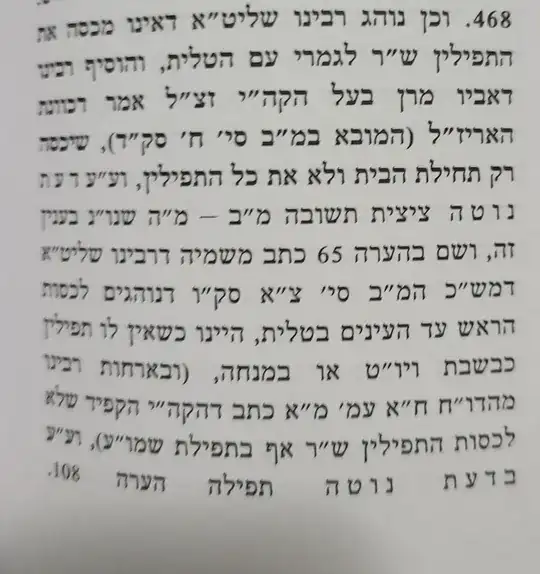
enter image description here

sam
  • 41,686
  • 4
  • 80
  • 141
  • I remember seeing that Rav Chaim Kanievsky held one only covers ones eyes with talis on shabbos or musaf without teffilin . Will add once I find it.. – sam Apr 25 '22 at 15:32
  • Seems the Zohar doesn't quote say it like the MB, but rather close the eyes: תָּא חֲזֵי, מַאן דְּקָאִים בִּצְלוֹתָא, בָּעֵי לְכַוְּונָא רַגְלוֹי, וְאוֹקְמוּהָ. וּבָעֵי לְחַפְּיָא רֵישֵׁיהּ, כְּמַאן דְּקָאִים קַמֵּי מַלְכָּא. וּבָעֵי לְמִכְסְיָיה (למכסייא) (ס''א לאסתמא) עֵינוֹי, בְּגִין דְּלָא יִסְתָּכַּל בִּשְׁכִינְתָּא. וּבְסִפְרָא דְּרַב הַמְנוּנָא סָבָא אָמַר, מַאן דְּפָקַח עֵינוֹי בְּשַׁעֲתָא דִּצְלוֹתָא, אוֹ דְּלָא מָאִיךְ עֵינוֹי בְּאַרְעָא, – Nissim Nanach Apr 26 '22 at 12:56
  • Come and see - whoever is standing in prayer must direct his feet, must cover (ChFY) his head like someone standing before a king, and must hide (KSY i.e. close) his eyes in order that he not gaze at the Shekhina. And in Sifra d'Rab Hamnuna Saba he said, whoever opens (PQCh) his eyes during prayer, or does not lower his eyes to the ground, [stern warnings r"l...] https://www.sefaria.org/Zohar.3.260b.2?vhe=New_Torat_Emet_Zohar&lang=bi – Nissim Nanach Apr 26 '22 at 12:56