0

Quran specifies permissible and non-permissible marriages in chapter 4, verses 22, 23, and 24.

Basically a list is given and then it's said that marry whomever beyond that list.

But granddaughters are not mentioned in the list.

Does this mean that grandfather can marry granddaughter?

goldPseudo
  • 12,475
  • 16
  • 59
  • 131
Saeed Neamati
  • 669
  • 6
  • 16
  • 3
    Does this answer your question? Who are the women that a man is forbidden to marry?. A grand-daughter is a daughter and the word بناتكم is inclusive of all female descendants, not matter how low, e.g. granddaughter, great grand daughter, great great grand daughter and so on. – UmH Nov 30 '21 at 14:24
  • @UmH thank you. Can you support that claim linguistically? I mean, in other languages daughter means daughter and no more than that. – Saeed Neamati Nov 30 '21 at 14:28
  • 1
    Even in English, the fact that granddaughter is a type of daughter is obvious in the word itself. It is a daughter described with the word "grand" which is to signify one level down. But, this is not so common to use in contemporary english – The Z Nov 30 '21 at 19:42
  • 1
    In Arabic, it is obvious in phrases like Bani Israel or Bani Adam, which all literally mean sons, but it refers to all descendants. – The Z Nov 30 '21 at 19:44
  • I have closed your main question as a duplicate, and edited out the follow-up question which really should be asked separately. – goldPseudo Dec 06 '21 at 19:28

1 Answers1

3

Granddaughters are mahrams to their grandfathers, it is not permissible to marry them. They are included in the meaning of the verse:

... حرمت عليكم أمهاتكم وبناتكم

Prohibited to you [for marriage] are your mothers, your daughters ...

Quran 4:23

Since بنات (daughters) can mean every female descendant, no matter how low i.e. granddaughter, great granddaughter, great great granddaughter and so on. Additionally there is consensus that granddaughters are forbidden for marriage. And it is also rational since Allah has forbidden nieces, whereas granddaughters are a closer relationship than them.


Ref:
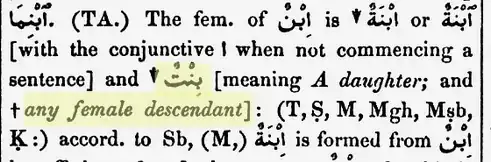
enter image description here

Lane's Arabic English Lexicon

وبناتكم - جمع : البنت ، فيدخل فيهن بنات الأولاد وإن سفلن

Binat is the plural of bint and it includes the daughters of one's children however far removed

Tafsir al-Baghawy

UmH
  • 28,329
  • 4
  • 40
  • 147
  • Again, in spite of appreciating your time, I have to admit that tafsir is not a good source for lingual approval. Also a dictionary from 1883 I guess is also not a good source. – Saeed Neamati Nov 30 '21 at 16:52
  • 1
    If Arabs use bint to refer to all female descendants, then there should be clear evidences all over the literature. – Saeed Neamati Nov 30 '21 at 16:52
  • For example, in English they have a single pronoun for the second person (attendee) and it's all over all texts. They might have thou but that is definitely archaic. – Saeed Neamati Nov 30 '21 at 16:55
  • 1
    And what is your problem with a scholarly exegesis and a well respected lexicon? There are even verses from the Bible where the cognate of daughters is used to mean descandants such as Genesis 36:2, 2 Samuel 1:24 Luke 1:5, Luke 13:16 etc. Usage of sons/daughters to mean descendants is well known. – UmH Nov 30 '21 at 17:24
  • I don't have problems with solid arguments. I only want to be sure. Grandchildren exist everywhere. Thus if using daughter to refer to them is common, we should see it in movies, in stories and novels, etc. – Saeed Neamati Nov 30 '21 at 17:35
  • Those references from the Bible were very helpful. Thank you. – Saeed Neamati Nov 30 '21 at 17:48
  • @SaeedNeamati granddaughters are simply the daughters of the daughters or the daughters of the sons, so they are daughters of one's offspring and similarly one could go upwards from mothers to grandmothers... This is a logic further Allah used the plurals (without specifying unlike where such a specification is needed) which mean any kind of these are meant. As a grandfather if sitting with daughters and granddaughters would call their gathering simply "my daughters". This is also common in other languages. – Medi1Saif Nov 30 '21 at 17:50