3

There is great ask about what should we eat? But I was always strugling how should one eat his food, sitting and thinking while eating a food. I see on my self that I don't respect food as much as I need to (want to). I sustain this body just because of the food I eat...

So my question is, how one should behave, do, think, (do every thing) while eating a food to show respect to his life?

3 Answers3

1

There is a popular mantra amongst some bhaktas, that could be of information to you sir. This is an advaitic perspective.

Here is a link This is from Shrimad Bhagavad Gita by Lord Krishna.

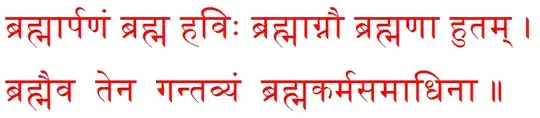
Brahmarpanam Brahma Havir Brahmagnau Brahmana Hutam Brahmaiva Tena Ghantavyam Brahmakarma Samadhina [Bhagavad Gita 4:24]

The bramharpanam shloka in sanskrit

The act of offering is Brahman. The offering itself is Brahman. The offering is done by Brahman in the sacred fire which is Brahman. He alone attains Brahman who, in all actions, is fully absorbed in Brahman.

This means that the act of eating, the object being eaten, and the one who eats. These three are One. These three are none other than Brahman. Remembering this prayer before every meal is what some bhaktas do in order to remind them of the One Unity behind the apparent phenomenal world. All the best!!

Sai
  • 4,435
  • 2
  • 19
  • 33
  • I wonder who started the practice of uttering the Brahmarpanam verse before meals. (I can certainly understand the intent behind it.) I assume it's a fairly recent practice; in ancient times the main thing the verse was associated with was the Yagna described in Purusha Sukta of the Rig Veda. By the way, it's a Bhagavad Gita verse, so you should call it a shloka, not a mantra. – Keshav Srinivasan May 18 '15 at 04:21
  • @KeshavSrinivasan - People also use om sahanavavatu sahanobhunaktu shanti mantra before eating. Also we should not talk during eating because any form of talk generates vittis. In order to realize bramhan in food we should sit and eat without uttering a word and just remain in calmness without thinking of good or bad (just pure concious existence should be the goal. – Yogi May 18 '15 at 05:19
  • I find my self quite often thinking obout the garbage (no existential meaning thoughts), and with this I kinda feel that I'm not respecting the food. So when I feel garbage in my mind I do some mantras like some similar mantra Hare Krisna. But still I kinda feel that I joust want to cover it... so I joust put my self in meditate state like @Creator say. But this verse of yours uff... its powerfull :D. To really feel this words while eating and to be in the calmness state should be the respect that I was looking for. Thank you! –  May 18 '15 at 09:41
  • @urosjarc which verse are you talking about – Yogi May 18 '15 at 10:09
  • Sai's translation of Brahmarpanam Brahma... –  May 18 '15 at 11:09
  • I tried to really feel your words Sai while eating, and in one moment I saw in food what property I would get if I eat it. And I think that "you are what you eat" is false its more like "you will become what are you eating", i kinda don't know how to express this with words :) –  May 18 '15 at 14:30
  • @KeshavSrinivasan yeah its a shloka. I feel its also a mantra, depending on what one means by mantra. IMHO mantra is based on this definition 'mananat trayate iti mantraha', which means that which protects, when repeated, is a mantra. So IMHO this is a mantra. But I'm sure scholars would say this is not. Thanks. All the best. – Sai May 18 '15 at 14:38
  • @Creator thank you for sharing those beautiful mantras. While eating, while sleeping, while drinking, while eating, while performing any actions, quietness is indeed important. But real quietness is quietness of thought. Such quietness will reveal to you the True Self.To achieve that state, quietness of talk is a tool. All the best. – Sai May 18 '15 at 14:40
  • @urosjarc Thank you for sharing your experiences. I feel inspired by reading your experiences upon chanting and feeling the sholka/mantra. Thank you sir. – Sai May 18 '15 at 14:41
  • @Sai Well, the difference is that a mantra has an inherent power in its sound. So if you walked up to an American on the street and told him to recite the words "Namo Narayanaya" every day, even if he had no idea it had anything to do with religion or spirituality, that by itself might be enough for him to attain Moksha (along with his Karma which led him to recite it, of course). On the other hand, the beautiful Gita shloka "Brahmano hi pratishtaham" has no inherent power of sound, but if you recited it while reflecting on its meaning regarding Vishnu, that would give you spiritual benefit. – Keshav Srinivasan May 18 '15 at 15:57
  • @KeshavSrinivasan and that's why its subjective because I think every Shloka has that inherent power of sound. It is upon the faith of the devotee. IMHO a devotee of God reciting 'Sri Krishna please grant me peace' is thousand times powerful than a newbie reciting 'Om Shanti Shanti Shanti Hi'. I know you subscribe to different philosophy so as you always say 'We're going to have to agree to disagree on this one'. All the best – Sai May 18 '15 at 16:01
  • @Sai Well, what you're taking about is a derived power of sound: reciting "Sri Krishna grant me peace" is powerful if it is said with devotion. But a mantra has a power regardless of what is in the heart of the person saying it. That is how Ajamila went to Vaikuntha, even though he was a sinner all his life. And I don't think this is a philosophical difference; if anything it's the Advaita Acharyas who have fostered the teaching of Shiksha (the art of Sanskrit pronunciation), because they believe that mantras are a form of Brahman and thus correctly pronouncing mantras is immensely important. – Keshav Srinivasan May 18 '15 at 17:48
  • @KeshavSrinivasan I feel my last example was not good enough, so let me clarify each of your points. "reciting Sri Krishna grant me peace is powerful if it is said with devotion". Yes the same goes for 'Om ,... Namaha' (I dont want to write any names and get into controversies). There are people who chant it thousand times everyday with no effect and there are people who chant it once and attain Nirvikalpa Samadhi. This cannot be denied. the difference is the faith that one has in the mantra. Therefore in this matter, there is little or no difference between the shloka and the mantra. – Sai May 18 '15 at 18:28
  • @KeshavSrinivasan 'But a mantra has a power regardless what is in the heart of the person saying it'. The same goes for shloka. A person who recites the entire Bhagavad Gita everyday obtains the same benefits of the person reciting Gayatri Mantra. Even though the former is a list of Shlokas and the latter is a mantra. Even if the person has no idea what He is saying. – Sai May 18 '15 at 18:29
  • @KeshavSrinivasan the question of 'Ajamila went to Vaikuntha, even though he was a sinner all his life'. I have a slightly different moral to that story. The moral is not about repeating a mantra without knowing the meaning. But it is rather about remembering God during the time of death. Remembrance of God during ones last few moments will liberate the soul from the bondage of birth and death. In order to remember the Lord during the last few moments, it is necessary to practice sadhana throughout one's life. – Sai May 18 '15 at 18:32
  • @KeshavSrinivasan "its the Advaita Acharyas who have fostered the teaching of Shiksha or proper pronunciation'. I think this is a different point altogether. Shlokas or mantras, both have to be chanted with proper Sanskrit pronunciation. I am not disagreeing there. My whole point is that the question of 'which is a shloka and which is a mantra' is really only of a grammatical significance and not spiritual – Sai May 18 '15 at 18:38
  • @KeshavSrinivasan - I also believe in these words by Sri Ramakrishna Paramhansa in the Gospel - [Approach the Divine as a child approaches his mother, with the same purity, sincerity, ardent love, and faith, and the Mother will come to you! Call ‘Ma, Ma’; call again and again. The Mother is bound to come.] Thats why I thought you may or may not believe in it. I dont know if it has anything to do with advaita or dvaita. All the best – Sai May 18 '15 at 18:39
  • @Sai Well, let me just ask you this: consider a person who is completely evil, has no faith at all, etc. Are you saying that if such a person chants a mantra like "Namo Narayanaya" or "Nama Shivaya", without having any idea what it means, then it will have no effect? I certainly agree that chanting it with faith would have more effect, but there is something sacred about those sequences of syllables, such that regardless of the circumstances which lead to their chanting, they still do good for person uttering them. By the way, Ajamila wasnt even thinking of Vishnu, he was just calling his son. – Keshav Srinivasan May 18 '15 at 18:53
  • @KeshavSrinivasan I think that such a person who chants 'Namo Narayana' certainly gets a good benefit. But you are saying that the same person chanting 'Brahmarpanam' does not get anything. That's where I disagree – Sai May 18 '15 at 18:54
  • @Sai OK I see where our disagreement lies. I just see a fundamental difference between Shruti and Smriti. The words of the Bhagavad Gita are sacred because of their meaning (and the one who said them, of course. But if Krishna had told Arjuna "Akshararpanam Aksharahavir..." (Akshara means Brahman), it wouldnt make any difference because the meaning is the same. But the Vedic mantras are different: "Namo Narayanaya" and "Vande Vishnum" convey the same meaning, but the syllable sequence in "Namo Narayana" is sacred. Thats why people have tried much harder to preserve the exact text of the Vedas. – Keshav Srinivasan May 18 '15 at 19:19
  • @KeshavSrinivasan Yes Im sure there are many who subscribe to both views. To me every verse of Bhagavad Gita is as important as the Vedas. Just as the Vedas originate from God, it is the same with the Gita. Infact the Gita is one of the least altered texts preserved very well. I also agree that there are differences between Shruti and Smriti. But just as not all Vedic statements are equally potent mantras, even in Smriti there are powerful verses which can dispell the darkness of ignorance is my belief (for example: 'Om Tat Sat' from Gita). – Sai May 18 '15 at 19:39
  • @Sai Yeah, the Gita is very well-preserved, thanks to the work of Adi Shankaracharya; there are only 14 potential verses which are left out of standard Gita editions, as I discuss here. (You can read the extra verses themselves here.). – Keshav Srinivasan May 18 '15 at 21:39
  • @Sai By the way, I agree wholeheartedly with your statetment "Just as the Vedas originate from God, it is the same with the Gifa." You may be interested in my question here, about the arguments used to establish that works authored by Vishnu have scriptural authority (which we find obvious, but people used to debate that): http://hinduism.stackexchange.com/q/6912/36 – Keshav Srinivasan May 18 '15 at 21:42
  • @Keshav - you say Akshara is brahman. But, if you read BG , Akshara is identified Soul or jeevathma. Krishna clearly says he is separate, beyond and higher than both Akshara (cit) and Kshara (achit) –  Jun 26 '15 at 18:44
  • @Krishna Well, akshara just means indestructible, so it can refer to either the Jivatma or Brahman depending on the context. Like I think there's Gita verse that starts with "aksharam paramam brahma". – Keshav Srinivasan Jun 26 '15 at 19:41
  • @Keshav - I not saying disputing it. But, Krishna, explicitly says that he is higher than akshara and kshara –  Jun 27 '15 at 09:10
  • @Krishna Yeah, and I'm just saying the word is used differently in different contexts. – Keshav Srinivasan Jun 27 '15 at 13:33
  • @Krishna For instance, the word Akshara is used to denote Brahman in Brihadaranyaka Upanishad verse 3.8.8. This is made clear in the Brahma Sutras; see the Sri Bhashya: http://www.sacred-texts.com/hin/sbe48/sbe48108.htm – Keshav Srinivasan Jun 27 '15 at 18:05
  • @Keshav- I am not contending it. But, the Akshara (Jiva) is below Supreme paramatma as told by lord krishna. The word Akshara means Jiva some times and some times paramatma. It depends on the context –  Jun 27 '15 at 18:43
  • @Krishna Yeah, we're in agreement. By the way, have you seen my question on Nammalwar? Parashara Bhattar says that Nammalwar lamented being born six weeks too late after Krishna departed the Earth, but I can't find it in the Thiruvaimozhi: http://hinduism.stackexchange.com/q/7564/36 – Keshav Srinivasan Jun 27 '15 at 19:03
  • @Keshav- yes..I think, one needs to check some Srivaishnava scholars where this verse is in Tiruvaimozhi. –  Jun 27 '15 at 19:24
  • Brahmarpanam is Gita 4.24 – Swami Vishwananda Aug 01 '15 at 10:58
  • @SwamiVishwananda yeah, I forgot to add it, thank you Swamiji, I have added that information into the answer. – Sai Aug 02 '15 at 03:42
  • @Sai Do you know any mantras of Shiva to chant while eating? – The Destroyer Feb 08 '16 at 04:39
  • @AnilKumar I'm sorry, but I am not aware of any specific mantras to be chanted for Lord Shiva while eating. I will definitely be sure to update you if I find out any mantra for God. Thanks – Sai Feb 08 '16 at 15:39
0

Swami Chinmayananda text books teachings say that,

  1. If you are born as human being you cannot survive without killing even if its just vegetarian like plants, grains.
  2. Only way to avoid the karma of killing plants is through a prayer or offering to god before consuming. The "Brahmaarpanam" (Its in Gita 9th chapter) is the one prescribed in Chinmayananda books.
PraveenMak
  • 101
  • 2
  • Welcome to Hinduism.SE! Answers on this site should be backed up with sources, so do you know which Chinmayananda book this information is from? – Keshav Srinivasan Jun 26 '15 at 15:36
  • Yes, its in the "MyPrayers" book. They have prayers when you get up in teh morning, taking shower , before food etc. – PraveenMak Jul 08 '15 at 18:44
0

Here I will give an answer to your question as Vaishnavas tend to do.

First of all, a Vaishnava does not take any food just like that, just to take it and begins to eat, but he takes a food with the intention that he will offer it first to the Lord Krishna. Basically there are two main reasons for that:

1) One reason is that the Lord asks to be offered the food before we eat it. This is nicely seen from the Bhagavad gita 9.26:
http://vedabase.com/bg/9/26/en

"If one offers Me with love and devotion a leaf, a flower, fruit or water, I will accept it."

See, Lord Krishna does not think that we should take and eat some food if we have not first offered it to Him! In fact He specifically says that we should offer food to Him with love and devotion (bhaktyā, bhakti-upahṛtam). The idea is that we offer food to Him with an attitude like that we serve some great and important exalted guest -- a guest who will accept our offering, as He says "I will accept it". It is a kind of service that we offer for His satisfaction, but it is also the way of developing a relationship with Him, giving with devotion (bhakti) -- accepting.
Then the Lord takes the food and it is considered that the food is left for us to eat it and venerate (regard with great respect; revere), as if that were food remnants that are left over after the Lord took the food. Those remnants are called the Lord's prasāda "mercy".

2) And secondly there are karmic reasons. It is said in the Bhagavad gita 3.13:
http://vedabase.com/bg/3/13/en

"The devotees of the Lord are released from all kinds of sins because they eat food which is offered first for sacrifice. Others, who prepare food for personal sense enjoyment, verily eat only sin."

Here it is said that offering the food to the Lord is, like, a participation in the sacrifice, and because of this sacrifice the food is free of sin.

So, first we offer Him food in sacrifice and then partake of the remnants that are literally called His prasāda "mercy".
Thus you can meditate on all of that mentioned above when you offer the food and later when you eat the food you can appreciate and enjoy the Lord's remnants, the Lord's prasāda "mercy", and thus you can venerate.

Pandya
  • 26,175
  • 10
  • 99
  • 243
brahma jijnasa
  • 3,035
  • 19
  • 36
  • "See, in this verse Lord Krishna does not think that we should take and eat some food if we have not first offered it to Him!" I don't think verse 9.26 addresses whether we should eat food that's not offered to Vishnu. Krishna is just saying that if we offer it, then he'll accept the offering. He doesn't talk about whether eating without offering is fine or not. Verse 3.13 is much more relevant. By the way, verse 3.13 reminds me of the Anna Sukta of the Taittiriya Brahmana, which I discuss in the end of my question here: http://hinduism.stackexchange.com/q/6582/36 – Keshav Srinivasan Jul 31 '15 at 22:16
  • @Keshav Yeah, indeed, it reminds of the sukta, good finding! -- So, we now have a confirmation in Shruti for the Gita verse 3.13. I often wondered where did Lord Krishna get all these ideas that He teaches Arjuna. It is often said that Smriti, and Gita too, derive their knowledge from Shruti. ---- Now, about my sentence above. I edited so that I deleted a part of the sentence "in this verse". I think this will be sufficient because as far as sentence reads now, it is correct. It is consistent with the teachings of the Vaishnavas. – brahma jijnasa Aug 01 '15 at 17:45
  • "I often wondered where did Lord Krishna get all these ideas that He teaches Arjuna. It is often said that Smriti, and Gita too, derive their knowledge from Shruti." That is actually a very interesting subject. the Bhagavad Gita actually originates in the Pancharatra tradition, aka Bhagavata Dharma. The wisdom contained in the Bhagavad Gita was taught earlier to the ancient kings of the solar dynasty, and Ikshvaku tried to spread these doctrines far and wide. But over time the Pancharatra tradition was lost, until Krishna revived it in the battlefield of Kurukshetra. – Keshav Srinivasan Aug 01 '15 at 18:16
  • See this chapter of the Shanti Parva of the Mahabharata, specifically what it says about the seventh Mahakalpa: http://www.sacred-texts.com/hin/m12/m12c048.htm Now regarding your question about the Gita originating in Shruti, the Pancharatra tradition actually has its origin in Shruti, not in the Pancharatra Agamas we have today. You see, there was originally a Shakha of the Shukla Yajur Veda called the Ekayana Shakha, founded by Vishnu's incarnation sage Narayana (brother of Nara). Pancharatra philosophy originates from this Shakha, but unfortunately over time the Shakha was lost. – Keshav Srinivasan Aug 01 '15 at 18:55
  • But thankfully, Vishnu anticipated that the Ekayana Shakha of the Shukla Yajur Veda would be lost one day, so he also composed a series of texts we now call the Pancharatra Agamas, in order to preserve the wisdom of the Ekayana Shakha. For more details you can read Yamunacharya's work the Agama Pramanya. I've posted a bunch of questions about the Agama Pramanya here: http://hinduism.stackexchange.com/search?q=Pramanya By the way, the Anna Sukta of the Taittiriya Brahmana is a very important hymn, because it is used by the gods and liberated souls to praise Vishnu in his abode of Vaikuntha. – Keshav Srinivasan Aug 01 '15 at 19:04