These are the relevant ślokas -
vālmīkiścāha bhagavān yudhiṣṭhiramidaṁ vacaḥ /
vivāde sāgnimunibhirbrahmaghno vai bhavāniti //
uktaḥ kṣaṇena cāviṣṭastenādharmeṇa bhārata /
so'hamīśānamanaghamamoghaṁ śaraṇaṁ gataḥ //
muktaścāsmi tataḥ pāpaistato duḥkhavināśanaḥ /
āha māṁ tripuraghno vai yaśaste'grayaṁ bhaviṣyati //
~ Anuśāsana Parva (18.8-10)
According to me, Vālmīki doesn't actually commit brahmahatyā, in this case. If Vālmīki had committed brahmahatyā earlier, he would have known it himself, he wouldn't come to know about it suddenly, while having a vivāda with the munis. Vālmīki tells Yudhiṣṭhira (ślokas # 9b-10), that after this incident, he went into the śaraṇa of Śiva, to destroy his pāpa of brahmahatyā, which seems to imply that he didn't bear the doṣa of brahmahatya before the vivāda with the munis. I disagree with the view that the wordings of the munis (brahmaghno..) were a false accusation or slander on their part, because then Vālmīki would have no need to destroy the pāpa of brahmahatyā. So, there are three interpretations here-
(i) The wordings (brahmaghno..) indicate that a kinda śāpa was bestowed by the agnihotrin munis on Vālmīki. Although Vālmīki hadn't himself committed the pāpakarman of brahmahatyā in this case, yet due to the munis' śāpa, he was bestowed with the patitva corresponding to brahmahatyā. This aligns with the interpretative standpoint taken by the translators of Gītā Press, as shown in attached img. (here's link)
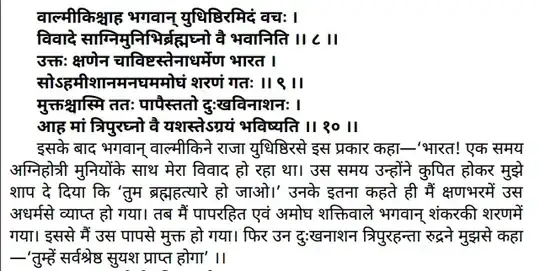
Why did the munis bestow śāpa on Vālmīki ? Gītā Press seems to hold that they had done it upon being angered/dissatisfied by Vālmīki, during vāda. Were they angered because of them perceiving Vālmīki saying something wrong or his disrespecting them? Or were they angered because of being defeated by Vālmīki in the vāda? The exact reason of them taking such an action, isn't known and can only be speculated upon.
(ii) Although Vālmīki hadn't committed brahmahatyā per se in the vivāda, he had committed a pāpakarman while having the vivāda with the agnihotrin munis, which they deemed equivalent to brahmahatyā. In his commentary Bhāratabhāvadīpa, Nīlakaṇṭha states -
vivāde vedaviparītavāde agnisahitermunibhirukta iti sambandha // (8)
tena vedavirodhajena // (9)
Here, Nīlakaṇṭha seems to imply that Vālmīki had put forth Vedaviruddha arguments, while having vāda with the munis. The vāda itself was going Vedaviparīta via his arguments. So, him (Vālmīki) being called upon (by the munis) as having committed brahmahatyā, is in that context.
Yājñavalkya smṛti (3.228) states that vedanindā is a pāpakarman equivalent to brahmahatyā -
guruṇāmadhyadhikṣepo vedanindā suhṛdvadhaḥ /
brahmahatyāsamaṁ jñeyamadhītasya ca nāśanam //
Mitākṣarā adds- "nāstikābhiniveśena vedakutsanam ...brahmahatyāsamanī"
Aparārka adds - "vedānāṁ nindanamprāmāṇyābhidhānam ... brahmahatyāsamaṁ veditavyaṁ"
Even arguing against the prāmāṇya of a Vedavākya, can be taken as Vedanindā, and thus equivalent pāpakarman to Brahmahatyā. So, Vālmīki might have done such a karman, either intentionally or by mistake, in vivāda.
(iii) This interpretation combines before two interpretations basically. Due to the Vedaviruddha arguments put forth by Vālmīki, during his vivāda with the munis, out of dissatisfaction, anger, etc., the munis bestowed a śāpa upon him, that made him patita with the pāpa of brahmahatyā.
Therefore, I have provided three interpretations, in order to resolve the issue, mentioned by OP.


