The total number of Purana texts is terribly uncertain, ranging from fifty to a hundred. Some of these texts are lost in the myths of history; we find references to them in other texts, but we don't have any complete manuscripts. To somewhat ease the burden of these texts, they themselves declare that there are principal eighteen of them, usually referred to as Maha-puranas. Some are recognized as Sthala Puranas, delineating the eminence and sanctity of a specific geographical location. Others are identified as Upa-Puranas, denoting minor Puranas. The compilation of Upa-Puranas exhibits regional variations, and there is no nationwide consensus regarding the list of Upa-Puranas.
Thus, the eighteen Puranas are; (estimated date of Composition from academic point of view, and the traditionally believed number of verses)-

The above-mentioned list is not universal either; in some lists, the Bhavishya Purana (500–1900 CE; 14,500 verses) is included, knocking out the Vayu Purana. Yet in other lists, Shiva purana is knocked out from the list and Vayu purana and Bhavisya purana are included.
To Complicate things Further, The Vayu Purana itself knocks out Agni,Linga,Vishnu and Shiva puranas from the Mahapurana list and instead adds one 'Adi Purana' in the fray.

Puranic Scholar Bibek Debroy states-
The Vayu Purana exhibits many more Purana characteristics than the
Bhavishya Purana does. There are references to a Bhavishya Purana that
existed, but that may not necessarily be the Bhavishya Purana as we
know it today. That’s true of some other Puranas too. Texts have been
completely restructured hundreds of years later. Third, it is not just
a question of Bhavishya Purana and Vayu Purana. In the lists given in
some Puranas, Vayu is part of the eighteen, but Agni is knocked out.
In some others, Narasimha and Vayu are included, but Brahmanda and
Garuda are knocked out.
That there are puranas outside even the standard list is evidenced by the fact that many ancient Nibandhakaras have cited purana texts which are not even mentioned in any of the 18 mahapurana or upapurana lists in any scriptures.
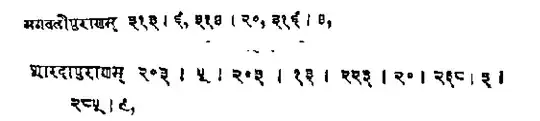

An example of this would be how Hemadri (13th CE) cites Puranas by the name of 'Bhagavati Purana' , 'Sharada Purana' and 'Devirahasya purana' in his Dharmasastra work 'Chaturvagra chintamani'. Neither of these works are available today, nor are they even even mentioned in the lists of puranas/upapuranas in any of the scriptures.
Now, let's cast a glance on their integrity. Initially, the traditional outlook conjectures that these were authored by an ancient Sage named Krishna Dvaipayana Veda Vyasa, in entirety. And this claim is backed using references of the same.
Shiva Purana affirms that the offspring of Satyavati, Vyasa, was the composer of the eighteen (principal i.e., Mahapurana) of them, अष्टादश पुराणानां वक्ता सत्यवती सुतः।, But contradicting the same, The Bhavishya purana lists the 18 puranas to be compositions of different authors.
पराशरेण रचितं पुराणं विष्णुदैवतम् ।।शिवेन रचितं स्कांदं पाद्मं
ब्रह्ममुखोद्भवम् ।। 3.3.28.१० ।। शुकप्रोक्तं भागवतं ब्राह्मं वै
ब्रह्मणा कृतम् ।।गारुडं हरिणा प्रोक्तं षड् वै सात्त्विकसंभवाः ।। ११ ।।
मत्स्यः कूर्मो नृसिंहश्च वामनः शिव एव च ।।वायुरेतत्पुराणानि व्यासेन
रचितानि वै ।। १२ ।। राजसाः षट् स्मृता वीर कर्मकांडमया भुवि
।।मार्कंण्डेयं च वाराहं मार्कण्डेयेन निर्मितम् ।। १३ ।।
आग्नेयमंगिराश्चैव जनयामास चोत्तमम् ।।लिंगब्रह्मांडके चापि तंडिना रचिते
शुभे ।। महादेवेन लोकार्थे भविष्यं रचितं शुभम् ।। १४ ।।
~ भविष्यपुराणम् /पर्व ३ (प्रतिसर्गपर्व)/खण्डः ३/अध्यायः २८
According to the above, Parasara composed Vishnu Purana, Shiva composed Skanda Purana, Brahama composed Padma Purana and Brahma purana, Shukadaeva composed Bhagavata purana,and Vishnu composed Garuda Purana.Matsya, Kurma, Nrsimha, Vamana and Shiva Puranas are the only ones stated to be composed by Vyasa. Marakandeya and Varaha puranas are stated to be compositions of markandeya, Meanwhile Agni purana is stated to be composed by Angira,Linga and Brahmanda puranas are stated to be compositions of Sage Tandi, and the Bhavisya purana is stated as a composition of Mahadeva.
In yet other puranas, the story Given for the origin of the puranas is that there was intitially Only one purana in the start of the kalpa, which was later abridged and divided into 18 for the beneifit of the people of kaliyuga. This theory finds support in puranas such as matsya, narada and skanda.
पुराणमेकेमेवाऽऽसीत्तया कल्पान्तरेऽनघ। त्रिवर्ग साधनं पुण्यं शतकोटि
प्रविस्तरम्।।
There was only one Purana in the beginning of the Kalpa. It was alone
the means of the accomplishment of the three ends of man (Dharma,
Artha and Kāma). And it was the only holy book consisting of thousand
millions of stanzas.
~ Matsya Purana verse 53.4
पुराणमेकमेवासीत्सर्वकल्पेषु मानद। चतुर्वर्गस्य बीजं च
शतकोटिप्रविस्तरम्॥ २२
O bestower of honor, In all the kalpas, there was only one Purana that
was the seed of the fourfold aims of life. It extended to a hundred
crores of verses.
~ नारदपुराणम्- पूर्वार्धः/अध्यायः ९२
Scholar J.L. shastri writes in the footnotes of the Narada purana for the above verse

Now, this is quite enchanting in itself. The reference to the latter gives us some hints regarding the genesis and development of these gigantic bodies of texts, including their vivid writing styles. Taking a bird's eye view of the style of composition, these texts exhibit a blended superimposition of multiple layers of conversations among individuals or deities overlapping at several instances. Perhaps the narrations were composed by a single individual, marking the terminus a quo post-Vedic age, which was popular among the hoi polloi. Over epochs, these narrations have journeyed, evolving beneath the sway of regional, cultural, and ideological shifts.
Regarding the evolutionary factors, these narrations had to traverse numerous sectarian and malicious channels. During the second half of the first millennium and beyond, following the decline of Buddhism, the foremost representatives of Vedic thought were engaged in developing separate schools of Vedanta. A well-known yet unknown dogma was partially confiscating the ideologies i.e., supremacy of deities.

There's a strong likelihood that none of the current prevalent
expressions of the Hindu faith took their current form before the era
of Sankaracharya, the influential reformer who thrived in the eighth
or ninth century. Ramanuja, among the Vaishnava teachers, emerged in
the twelfth century; Madhva in the thirteenth, and Vallabha in the
sixteenth. The Puranas appear to have coincided with or followed these
innovations, evidently designed to promote the doctrines they
espoused.
~ H.H.Wilson
But the influence of these individuals in these texts wasn't solely positive. The information mentioned about these individuals in the Puranas is sometimes peculiar, ignominious, and degrading in nature. For example,
A segment in the Padma Puranas, Uttar-khand, mentions that Pasandins, particularly those devoted to Shiva worship, have been delineated, and the Mayavada (of Sankaracarya) has been criticized as Pracchanna Bauddha (i.e., disguised Buddhism).
Renowned Puranas researcher Dr. Rajendra Chandra Hazara states about this chapter, "Though the absence of such verses subjects the above information to doubts, there is a chapter (263) which seems to have been interpolated by someone belonging to the Śrī or Madhva sect."
This view is also accepted by some traditional scholars such as Pandit Kaluram Shastri, Pandit Madhavacharya Shastri, etc. Pandit Jwala Prasad Mishra also writes in one of his books :-

The Above scholar elaborates how the padma purana went through multiple revisions. The first was the one actually compiled by vyasa, the second revision was during the decline of buddhism, the third is as per the description of the purana as stated in the Brihannaradiya, and the fourth one was when the views of Sri Ramanuja and Madhvacharya attained currency.
This view seems to be true at least to an extent, for as Dr. R.C. Hazra states, there are manuscripts which state that there were originally only 5 khandas to this purana compared to the 7 which the currently published version has.

And even the Naradiya purana which gives a complete overview of the chapters of Padma in detail , does not mention the chapters in uttarakhanda which deal with the condemnation of mayavada and 'heretical' doctrines.
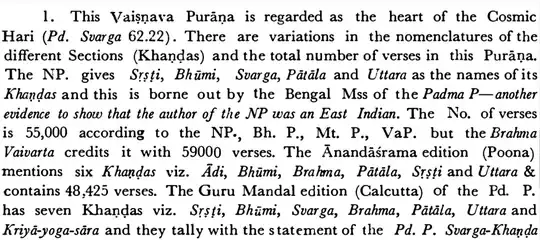

In a manner similar to the above verses, in the Saura Purana, A Shaivite text, some chapters, most probably inserted by Shaivas, assert that,
प्रच्छन्नोऽसौ महादुष्टश्चार्वाको मधुसंज्ञकः भविष्यति कलौ विप्राः
शिवनिन्दाप्रवर्तकः (४१.६१) मधुदर्शितमार्गेण पापिष्ठा वैष्णवाः कलौ
भविष्यन्ति ततो म्लेच्छाः शूद्रा यूथबहिष्कृताः (३९.७७)
Madhva, known as Madhu in the text, is depicted as a Carvaka, an
extremely malevolent, covert disseminator of the slander of Siva. His
Vaisnava adherents are malevolent beings; they are mlecchas, sudras,
and should be ostracized from the community.
While some puranas have undergone comparatively lesser revisions, there are others which have undergone so many that they have almost lost their original character. One example of this is probably the Krishnaite text Brahma Vaivarta Purana.
Puranas researcher Anand Swarup Gupta mentions the existence of a recension of the text called Adi-Brahmavaivaivarta purana, which is extremely different from the extant version of the text available today.


On further Perusal, Yet another observation which suggests that puranas as they are available today lack integrity and cannot be completey the works of one author is through the notorious Puranic classification concept - Satvik, Rajsik, and Tamsik. This is because there's no certainty or criteria to implement the classification on these texts as they contradict each other.
Just imagine, an individual writes 18 texts, and almost all of them contain more or less the same stories from different perspectives. As the Panchalakshana states, that they need to describe the histories of the Solar and Lunar dynasties, the deities with which they deal in the mythological section are also approximately the same. Yet, some of them will lead you to heaven, and some will lead you to hell... How interesting!
So, firstly we shall see the classification of Matsya Purana. It affirms that Sattvik Puranas primarily exalt Hari, the Rajasik Puranas primarily extol Brahma, while the Tamasik Puranas extol Agni and Siva, alongside Samkarsana (of mixed nature), Sarasvati, and the Pitrs.
सात्त्विकेषु पुराणेषु माहात्म्यमधिकं हरेः ।राजसेषु च माहात्म्यमधिकं ब्रह्मणो विदुः।।
तद्वदग्नेश्च माहात्म्यं तामसेषु शिवस्य च। संकीर्णेषु सरस्वत्याः पितृणां च निगद्यते ।।(Matsya-P., 53. 67-68)

No the question to ask if the above is true, then why aren't there any puranas that are predominant with the glory of brahma,sarasvati, or pitrs? Almost all the puranas currently available are either predominantly Vaishnavite or Shaivite with traces of shaktam and sauram. If the above is true, then none of the currently available 'Rajasa' puranas are in anything close to their original form.
As per the Padma Purana, the Sattvik Puranas guide towards salvation, the Rajasic Puranas lead to heaven, and the Tamasic Puranas lead to hell.
सात्त्विका मोक्षदाः प्रोक्ता राजसाः स्वर्गदाः शुभाः। तथैव तामसा देवि निरयप्राप्तिहेतवः ।। (VI. 263-85)
However, in the Bhavishya Purana, the Rajasik Puranas are said primarily focus on the karma-kanda or rituals, whereas the Tamasik Puranas relate to Sakta dharma.
राजसाः षट् स्मृता वीर कर्मकाण्डमया भुवि। तामसाः षट् स्मृताः प्राज्ञैः शक्तिधर्मपरायणाः।। ( III. iii.28,13ab, 15ab)
And the classification they provide is -

Quite contradictory in nature, not just the criteria of Sattvik, Rajasik, and Tamasik categorization, but they declare outrightly that texts related to some specific deity are not good. None of the texts listed tamasa in this classifications are predominantly shakta, and it's quite interesting to see how certain 'sattvika' puranas of padma purana are pushed to rajasa/tamasa category in this classification, while the Skandapurana, a shaivite purana is listed as sattvika which is baffling.
In the Garuda Purana, the Brahma Khand's first chapter, it states that Vishnu-related texts are Sattvik, and Shiva-related texts are Tamasic, and provides yet another classification, which contradicts both of the above.

So, the Puranas, which classify other Puranas based on deities, are really flawed in this perspective. The Matsya Purana, a Vaishnav Purana considered Sattvik in this classification, while the Padma Purana considers Varaha as a Sattvik text. However, the Bhavishya Purana considers it Tamsik, and the Garuda Purana considers it Rajasik. While they are usually thought to glorify Vishnu, according to the Shiva-rahasya khanda of the Sankara Samhita of the Skanda Purāna, the Vamana Purana is the one among the ten Puranas (Shiva, Markandeya, Linga, Varaha, Skanda, Matsya, Kurma, Vamana, Vayu, and the Brahanda) that praises Shiva.
Beyond the relative superiority of Vishnu vis-à-vis Shiva, the
taxonomy probably doesn’t serve much purpose. The second
classification is even more tenuous and is based on the three gunas of
sattva (purity), rajas (passion) and tamas (ignorance).
−Bibek Debroy
I think it's pretty clear by now that these classifications are self-contradictory in nature and not universal and can't be taken seriously from an unbiased outlook. In ancient times, this was a highly debated topic; Vaishnavas tried to prove that the Shiva Purana is Tamasic as it contains tales making Shiva supreme to Vishnu, while Shaivas tried to prove it Sattvik.
One classic example is the controversy between Vijayendra Tirtha (a Madhva Vaishnav) and Appayya Diksita (a follower of Srikantha Shivacharya). Both of these individuals wrote a number of texts to prove the supremacy of their ista-deva. For example, Šaivasarvasvakhandanam of Vijayendra Tirtha [a polemical treatise refuting the supremacy of Siva over Vishnu depicted in the various episodes of the Saiva Puranas] and Śivapurāņatāmasatvakhandanam of Appayya Diksita [a work which refutes the view that the Siva Purana is a Tamasic work].
Some scholars, using these factors, totally neglect the Puranas and consider them nothing more than highly interpolated sectarian works. Like Prof. Edwin James Rapson states in his book Cambridge history of India-

The mainstream traditionalist view however, differs. Nonetheless, the presence of interpolations is still accepted by informed members of the traditionalist diaspora.
There is perhaps an element of the imaginary in the Puranas. It is
also possible that they contain interpolations. But who is to
determine what parts are imaginary and what passages constitute the
interpolations? And who is to seperate the authentic from the
spurious? If each one of us removes what seems interpolatory, nothing
will be left of the stories in the end. So it would be better to
preserve the Puranas in the form in which they have been handed down
to us notwithstanding the apparent errors and distortions.
~ Quoted from the book 'Hindu Dharma' by Sri Sri Chandrasekharendra Saraswathi MahaSwami of Kanchi peetham
I cannot say which parts are interpolated but surely there are interpolations. My reasoning is that Śrī Jīva Gosvāmī quotes many
verses from Brahma Vaivarta Purāṇa and they are not to be found in the
available editions. Moreover, what is available now, he does not
quote. If they had been available in the Brahma Vaivarta Purāṇa at
that time, he would have definitely quoted them, because they would
also have been useful to his work. Jīva Gosvāmī also mentions the
story of Śukadeva’s birth, in which it is said that he did not want to
come out of the womb, and took birth only on Krsna’s assurance that
His māyā will not trouble him. This is supposed to be in Brahma
Vaivarta Purāṇa but is not seen in the available editions. Some
research should be done what is interpolated.
In Bhaviṣya Purāṇa there are also descriptions about Caitanya
Mahāprabhu, Guru Nanak, Kabir, etc. It is over 20 years ago that I
read Bhaviṣya Purāṇa, but if I am not wrong there is a story of a
meeting between Mahāprabhu and Bhaṭṭaji Dīkṣit, the author of
Siddhānta Kaumudī. Now Bhaṭṭajī lived even after Jīva Gosvāmī, so how
could he have met Mahāprabhu? I remember when I read it, I lost all
faith in these stories. There is also a verse in Bhaviṣya Purāṇa
which says that in Kaliyuga ravi-vāsara (Sanskrit name for Sunday)
will be called Sunday. That is quite a far out prediction. So
definitely here are interpolations in Puranas. Some have more
interpolations and some less.
~ Satyanarana Dasa Babaji (Gaudiya Vaishnavism)
On A Disconnected note, As we bring the write up to a close, It would be interesting to observe how sri Adi shankaracharya interprets the word 'Purana' in Vedic context.
स यथार्द्रएधाग्नेरभ्याहितात्पृथग्धूमा विनिश्चरन्ति, एवं वा अरेऽस्य
महतो भूतस्य निह्̣स्वसितमेतद्यदृग्वेदो यजुर्वेदह्̣ सामवेदोऽथर्वाङ्गिरस
इतिहासह्̣ पुराणम् विद्या उपनिस्̣अदह्̣ श्लोकाह्̣ सूत्रान्यनुव्याख्यानानि व्याख्यानानि; अस्यैवैतानि निःश्वसितानि ॥ १० ॥
As from a fire kindled with wet faggot diverse kinds of smoke issue,
even so, my dear, the Ṛg-Veda, Yajur-Veda, Sāma-Veda, Atharvāṅgirasa,
Itihasa, Purana, arts, Upaniṣads, verses, aphorisms, elucidations and
explanations are (like) the breath of this infinite Reality. They are
like the breath of this (Supreme Self).
~ Brihadaranyaka Upanishad 2.4.10:
Sri Adi Shankara Comments-
एवम् उत्पत्तिकाले प्रागुत्पत्तेः ब्रह्मैवेति शक्यमवगन्तुम् ; यथा
अग्नेः विस्फुलिङ्गधूमाङ्गारार्चिषां प्राग्विभागात् अग्निरेवेति
भवत्यग्न्येकत्वम् , एवं जगत् नामरूपविकृतं प्रागुत्पत्तेः प्रज्ञानघन
एवेति युक्तं ग्रहीतुम् — इत्येतदुच्यते — स यथा — आर्द्रैधाग्नेः
आर्द्रैरेधोभिरिद्धोऽग्निः आर्द्रैधाग्निः, तस्मात् , अभ्याहितात्
पृथग्धूमाः, पृथक् नानाप्रकारम् , धूमग्रहणं
विस्फुलिङ्गादिप्रदर्शनार्थम् , धूमविस्फुलिङ्गादयः, विनिश्चरन्ति
विनिर्गच्छन्ति ; एवम् — यथायं दृष्टान्तः ; अरे मैत्रेयि अस्य परमात्मनः
प्रकृतस्य महतो भूतस्य निश्वसितमेतत् ; निश्वसितमिव निश्वसितम् ; यथा
अप्रयत्नेनैव पुरुषनिश्वासो भवति, एवं वै अरे । किं तन्निश्वसितमिव ततो
जातमित्युच्यते — यदृग्वेदो यजुर्वेदः सामवेदोऽथर्वाङ्गिरसः - चतुर्विधं
मन्त्रजातम् , इतिहास इति, उर्वशीपुरूरवसोः संवादादिः — ‘उर्वशी
हाप्सराः’ (शत. ब्रा. ११ । ५ । १ । १) इत्यादि ब्राह्मणमेव, पुराणम् —
‘असद्वा इदमग्र आसीत्’ (तै. उ. २ । ७ । १)इत्यादि
The Ṛg-Veda, Yajur-Veda, Sāma-Veda, Atharvāṅgirasa, i.e. the four kinds of Mantras. By Itihasa, such as the dialogue between Urvaśī and Purūravas—‘The nymph Urvaśī,’ and so on ; it is this Brāhmaṇa that is meant.By Purana, such as, ‘This universe was in the beginning unmanifest,’ etc. (Taittiriya. Up. II. 7)etc.(are meant).


