Here, Tulsidas is talking of Shri Ram's incarnation as Shri Vamana.
Note: ISKCON version, the Geeta Press Gorakhpur pdf didn't allow copy-paste, and if I took pictures, it would be like a whole page and a half worth of pictures, but I verified to make sure they are the same thing cause I know some want a non ISCKON associated source.
तत्र भगवत: साक्षाद्यज्ञलिङ्गस्य विष्णोर्विक्रमतो वामपादाङ्गुष्ठनखनिर्भिन्नोर्ध्वाण्डकटाहविवरेणान्त:प्रविष्टा या बाह्यजलधारा तच्चरणपङ्कजावनेजनारुणकिञ्जल्कोपरञ्जिताखिलजगदघमलापहोपस्पर्शनामला साक्षाद्भगवत्पदीत्यनुपलक्षितवचोऽभिधीयमानातिमहता कालेन युगसहस्रोपलक्षणेन दिवो मूर्धन्यवततार यत्तद्विष्णुपदमाहु: ॥ SB 5.17.1
Śukadeva Gosvāmī said: My dear King, Lord Viṣṇu, the enjoyer of all sacrifices, appeared as Vāmanadeva in the sacrificial arena of Bali Mahārāja. Then He extended His left foot to the end of the universe and pierced a hole in its covering with the nail of His big toe. Through the hole, the pure water of the Causal Ocean entered this universe as the Ganges River. Having washed the lotus feet of the Lord, which are covered with reddish powder, the water of the Ganges acquired a gorgeous pink colour. Every living being can immediately purify his mind of material contamination by touching the transcendental water of the Ganges, yet its waters remain ever pure. Because the Ganges directly touches the lotus feet of the Lord before descending within this universe, she is known as Viṣṇupadī. Later, she receives" other names likeViṣṇu'sī and Bhāgī"athī. After one thousand millenniums, the Ganges water descended Vishnu'svaloka, the topmost planet in this universe. Therefore, all learned sages and scholars procVishnu'suvaloka to be Viṣṇupada [“situated on Lord Viṣṇu’s lotus feet”].
Now, the question might arise: How come the story is about Vishnu's incarnation, but here Pujya Shree Gowswami Tulsidasji Maharaj uses the name of another of Vishnu's incarnations, Ram? The answer is that the name Ram existed before the incarnation of Ram. The substance (tattva) of Ram that Gowswami is talking of is the Para-Brahm. That Para-Brahm is said to be Visnu in Bhagavatam and Ram in Ramcharitmanas. Another reason is that Shree Tulsidasji Maharaj is in bhakti bhava, so he sees everything as Ram (it is Advaita philosophy in a sense). For him, the original form of the Para-Brahm is that of Ram, and that Ram turns into Vishnu.
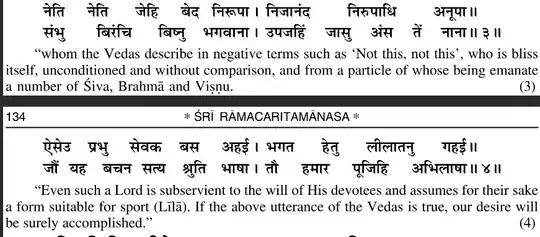
As can be seen in the picture below, Pujya Gowswamiji tells us it is the supreme Brahm that takes the form of Ram and blesses Manu and Satrupa to be born as their child. So, to please the devotees, supreme Brham takes the form of Ram. In other cases, the supreme Brahm comes as Shiva and Vishnu to please the devotees.
 Geeta Press Gorakhpur
It is foolish to try to separate the Lord and his incarnation as it is the same Lord. Vishnu=Ram=Krishna=Vamana (even scriptures tend to use names interchangeably for the lord and his incarnations).
In summary, Pujya Shree Tulsidasji Maharaj does so because Ram is Para-Brahm, so he always existed and is Vishnu of Bhagavatam. This means Ram takes incarnation as Vamana (as he is Vishnu). Of course, the name of god and his incarnations are infinite, and all the names are used interchangeably. Depending on sampradaya: When it says Vishnu and Shiva come out of Ram, it is either taken directly at face value or it is seen as said bhati bhava, as Shree Tulsidasji Mharaj sees nothing but Ram.
In some Sampradaya, Ram = Vishnu = Shiva, in some Ram-> Vishnu = Shiva, in some Shiva-> Vishnu -> Ram, in some Vishnu -> Ram -> Shiva, etc., all these differences are due to bhakti-bhava.
It is commonly accepted by most Vaishnavacharyas that they are all the same. Still, we, due to our loving devotion and following in the footsteps of previous acharyas, select one form of god and treat it as supreme. The more you study with a Pujya Satguru Dev Maharaj more you will come to understand and see them as one and the same.
Hopefully, I was able to answer your question. It is suggested scripture is best read with the guidance of Satgurudev Bhagwan, as scriptures tend to confuse even the smartest of people. Also, this scripture has knowledge of all scriptures, so it is common to get confused about the meaning of the scripture. Try to get initiated into a traditional authentic sampradaya (of course, as I'm Vaishnava, I am biased toward the four Vaishnava sampradayas) and read with guidance of the guru if possible; else listen to ram katha on YouTube. Listening to Satsang and doing Naam Jaap ultimately leads to Satguru Dev Bhagwan.


