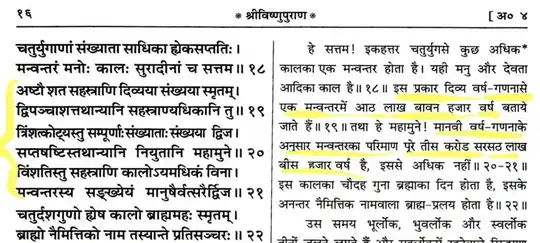
In Hinduism, the duration of Kali Yuga is believed to be 432,000 years. This belief is based on the scriptures, particularly the Srimad Bhagavatam and the Mahabharata.
The confusion about the duration of Kali Yuga arises from a misinterpretation of a verse in the Surya Siddhanta, an ancient Hindu text on astronomy. The verse states that Kali Yuga began when the sun and moon were in conjunction at the beginning of the lunar month of Kartik. Some scholars have interpreted this verse to mean that Kali Yuga began on the day of the conjunction, which occurred in 3102 BCE. Using the four yugas cycle of Satya, Treta, Dwapara, and Kali, they have calculated the duration of Kali Yuga to be 5,000 years. However, this interpretation is not supported by other Hindu texts and is considered to be a mistake.
The correct calculation of the duration of Kali Yuga is 432,000 years. This is based on the scriptures, which describe the duration of each of the four yugas in a descending order. Satya Yuga lasts for 1,728,000 years, Treta Yuga lasts for 1,296,000 years, Dwapara Yuga lasts for 864,000 years, and Kali Yuga lasts for 432,000 years. After the end of Kali Yuga, a new cycle of yugas begins with Satya Yuga.
It is important to note that the concept of yugas and their durations is a symbolic representation of the cyclical nature of time in Hinduism. The exact duration of each yuga may not be as important as the spiritual lessons that they convey.
The mention of the duration of Kali Yuga as 4,32,000 years can be found in the Mahabharata, Book 12, Shanti Parva, Section 231, Verse 8. Here's an English translation of the verse:
"Eighteen yugas have passed away, and there are only two yugas now. O son of Kuru's race, those two are the Krita and the Kali. The duration of the Krita has been stated to be four thousand years and that of the Kali Yuga, only one thousand. The remaining period of time, constituting the difference between the Krita and the Yuga that comes next after it, is called a twilight by those that are well versed in ancient lore."