10

The Alwars (also spelled Azhwars) are a group of 12 ancient Vaishnava saints who lived in Tamil Nadu and are famous for their poetry in praise of Vishnu. The Alwars are crucially important figures in the development of Vaishnavism; it is the principles and beliefs embodied in the Alwars' poems that ultimately gave rise to the Sri Vaishnava sect (of which I'm a member). The Alwars praised many Vishnu temples and other sacred places of Vishnu in their poetry; a sacred place of Vishnu that was praised by at least one Alwar is called a Divya Desam, and there are 108 of them;here is the list.

One of the 108 Divya Desams is Thiruvidanthai near Chennai, the site of the Lakshmi Varahaswami temple, AKA the Nithya Kalyana Perumal Vishnu temple:
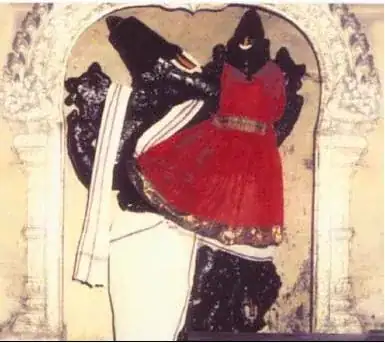
enter image description here

This is where Vishnu's incarnation Varaha the boar appeared to the sage Galava and married his 360 daughters, all of whom were incarnations of Vishnu's wife Lakshmi. They all merged into a single woman, Komalavali, who appears on Varaha's lap above.

But this web page says that Vishnu also appeared to another sage in this location; for Thiruvidanthai it says "Prathyaksham to Markandeyar". Prathyaksham is a term for a god appearing directly before someone's eyes. So my question is, what is the story of Vishnu appearing before the sage Markandeya in this place?

For those who don't know, Markandeya is a famous sage who was saved from Yama god of death by Shiva because of his devotion to Shiva. But Markandeya is also a great devotee of Vishnu; the famous Upillaiappan Vishnu Temple near Kumbakonam is due to Vishnu appearing before Markandeya in his Venkateshwara form and marrying Markandeya's daughter. But does anyone know the story of Vishnu appearing before Markandeya in Thiruvidanthai? Is this before or after his interactions with Upillaiappan?

Dr. Vineet Aggarwal
  • 19,325
  • 3
  • 100
  • 206
Keshav Srinivasan
  • 98,014
  • 18
  • 293
  • 853
  • Can you provide the Sanskrit names of these kshEtras, if possible. In my experience, Tamil kshetras have a corresponding Sanskrit name. For e.g., Tiruvannaikoil is Jambukeswara. Thx. –  Jan 25 '15 at 00:03
  • @moonstar2001 Well, I don't think Thiruvidanthal has a Sanskrit names. But the name of the deity, Nitya Kalyana Perumal, is Sanskrit except for the Perumal part (Perumal is a name of Vishnu). – Keshav Srinivasan Jan 25 '15 at 18:43
  • Thank you. How about Uppiliappan? Kumbhakonam has a Chakrapani temple. Is it the same? –  Jan 26 '15 at 02:31
  • @moonstar2001 No, Chakrapani is a different temple. Chakrapani is a temple that's actually in Kumbakonam. Upillaiappan is in a place called Thiruvinnagar near Kumbakonam. I'm not sure whether Thiruvinnagar has a Sanskrit name, but this Wikipedia article says that the story of Upillaiappan is recounted in the Brahmanda Purana: http://en.wikipedia.org/wiki/Uppiliappan_Temple#Legend So presumably the account there would have Sanskrit names. Unfortunately I wasn't able to find it in the Brahmanda Purana. Here's the table of contents and index: http://tinyurl.com/kqrhhvs http://tinyurl.com/laxj5a5 – Keshav Srinivasan Jan 27 '15 at 03:01
  • 1
    @moonstar2001 I happened to go to the Upillaiappan temple the day after my last comment to you, and in the Sthala Purana of the temple it says that one of the boons that Markandeya asks Upilliappan is "The holy place should be known in his name as Markandeya kshetra." And then it says "The Lord glandly granted the boons as prayed for and further blessed that the place will be known as "Tiruvinnagar' and 'Tulasivani Markandeya kshetra'" – Keshav Srinivasan Jan 30 '15 at 14:18
  • @moonstar2001 You're welcome. By the way, I just posted a new question about Upillaiappan, because I want to know where exactly the story occurs in the Brahmanda Purana: http://hinduism.stackexchange.com/q/5301/36 – Keshav Srinivasan Jan 31 '15 at 03:41
  • @gansub I'm not sure about Mala; perhaps its a loanword that Sanskrit borrowed from Tamil. In any case at least the "Peru" part, meaning big, is a Tamil word. – Keshav Srinivasan Mar 12 '16 at 17:59
  • @gansub Yes, I'm born and brought up in America, and I can understand Tamil but I can't read or write it, and I don't know Sanskrit. In any case, if you know any Sanskrit scriptures that use Mala as a name of Vishnu, I'm happy to see them. I was just speculating because I haven't encountered it. – Keshav Srinivasan Mar 13 '16 at 03:09
  • @gansub Yeah, I belong to the Sri Vaishnava Sampradayam (and my Acharya is the Vanamamalai Jeeyar), but unfortunately living in America I don't really have much access to Sri Vaishnava Acharyas. By the way, out of curiosity what tradition do you belong to? – Keshav Srinivasan Mar 13 '16 at 03:29
  • The Wikipedia page on 108 divya desams mentions that Thiruvallikeni is present in Kanchipuram, but it's actually in Triplicane, Chennai. Someone with an account on Wikipedia should edit that. – Bhargav Rao Jan 01 '18 at 01:49
  • @KeshavSrinivasan This is a good question, and a bit dated (I saw it only a few minutes ago). There are many sthala-puranas that are conflicting. So while I have no convincing answer for you, I just come through this comment to convey my view that the origins of sthala-puranas as unclear. Personally, I consider some of them like interpolations in The Puranas. For example, Kanchi Sri Ashtabhujam sannidhi is associated with Gajendra Moksham. But there is another kshetram in the south associated with the same (the name eludes my memory, but it is also regarded as one of the divya desams) – Vidyarthi Jan 15 '20 at 00:35
  • Similarly there is a sthalam in the south regarded as matsyAvatAra sthalam, but in The Puranas matsyAvatAra is described differently. In The Matsya Purana there is a reference saying only river Narmada existed during the matsyAvatArA with the rest submerging in the ocean. There are many, many, kshetras, of various Gods of Hinduism all involving sthala puranas, but the origins are not traceable in any known literature. I tend to view these stories the same way as the evolution of The Puranas. The notion of Gods and deities evolved over time from The Vedic descriptions. – Vidyarthi Jan 15 '20 at 00:40
  • @Vidyarthi I think the Vedic and Puranic conceptions of the Devas are exactly the same, and it’s just that Western Indologists who are misinterpreting Hindu scripture. Regardless, what is the supposed Matsyavatara Sthalam in the South? – Keshav Srinivasan Jan 18 '20 at 01:36
  • I don't recall from the top off my head, but will get back on that in a couple of days. As for the former message, I am not influenced by the western ideas, though I have studied the views of scholars from both sides of Atlantic (or Pacific) over the years. Personally based on my own reading and examination, it has been my continuous observation that the deities are depicted differently in The Vedas and The Puranas. Of course all these can be interpreted, differences can also be interpreted, homogenized, coerced to a form of consistence etc. Our scriptures can be interpreted in different ways – Vidyarthi Jan 18 '20 at 18:55
  • in the previous message: consistence = consistency – Vidyarthi Jan 18 '20 at 19:02
  • That said, there are many western indologists who take somewhat of an unorthodox view (in lack of better word), which I do not look askance. They have the right to see things however they make sense to them. Their views conflict with many faith based interpretations of (some of the) Indian scholars. But this is a natural consequence of our literature that has been evolving over thousands of years. That said, I know of many Indian scholars and even saints who advocate for certain views, which one might call western view. but knowing what I know about them .. contd in the next message – Vidyarthi Jan 18 '20 at 19:10
  • I do not see any western influence in their education, or training, or adherence. Interestingly I was taught the history of Sanskrit literature by two professors, and they taught both Indian and western interpretations impartially. The nice thing was they didn't force me to subscribe to any of the views, but they made sure I was aware of all the conflicting views, and the supporting reasons behind them. I guess that helped during my younger ages to see our scriptures from multiple perspectives, though I personally own the responsibility for my own view, which is an evolutionary continuum – Vidyarthi Jan 18 '20 at 19:17
  • @KeshavSrinivasan Here are the sthalams in the south that are believed to be the sthalam of Matsyavatara (by the local people, and those who are associated with the temple):
    1. There is a temple by name Adi-Narayana Perumal (also known as Adi-Ranganatha Swami, Adi-Arangan Temple) that is somewhere off Vizhuppuram, and I believe this is the wikipedia page for it, though I am not sure about the accuracy of wikipedia: https://en.wikipedia.org/wiki/Adhirangam_Ranganathaswamy_temple
    – Vidyarthi Jan 19 '20 at 01:20
  • Though the wikipedia article doesn't say any thing about the Matsyavatara, the temple I am referring to is believed to be the place where The Lord Sriman Narayana incarnated as Matsya Murthi by the locals and the priests. What I am not sure of is, whether the temple I am referring to is the same one featured in the wikipedia article.

    Another one is - https://tamilnadu-favtourism.blogspot.com/2018/08/matsya-moorthy-temple-thuvarimaan-legends.html

    Look at the first para of that link.

    There are other temples ofcourse, but they dont claim to be the avatara-stalam of Sri Matsya Murthi

    – Vidyarthi Jan 19 '20 at 01:26
  • Like the one in this stackexchange Q&A: https://hinduism.stackexchange.com/questions/2080/are-there-any-temples-for-matsya-kurma-and-varaha-avatars?noredirect=1&lq=1

    But The Puranas such as Matsya Purana & others don't sound like this avatara happened in what is called TamilNadu today. If my memory serves me well, I think Matsya Purana says only the river Narmada existed at the time of Pralaya when Matsya Murthi took people to safety. In Narayaneeyam, Sri NarayanaBhattar describes this avatara as something that happened elsewhere (take this as reference & I will post the exact slokha later)

    – Vidyarthi Jan 19 '20 at 01:32

1 Answers1

1

This is a story that I read in "Journey Through the Twelve Forests" by David L. Haberman. Markandeya occasion reminds me of Jed McKenna (the pseudonymous spiritual author) because their stories are so similar. McKenna occasionally quotes Indian spiritual works in his books, but not in a dogmatic fashion. The story which I'm about to relate is found both in the Mahabharata and the Bhagavata Purana.

D.L. Haberman version: Markandeya successfully enters the body of Vishnu and sees that the entire world is encapsulated inside it. "Everything is inside Vishnu." This is probably why the Vishvarupa of Vishnu is often described as being a macrocosm of everything. Traditional depictions of Vishnu show Him floating on an endless and featureless ocean, floating on His assistant, Shesha, accompanied by His consort, Lakshmi. Vishnu dreams the universe into existence. Alexandra David-Neel quotes a similar story where it is said that "the universe is but the dream of Brahman." Vishnu is often equated with Brahman, so, same difference.

At a certain point, Markandeya manages to escape from the mouth of Vishnu and finds himself outside of the universe, treading water on the featureless ocean (AKA, nowhere). He screams when he notices the utter nothingness around him. Vishnu wakes up and promptly plops him back in his mouth, thereby restoring his sanity. If you read McKenna's books closely you'll see that this is virtually, exactly what he experienced.

Mahabharata version: I read this one in the play adaptation by Jean Claude-Carrier, which is also quoted in McKenna's "Theory of Everything."

Much of the world has ended and become a wasted desert. Markandeya wanders around the wasteland for a several years until he sees a small blue child sitting underneath a tree (Vishnu). The child says: "you look tired, why don't you come into my mouth and rest?" Markandeya suddenly experiences a "strong disdain for life," and is swept up by an unimaginable current into the child's mouth. Wandering around inside the body of the child he sees everything on the Earth in its exact form. After an unknown amount of time he's suddenly drawn up back outside the child. The child says to him: "did you have a good rest?"

Bhagavata Purana version (book 12, chapter 9): Mr. Markandeya worships Vishnu until Vishnu is pleased with him. Vishnu asks Markandeya what he wants and Markandeya says he wants to see the power of the Lord's illusory potency. The Lord grants his wish.

Markandeya is walking around one day until the entire world undergoes dissolution, Mr. Markandeya is now floating on the causal waters all alone. Floating on some wreckage, he manages to make his way over to a child sitting underneath a tree, who once again inhales him into his body. He sees the entire universe inside for a moment and is exhaled back out.

Finding himself alone on the water, he realizes that the child is Vishnu and attempts to embrace him but at that moment the child disappears and he's left alone on the ocean. Suddenly the ocean disappears and Markandeya is once again back in his home.

James Yen
  • 405
  • 3
  • 10
  • 1
    I'm familiar with that story, but I've never heard of any indication that it has anything to do with Thiruvidanthai. – Keshav Srinivasan Nov 15 '16 at 16:22
  • Oh I see what you're saying. Yes I narrated this story to you because I figured that the only story in circulation regarding Markandeya's interactions with Vishnu was the story regarding him being taken into Vishnu's mouth in order to experience Vishnu (Brahman) as the macrocosm of the universe. – James Yen Nov 15 '16 at 18:08
  • Sorry, hitting "enter" adds the comment. So if there's any mention of Vishnu appearing to Markandeya at Thiruvidanthai, then it must be in reference to the above story (since we don't know of any other stories, at least not within the Puranas and the epics). – James Yen Nov 15 '16 at 18:10
  • 1
    I'm basically just using deductive logic. If "Prathyaksham" means appearing directly to devotees, then the story I told above accords with that term. Since, in the story, Markandeya prays to Vishnu and Vishnu appears to him personally and grants his wish. – James Yen Nov 15 '16 at 18:12