5

How do I stop thoughts when meditating ?

Meditating (on breath, etc) itself is a thought and I want to be occupied with it, however, I find myself constantly humming a song or thinking about the next thing I want to do after meditation. Even though I constantly remind myself that breath is what I want to focus on, still the other thoughts preoccupy my mind while another parallel thought is watching the breath/etc.

I am interested to know what the Hindu scriptures say about this.

Sarvabhouma
  • 25,803
  • 11
  • 123
  • 202
happybuddha
  • 327
  • 1
  • 10
  • The thoughts will come, that's how our mind functions anyway. That's why it's advised to focus on breathing or some part of body like 3rd eye. When you're focusing on one of these, try to reject any other thoughts. There is no other way because the thoughts are generated by you no one can stop these but you. – TheLittleNaruto Apr 03 '19 at 01:57
  • @TheLittleNaruto - agreed. I am happy to take the burden of stopping the thoughts - the question is - how ? Certainly, am not the first one to face this and am hoping the ancient sages of Hinduism have commented on this. – happybuddha Apr 03 '19 at 02:02
  • 2
    Keep reminding your mind these thoughts you're not seated to focus on but your breathing. This is extremely difficult to do at start. And it'll take time. So don't worry keep meditating. – TheLittleNaruto Apr 03 '19 at 02:09
  • 1
    Do not attach any importance to those thoughts. They come and they go. You are mere a witness. Ask who is the one who is witnessing the thoughts and you will end up being quiet.-Ramana Maharishi – Sai Baikampadi Apr 03 '19 at 02:46
  • 1
    When you do something which you love most, is thoughts disturbing you??? – Agamas Tantras Apr 03 '19 at 02:49
  • 1
    You need to take proper Diksha from Guru, and he would either advise methods of cleaning 5 Shariras, Koshas, or he would himself clean these. When these are cleaned, thoughts also will go off! Secondly, the karma for which you have taken this body, only if you cross that, the next door opens up in path to Brahman. – Agamas Tantras Apr 03 '19 at 02:50
  • 1
    it is a lot easier to focus on one thought than to focus on no thought. that is why scriptures recommend dhyaan on murti of ishta devata. – ram Apr 03 '19 at 03:43
  • @ram Agree! That's why one should focus on one form, after certain stage it'll lead one's mind to no form. – TheLittleNaruto Apr 03 '19 at 07:00
  • I have tried to simply witness the thoughts without reacting to - say a song repeatedly running in the mind. However all the time I set for meditation is then spent witnessing this endless loop - while the focus on breath/heart/whatever goes out of the window. I have asked who is witnessing this aka Ramana M, the answer is repeatedly I. My dilemma still remains - how do I stop the thoughts I dont want. Finding a guru for deeksha is not feasible for me (finding true guru, surrender, faith and such things will surface - and then fighting the contradicting thoughts for these attrs will be there). – happybuddha Apr 03 '19 at 10:54
  • 1
    @happybuddha you can't even stop 1 thought by fighting. In fact it will multiply. Your birth karma should be crossed and your koshas have to be cleansed. If these are done automatically how much ever thoughts your aura has will go off in 1 second. You need to turn pure and practice rituals to what nature of family you are born....and practice karma yoga without fail. When God feels u r ready and pure, either he will come himself or he will send you right guru. – Agamas Tantras Apr 03 '19 at 12:24
  • @Pratimaputra this not advice. These are absolute truth am speaking on Dharma. Worshipping God is different from full involvment, devotion, love for him is different. 1st one, you may still face death, but second one, in history we have never seen anyone dying irrespective of path they went! – Agamas Tantras Apr 03 '19 at 13:26
  • @AkshayS yes, its absolute truth. Yes, yadgatva na nivartante taddhama oaramam mama,/|\ –  Apr 03 '19 at 13:28
  • @Pratimaputra Chanting of nama definitely has great influence on one's life but chanting alone is not enough. Ex: If one is Krishna devotee , chanting Krishna nama alone not enough. When Krishna's Geeta teachings is converted into his life experience, then along with chanting will cleanse his Koshas and bestow him Moksha. But nama of Isvara has power in it!!! But that too when it will have power? One should be like Hanuman then it will have power. Full dedication, love!!! – Agamas Tantras Apr 03 '19 at 13:36

3 Answers3

4
  • There is no shortcut in Meditation as it is not a joke. Like someone randomly sits and thinks that he can control his/her mind. No! It will never happen. Randomly practicing won’t help anyone to control his/her mind.
  • Meditation Apps are all fake. If you depend on others while meditating then how is your mind in our own control?

Meditation is a purification process of mind and soul. One may require many lives to achieve that success. It requires dedication, sacrifices, truth, discipline, hard work, and many more.

Patanjali gave systematic Yoga Sadhana normally comprises of an “Eight Step” approach of Ashtanga Yoga.

A person must follow these “Eight Step” one by one which first include

  • purification of habits,
  • then the body
  • and then this leads to stabilization and concentration of mind.
    • If someone starts from step 5 or step 6 directly, he surely left it in between and call it impossible or a hoax.
    • If you don't follow what these below systematic sequence, then if you try you whole life you never stop your thoughts while meditation.

1. Pancha Yama

The five moral restraints that help us obtain control over our lower, animal centric nature thus becoming human. These are:

1. Ahimsa - control of one’s violent tendencies

2. Satya – control of one’s lying tendencies

3. Asteya - control of one’s thieving tendencies

4. Brahmacharya - control of one’s creative energies

5. Aparigraha – control of one’s possessive tendencies

2. Pancha Niyama

The five ethical observances that help us to enhance our humane qualities preparing us for the higher, conscious life of Yoga. These are:

1. Saucha – cleanliness at all levels

2. Santhosha – self contented happiness

3. Tapa - disciplined efforts

4. Swadhyaya – introspectional self analysis

5. Ishwara Pranidhana – the ability to surrender one’s will to the higher divine will after making one’s best efforts meaning thereby that one accepts with gratitude the results of one’s action coming back in the form of Divine expression

3. Asana

Having given us a clear view of Yama-Niyama as the firm foundation (Adikara Yoga) of a systematic Yoga Sadhana, Patanjali goes on to describe the third limb of Ashtanga Yoga, namely Asana as “sthira sukham asanam”. This is the best definition of Asana as a state that radiates stability and ease. Such a state may be attained only through regular, disciplined and determined practice. He advises us to practice Asana with a relaxation of effort (prayatna shaithilya) and contemplation on the infinite (ananta samapathibyam).

Through the practice of Asana, one attains the state of balanced equanimity (described in the Bhagavad Gita as Samatvam) that enables one to overcome the dualities (dwandwa anabighata) that normally torment us into imbalance.

4. Pranayama

He defines Pranayama as the “cessation of the processes of inhalation and exhalation”.

Pranayama that is a bridge between the external and internal worlds.

He describes the different varieties of Pranayama such as the external (Bahya), internal (Antara) and the stupefied (Stambavritti). He also explains that Pranayama practice is regulated by the location (Desha), season (Kala) and rhythm (Samkya) making it either to be deep (Dirgha) or subtle (Sukshma).

5. Pratyahara –

It is defines as the “withdrawing of the mind from the sensory engagements”. Just as a tortoise withdraws its limbs into its shell, the senses cease to function as soon as the mind (the main energy source for sensory function) starts the journey inwards. No wonder the mind is called the super-sense or the Ekendriya (the one sense).

Dharana, Dhyana and Samadhi are the three internal aspects (Antaranga) of Yoga:

6. Dharana

He defines Dharana as the process of binding consciousness to a point, place, region or object (desha bandhah chittasya dharana).

7. Dhyana

He further Dhyana as the state when there is a steady and continuous flow of attention and concentration on a point, place, region or object.

8. Samadhi

The state of absorptive super- consciousness (Samadhi) is expressed by Patanjali as an omnipresent state when the mind loses itself and the object alone shines without differentiation (tadeva arthamatra nirbhasyam swarupa shunyamiva samadhi).
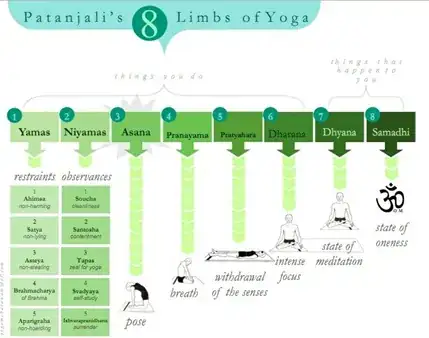
**Systematic “Eight Step” approach of Ashtanga Yoga**

Maharishi Patanjali has given us an amazing and crystal-clear road map for meditation. I offer my deepest heartfelt salutation to the great Maharishi Patanjali, the incarnation of the thousand headed Adishesha, armed with the conch, discus and mace.

Note: This is just introduction. If anyone wants to do meditation then first learn under a Guru who himself have taken Diksha from a Parampara Praapt Guru (परंपरा प्राप्त गुरु) or else don't waste your time.

  • 1
    Good answer. Thanks –  Apr 06 '19 at 12:18
  • @Pratimaputra Please note that I gave the answer according to the Q. This is only for how to stop thoughts while meditating. For Liberation we have to dedicated to a teacher (Parampara prapt Guru) and self leaning will not help in achieving liberation. –  Apr 06 '19 at 12:27
  • 1
    Yes I fully agree.The practice of yoga without guidance of an able Guru is dangerous and risk one's life. –  Apr 06 '19 at 12:34
  • Excellent!!!!!!!!!!!!! – Agamas Tantras Apr 06 '19 at 13:20
1

Arjuna asked a similar question to the Lord in Vyasa Mahabharata - specifically in Bhagavad Gita 6th skanda 35 sloka, and the bhagawAn said in response this answer:

asamsayam mahAbAhO manO dur-nigrahan-chalam abhyAsEna tu kauntEyA vairAgyEna cha gruhyatE

Meaning: It is impossible O mighty armed, to control your mind! But by practicing the art of distraction/detachment, you can slowly draw in the mind to your desired thought/input.

i.e. it is sort of like using a thorn to remove a thorn, or fighting a fire with another fire. What the Lord is saying is that you can never really remove thoughts from the mind, but by distracting the mind with other thoughts (japa, bhajana, mindfulness) you can rein it in and control it.

Vijay Sharma
  • 1,191
  • 8
  • 16
1

For someone who is beginning to practice meditation it becomes particularly difficult to meditate because of the sudden flow of thoughts. But this flow of thoughts was there before too but now since you are sitting silently are aware of them.

If you look at the origin of thought, you really have no control over it directly once the thought originates you become aware of it but by that time the thought is already there no point in wishing that it should not come. But just a thought comes if you observe a thought goes away too just like that. Boop! So thoughts keep coming and going, just become aware of this.

There could be positive thoughts or negative thoughts, and it depends on your prana levels what range of thoughts come into existence. Prana is the life force, the higher the prana, better the flow of thoughts. That is why hatha yoga is focused on cleansing the body of tamas and rajas so that you get ready to meditate. So before sitting to meditate do some yoga asanas and paranyama to raise your prana. There are other cleansing techniques too which are called shatkarmas. But they are to be in done in the presence of a teacher and not alone.

Even with higher prana levels thoughts will come but they will be positive thoughts, spontaneous and clear.

You can chant a mantra given by your guru and that is surprisingly effective in letting you move beyond thoughts. I have done the sahaj samadhi meditation and it is the most effective way for me to just slip into meditation easily.

Your quality of meditation depends a lot on what you do for the rest of the day, if you have been in bad company, drinking, smoking, eating tamasic food, talking uselessly then your meditation will be poor. But if you have been eating healthy food, talking about knowledge, doing some sort of service to the society then your meditation will be deeper and refreshing.

And learning meditation from someone who is qualified to teach is the best way to start meditating.

Diwesh kumar
  • 167
  • 7
  • Welcome to Hinduism Stack Exchange! In order to meet quality standards, we insist on citing sources. Edit your answer to include/cite some sources. – Pandya Apr 12 '19 at 01:36