8

I'm trying to construct a stainless steel high pressure containment vessel (pressure reactor) (2000 psi or so). Yes I realize that this is a don't try this at home type of thing, and I plan to put some lexan in front of it before I do any testing.

I'm looking at 2" stainless pipe with a wall thickness of .148"(rated 4000 psi), and I'm trying to figure out the best way to seal the ends. I plan on welding one end cap on, but the other end needs to be removable. I'm not certain how to calculate how much pressure a threaded pipe end would be able tolerate, or if perhaps some sort of high pressure triclamp. I've seen some industrial pressure reactor vessels, but they are rates for something like 13,000 psi, way overkill, they are also super expensive. Looking for a DIY lower cost alternative. Any info would be appreciated.

706Astor
  • 1,064
  • 1
  • 8
  • 19
user379468
  • 495
  • 2
  • 7
  • 10
  • 7
    Please also make sure it's very thick Lexan. – Ethan48 Feb 14 '15 at 18:36
  • 1
    There are a number of additional things that are needed to give a good answer here. First, what is "fairly thick" for the pipe, and how big is the overall diameter (in pressure vessels, ratio of thickness to radius is more important than either number individually.) Also, what kind of end caps are you looking to use (shape of the end cap affects the stress and force on them.) – Trevor Archibald Feb 14 '15 at 19:01
  • @TrevorArchibald Was looking at 2" OD pipe with a wall thikness of .148 in, according to Barlow's formula it can withstand 8663 psi. I'm only looking to pressurize to 2k psi but I want a huge margin of safety. When it comes to the end caps, I will probably tig weld one end, sleeve it, and tig it again, but for the open end I don't really know where to begin to calculate the forces on it. I assumed there perhaps there were some standard fittings when it comes to high pressure applications. Also when I say DIY I don't mean super cheap just cant pay 5k for a commercial one. – user379468 Feb 14 '15 at 19:52
  • 2
    If you're going to weld it, you should definitely consider getting it hydrotested before you put your process chemicals in it. That's probably a good idea for any other solution too. – Ethan48 Feb 14 '15 at 20:15
  • I don't know how to answer that, but if I did I'd be very hesitant: You, dear @user379468 sound like someone who grossly underestimates the dangers in what you are doing (I hop I'm wrong). – mart Feb 14 '15 at 22:01
  • 1
    @mart I don't underestimating anything, that is why I'm collecting as much information as possible. I understand that a pressure vessel is essentially a pipe bomb and is quite dangerous. I'm interested in creating a chamber capable of doing supercritical CO2 botanical extraction (an no not the controlled type of botanicals). My plan in addition to making the actual chamber was to weld a vented containment jacket also made of think hardened steel incase of a catastrophic failure. Thanks for your concern though. – user379468 Feb 14 '15 at 22:15
  • 3
    FYI I found Schedule 80 SS pipe at McMasters Carr that is rated for 4000 psi and high pressure end caps rated for 6000 psi – user379468 Feb 15 '15 at 01:41
  • 1
    Hardened steel is not a good choice for a containment vessel as it is generally more brittle. You want a more ductile steel that will absorb the energy of the explosion. – Ethan48 Feb 15 '15 at 10:13
  • I don't know for sure, but in that situation I'd be looking at hydraulic components - rated for high pressure, generally many connectors and odd ends available and the large ones on cranes etc are around 2" I believe. – mart Feb 15 '15 at 12:29
  • 3
    If you're asking these kinds of questions, this is probably not something you should undertake without the resources to do it safely. There's a reason for the ASME vessel code. – DLS3141 Jul 15 '15 at 19:06

3 Answers3

9

I have done this before so would like to share some of what I know. Super critical CO2 has some unique properties, for one it is extremely difficult to keep in a closed container since it has near zero surface tension. As such, if a standard threaded fitting is used and the fluid comes into contact with it you can be fairly certain it will leak (and usually badly).

Welding stainless of this thickness properly requires a powerful TIG welder, this in turn calls for a certain level of skill in the operator. If you have both of these then please disregard this comment.

Another option all together is carbon steel. It is inexpensive (compared to your stainless piece), comes in a variety of sizes (DOM is a good place to start), welds nicely with a basic MIG, and is easier to machine.

Regardless sizing and material type are critical, although engineering this piece with an adequate factor of safety will keep things together. Once again this requires a certain level of skill, if you don't have it then this is not a safe project to tackle.

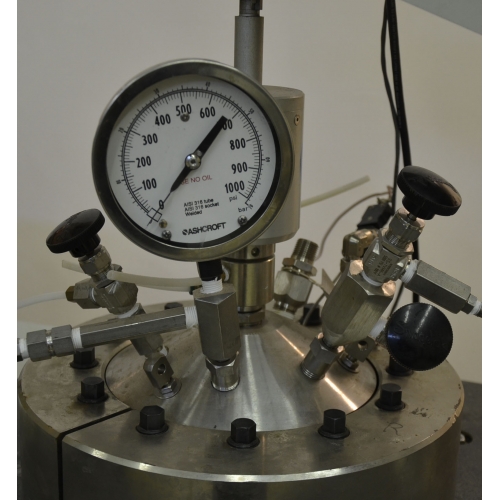
Next you will need correctly rated and calibrated pressure gauges. Installation is straightforward although their importance can not be under estimated. Two is the minimum in case one is not reading properly (stuck needle for example).

Calibrated pressure relief valves are also essential, and once again two is the minimum in case of failure.

If you manage to build a well engineered container then the next step is getting the liquid in it. I suggest first packing it with dry ice (can be found at nearly any supermarket) and then sealing the unit. A bottle of CO2 can be used to maintain pressure although their regulators are intended for low pressure output. If you are unsure of how to perform modifications safely on one of these setups then this project should not be carried out.

Generally what I am getting at is this, a project of this type brings up safety concerns even for a veteran engineer. Playing with extreme pressures and super critical fluids in a home built container is no easy task and could easily result in catastrophic failure.

I certainly can understand the scientific curiosity/challenge aspect(s) of a project like this although there are still other concerns that need addressed beyond what I wrote here. If your skill sets are not in place to at minimum perform the operations listed thus far then I suggest leaving this project alone.

I am not saying you do not have the ability to acquire said skills, just that this is not the type of thing to learn and try them out on.

eatscrayons
  • 716
  • 5
  • 16
1

Use Flange & Blind Flange ANSI 2"-2500# WNRTJ ASME B16.5 A-182 F304. With a gasket RTJ SS304 and bolting.

RainerJ
  • 21
  • 2
  • 14
0

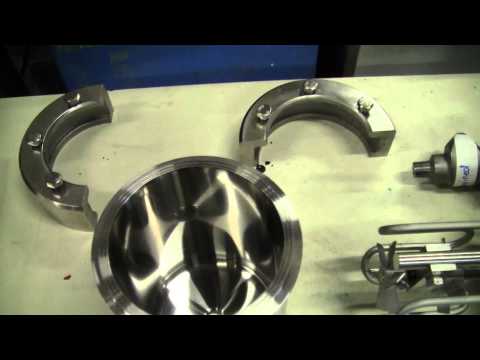
Have you looked at the design that a Parr reactor uses? It would require a bit of machining (mostly lathe work), if that is an option to you. Basically, there are two C-shaped pieces of metal that fit around one end of the vessel (forming a circle). The bottom goes under a lip at the top of the vessel, and the top goes over a lip on the vessel cap. Bolts thread into the top of the C and press down on a metal ring that sits on top of the lip of the vessel cap (the ring is just there to protect the lip of the vessel cap, as the bolts will mar the surface they press against - if the surface gets really bad, you can just replace the ring instead of the entire cap). There is a ring cut out of the bottom of the cap, where a teflon ring can be inserted, and it is pressed into the top of the vessel (where there are a couple of lines cut into the metal to form a better seal).

An alternative with less (or no) lathing would be to have a lip on the top that you drill holes in, matching up with holes that you tap on the lip of the vessel. The lips could be metal rings that you weld on. The downside of this would be that it would be harder to find a way to put a sealing ring in and get a good seal.

You will probably be able to understand this better after looking at some of the pictures of Parr reactors online, then reading through again a time or two. Some decent pictures are found here and here.

Chris Mueller
  • 6,416
  • 2
  • 28
  • 54