8

[When Harry blurted out the name ‘Voldemort’ which wizards are afraid of voicing, Ron gasped and said]
"You said You-Know-Who's name!" said Ron, sounding both shocked and impressed. "I'd have thought you, of all people [...]"
(Harry Potter and the Sorcerer's Stone)

What does "I'd" mean? If it is "I would," the part following "of all people" should be "you would be the last to say the name, for you lost your parents because of him." If it is "I should," the next part should be "you have the courage to say the name, then why do I have to gasp?"

CowperKettle
  • 36,571
  • 17
  • 132
  • 226
Listenever
  • 24,139
  • 38
  • 136
  • 254
  • The "I'd" is not in clause about Harry being the last to say the name; it's in the frame sentence "I'd have thought [that]" = "I would have thought that" = something like "I expected that". – Colin Fine Nov 14 '16 at 23:19

2 Answers2

10

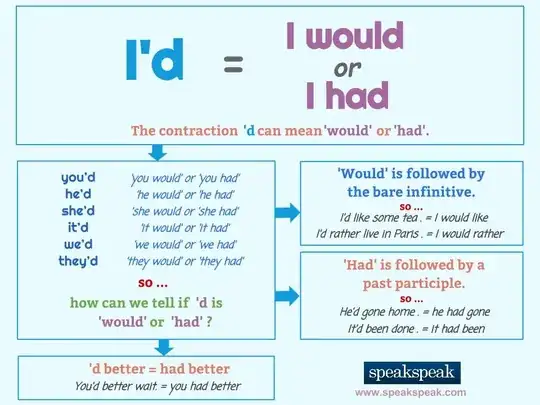
The contraction I’d can mean either ‘I would’ or ‘I had’.

  • would is followed by the bare infinitive (infinitive without to)
  • would can also be followed by the perfect infinitive (have + past participle)
  • had is followed by a past participle.

enter image description here

Credits : http://speakspeak.com/vocabulary-articles/does-id-mean-i-had-or-i-would

aamir
  • 201
  • 2
  • 3
9

"I'd" can be short for "I would" or "I had". You have to tell which from context.

"I would" makes the most sense here. "I would have thought ..."

Jay
  • 65,313
  • 1
  • 69
  • 142
  • 3
    It can also be short for I had. – Matt Ellen Apr 23 '13 at 15:09
  • 3
    When is "I'd" used for "I did"? I don't think this is a standard contraction. Do you have a reference? I do. And also it's never used for "should" in the sense of obligation. – Peter Shor May 05 '13 at 14:16
  • RE "I did": Maybe not. Now that you mention it, all the examples I can think of could just as well have been intended to be "I would". RE "I should": Probably true. Of course the catch to a contraction is that, by definition, it leaves out information, and while it is usually possible to determine the writer's or speaker's intent, there may be ambiguity. – Jay May 08 '13 at 14:59
  • 1
    I would or I had, but not I should or I did. –  Nov 15 '16 at 03:35