Is there any reason, historical or grammatical etc? Why isn't this tolerated like "judgement" or "blueish"?
I couldn't find related posts around here or EL&U forum as far as I searched. I'd truely appreciate your answers...
Is there any reason, historical or grammatical etc? Why isn't this tolerated like "judgement" or "blueish"?
I couldn't find related posts around here or EL&U forum as far as I searched. I'd truely appreciate your answers...

I think you mean you truly appreciate our answers, because--like it or not--that is the modern spelling. You are free to differ from the norm.
I don't know the why (other than an arbitrary rule or practice, such as the one below from the OED), but the how is almost certainly due to dictionary standardization, or standardisation if you prefer the BrE spelling.
EDIT:
from the OED (which gives observations, not rules):
...
When -ly is attached to a disyllabic or polysyllabic adj. in -le, the word is contracted, as in ably, doubly, singly, simply; contractions of this kind occur already in the 14th c., but examples of the uncontracted forms (e.g. doublely) are found as late as the 17th c.Whole + -ly suffix2 becomes wholly, but in all other similar instances the written e is retained before the suffix, e.g. in palely, vilely, puerilely.
Adjs. ending graphically with ll lose one l before -ly, as in fully (in southern English commonly pronounced with a single l, but in Scotland often with double or long l), dully /ˈdʌllɪ/ , coolly /ˈkuːllɪ/ . Adjs. of more than one syll. ending in y change y to i before -ly, as in merrily; in formations from monosyllabic adjs. the usage varies, e.g. dryly, drily; gayly, gaily (cf. daily adj., which is the only current form); slyly, slily (but always shyly); greyly, grayly has always y. Another orthographical point is the dropping of the e in the two words duly, truly.
Another orthographical point is the dropping of the e in the two words duly, truly.
It is unusual to append -ly to an adj. in -ic; the ending of the adv. is nearly always -ically suffix, even when the only current form of the adj. ends in -ic.
Note the "rule" and then the exceptions, duly and truly--so there is no real reason other than this arbitrary practice, and these spellings became enshrined in a dictionary.
The influential 1755 A Dictionary of the English Language by Samuel Johnson spells the word as truly. Here is the entry snipped from the online version:
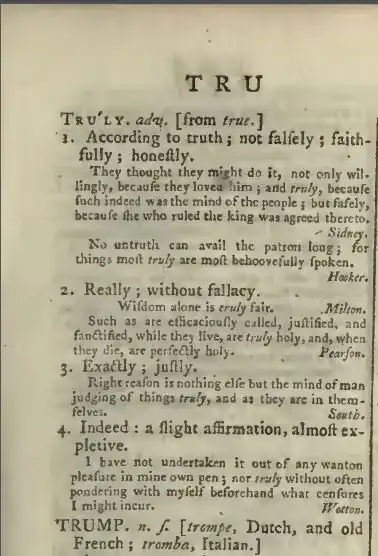
Corresponding to publiction in dictionary, there is no spelling of the word in the entry for truly in the Oxford English Dictionary (OED) that deviates from the spelling truly after about 1700. Truly existed before, along with variant spellings. (Truely exists in other entries after 1700.)
Another word, blue, whose modern adverbial form bluely exists from the late 16th century, was also spelled blewly and bluly before about 1750.
And although we retain the e in nicely and bluely, we do not in wholly and duly--which are also how the 1755 dictionary spells the words. Frankly, these rules are arbitrary, and wholely and duely look about as good as truely.

English words don't often end in u (there are exceptions as always!). The e in true, cue, blue, due etc., therefore serves the function of making the u word-medial. ⟨ue⟩ is a common spelling for [uː] (as in true) and [juː] (as in due), so the e in 'true' and 'due' is there for making the u word-medial.
However, when we append -ly to 'true' and 'due', the u becomes medial and the e becomes superfluous. As is the case with argument (not arguement). Although *truely is attested, it's a misspelling now.
If you don't believe me, look it up in the Irregularities in Modern English by W. Hansen and Hans Frede
