15

I contracted a company to remove a closet partitioning wall along with a header and a few small pieces. That work was all approved by a structural engineer in an official report.

However, I was also having the company install a power outlet in the same location as the now removed wall.

In the corner of the room, the electrician drilled four holes into what I believe to be a load bearing stud while trying to route a cable before abandoning that tactic and cutting squared pieces out of adjacent 2x4s. the guy seemed flustered and rushed, which is making me feel like he may have messed up here.

I've attached photos, some are the holes, and others are contextual to show the stud's location. Is this a problem?

Holes enter image description here

Alternate angle enter image description here

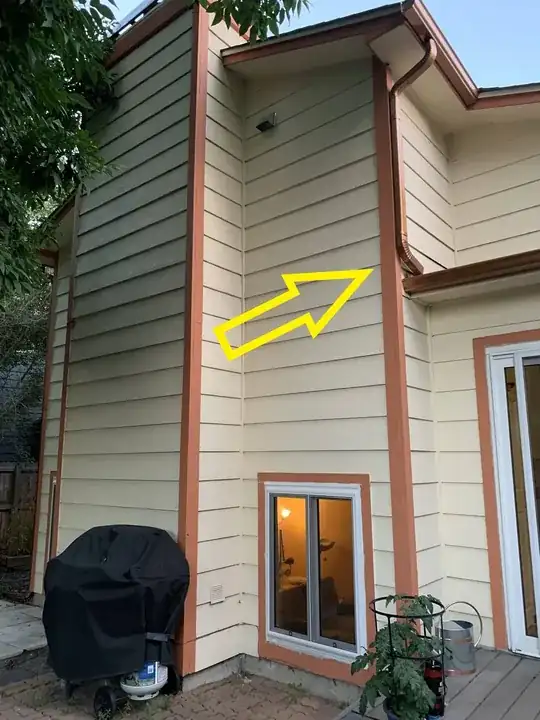
Exterior location

Exterior location

Attic Location enter image description here

In response to the other commenters advising caution, my engineer was a pretty generous guy and I sent him what I sent you all plus some more. Hopefully he won't mind putting my mind at ease "under the table". Additionally, the contractor will be out today and I'll show him exactly what happened and ask that he at least do something to both protect the cable and put our minds at ease. Thanks again.

isherwood
  • 137,324
  • 8
  • 170
  • 404
Kyle
  • 153
  • 1
  • 5
  • http://www.wwpa.org/resources?text=notching%20and%20boring - free download will show tolerances for notches and boring. 25% of stud width ( 7/8" max ) for exterior wall 2x4. – Fresh Codemonger Jul 12 '23 at 04:31
  • drilling is permitted as long the holes are in the middle and not bigger than 30% of the stud with – Traveler Jul 12 '23 at 04:42
  • 2
    Note that there is at least one more member, and likely two, in the corner between the hacked studs. Although the corner member(s) have been drilled, there is no other damage. – HABO Jul 12 '23 at 12:54
  • 1
    @Armand, your eye is off. The total depth of all that damage doesn't seem to exceed the width of a stud (1-1/2") by much at all. At least half the studs are still present and accounted for. This isn't the apocalypse. Everyone loves to be a hero, but no hero is needed here. – isherwood Jul 12 '23 at 12:58
  • @kreemoweet, apparently you've spent little time trying to work in existing structures. Sometimes "heinous" is exactly what's called for, and pretty isn't a priority. – isherwood Jul 12 '23 at 12:58
  • 2
    @armand, "mending" plates don't mend $#!t. They're false confidence in a shiny package. They will do nothing to bolster post structure, and bending isn't an issue in the slightest in this fully sheathed corner. Man am I tired of laypeople peddling horror around here. – isherwood Jul 12 '23 at 13:00
  • @isherwood Thanks for the real-world info - I do appreciate your efforts. My limited experience has been with Strong Tie brand products that are explicitly rated for structural uses when combined with similarly-rated fasteners. – Armand Jul 12 '23 at 15:01
  • 1
    Right, but those are far different from simple plates--they're 3D. – isherwood Jul 12 '23 at 15:04
  • 1
    based on what I can see in the picture, anyone who is worried about what's been cut there has never cut down a tree and recognized how much really needs to be cut away before it loses its standing strength. And then with your cut up stud there (unlike a tree) there's all the other studs up and below it supporting it in the other directions. so what you have cut away I would not worry about – ron Jul 12 '23 at 19:44
  • I'd be more annoyed about the cut vapour barrier. You might want to patch that with plastic film and stout tape before closing up the wall. – Criggie Jul 13 '23 at 02:45
  • Why would you be "annoyed"? This is part of the job requirements and vapor barrier replacement comes later. There's no workaround. – isherwood Jul 13 '23 at 12:51
  • 1
    @MikeWaters Romex 14/2 includes 2 conductors plus ground, no problem with using that. – Armand Jul 14 '23 at 04:09

2 Answers2

25

That is a little rough. It's not a problem.

  • Any stud is part of a system, which includes many other studs, wall plates, wall sheathing, the roof structure, etc. You could take just about any common stud out of a home completely and nothing would happen. The fact that this is a double stud (maybe triple with the sheathing backer outside) means that this damage is even less of a concern.

  • It's on a corner, which means that it's locked in place on both wall planes. There's no concern that the stud can bend whatsoever.

  • There's not much load there. The gable end is basically a giant shear wall. Not much of the roof's load is transferred to that corner.

  • There's actually quite a bit of wood left--probably the equivalent of a whole stud.

  • Inspectors know the things above and aren't concerned with one gouge here or there unless it's in a much more critical member. I've seen much worse in new construction where rigorous inspection passed just fine.

I would ask the sparky to put plates over the cables to protect them, though, and they should be gently let into the studs so they don't bulge the drywall.

Folks here will wring hands over this, but that's partly because they take individual, minor code violations as harbingers of doom and partly because they don't understand the big picture very well. After demolishing many structures in part or whole, modern and archaic, over many years, I have good insight into what makes a structure unstable. This isn't it. Sleep well.

isherwood
  • 137,324
  • 8
  • 170
  • 404
  • 13
    I would ask the sparky to put plates over the cables to protect them That is the important part. Required by electrical code, and especially in a corner because the next owner may assume, correctly, that there is a stud in the corner that they can use to mount heavy stuff with some screws...that will go straight into the cable...zap*. – manassehkatz-Moving 2 Codidact Jul 12 '23 at 14:26
  • Fixing the vapor barrier needs to be done too. Don't forget that part. – Tonny Jul 13 '23 at 12:12
  • +1 for the wall sheathing, As a corner stud it has sheathing on 2 sides, most of the load can transfer from the stud to the sheathing, if the stud bends even slightly... It won't move. – Questor Jul 13 '23 at 16:08
1

I agree it's not a concern, but that is a lot of holes.

For comfort's sake I would fill the holes by getting plugs made out of similar or harder lumber, cleaning up the holes if need be so they are dimensionally tight to the plugs - no more than 1/16” slop. Then mix up some West System 105 epoxy, wet the interior of the holes for good soak-in, then add in 403, 404 or 405 adhesive fillers to thicken it up, heavily coat the hole and plugs with that, and pushing them in until it oozes out everywhere :)

Then use the same process to glue in some blocks to fill in front area of the studs.

That will be as strong as the original stud, if not stronger. Dimensional lumber (typ. white pine or redwood) isn't that strong :)

Harper - Reinstate Monica
  • 300,628
  • 26
  • 286
  • 734