I am not a perfumer of any class, even amateur. Because I have an interest in and have dabbled with essential oils for health benefits, I am intrigued by your question and interested in doing a bit of research on it.
The most pertinent resource I found, the beautiful Blog 'The Scent of Love: Ancient Perfumes - How to make your own perfumes just like the ancient Greeks and Romans did', discusses how rose and myrrh can be blended, with the ultimate idea that you can make a reproduction of a typical ancient perfume for yourself. Starting with a carrier oil (she uses olive oil), she adds a base note from several choices, including myrrh resin, which is ground with mortar and pestal. Mid-notes are then added, among others, rose petals, which are placed directly into the oil. Last they added top notes which consisted mostly of kitchen spices.
"A favorite recipe of many was myrrh, rose, styrax, and marjoram for a warm, sweet perfume." [The Scent of Love: Ancient Perfumes]
In describing how to finish the perfume, once ingrediants have been added to the carrier oil, she says:
"To complete your perfume, heat your oil mixture by pouring the oil and other materials into a glass or ceramic dish, heating water in a pot to boiling, turning the heat off and sitting the dish with the oil into the water as it cools. This process draws the essential oils from the materials and can be repeated more than once. The mixture should then steep for at least 24 hours, at which point it can be strained—cheesecloth lets you wring the oil out while keeping all bits of ground materials out of the final mixture."[The Scent of Love: Ancient Perfumes]
The Scent of Love Blogger, Erin Branham, even offers a printable PDF with complete instructions.
Below is an image she featured in her story, which is very descriptive of the ancient perfume-making process which Branham describes:
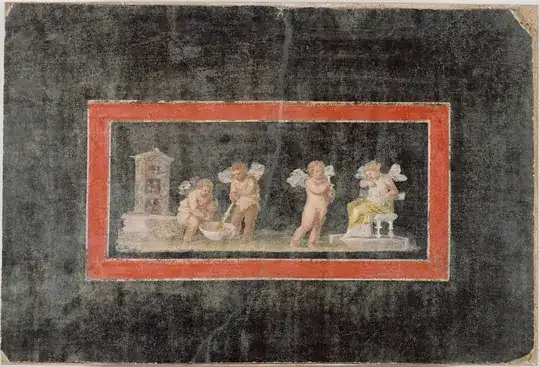 Wall Fragment with Cupids and Psyche Making Perfume, Roman, A.D. 75–100. Plaster and pigment, 14 15/16 x 22 1/16 in. A group of cupids tend a perfume shop in this picture. At right, a cupid holds up an alabastron filled with perfume, while Psyche (Cupid’s beloved) lifts her arm to smell the scent. Image used by permission of Getty Images.
Lastly, I took a gander at a Fragrantica.com, an online encyclopedia of perfumes, a perfume magazine and a community of perfume lovers. This page goes into great detail about all things myrrh, right down to harvesting. At the bottom is an impressive array of around 150 tiny perfume bottles, each one a link to detailed information on a "myrrh perfume". It only took me 8 tries to find one which also contains rose. [Frangratica.com]


