12

I've been hanging my own Pancetta based on the recipe in Ruhlman's 'Charcuterie' book. Some small white dots of mold have started to appear.

I want to identify whether this mold is to be expected or whether it is a sign of my preservation gone wrong. I realise mold is almost an ever present factor in charcuterie but how can you tell the safe mold from the dangerous ones?

colethecoder
  • 997
  • 2
  • 8
  • 21

6 Answers6

11

On another couple of sites (Ruhlman for starters) I found the answer to this. It appears that mould is expected sometimes in the Pancetta making process and as a general rule of thumb as long as it isn't too green and furry then it should be OK. I've followed Ruhlman's advice and dabbed the spots of mould with a vinegar soaked cloth and it wiped straight off and looks fine.

My meat was coming up to the end of it's hanging time anyway so rather than worry about it further I've refrigerated it.

I hope this helps anyone that stumbles across this with the same issue.

glenschler
  • 143
  • 1
  • 4
colethecoder
  • 997
  • 2
  • 8
  • 21
3

The mould is an important part of the curing process and as a general rule, as long as the mould is white and the meat doesn't smell 'bad' in any way, your pancetta will be doing what it's meant to. Sorry, I realise 'bad' might be objective, but generally very obvious to tell off meat with curing. If the mould is white, speckled with black, or mostly black, or green, then your pancetta's in trouble.

nunu
  • 486
  • 2
  • 5
2

if you are using a stble controlled mold (ie. Bactoferm 600 or mondostart etc.) the mold should appear white. if you are begginning to get blue spores there is most likely an issue with air circulation or moreso the relative humidity of the chamber. Humidity should reach into the mid 70s for proper mold growth. to counteract mold one can also purchase potassium sorbate for the war on green and blue.

Since your pancetta is tesa i dont see there being a possibility of internal mold. unless you did a shit job butchering.

I work in a producer of cured meats and our pancetta regularly takes mold from the rest of the room

user22443
  • 21
  • 1
0

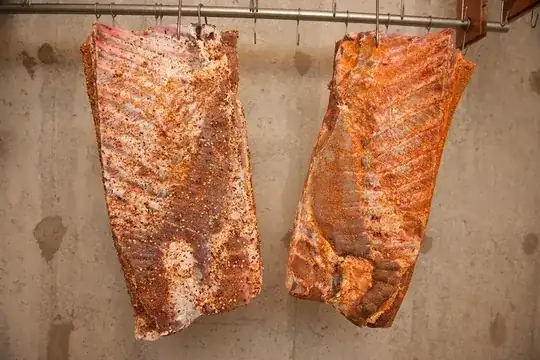
I learned from my fathers methods. In the way we prepare the Pancetta, there is very little mold that forms and if it does (white fuzzy stuff) it gets cut off any way. once it is washed from the salt it has stayed in for its weight. we cover it with hot pepper flakes/fine pepper powder, cured with the ribs in. I have attached a picture of the Pancetta that i made last year after the salting and peppering. 2014 Pancetta

0

enter image description hereI am making Prosciutto for the first time. It sat in my fridge covered in salt for 30 days. It was then hung in my basement for a couple months, but then summer came and the humidity rose. The Prosciutto grew white fuzzy and light green mold. I took it down unwrapped and scrubbed with a water white vinegar mixture. I then wrapped it in cheese cloth again and its on a wire rack in my fridge. Maybe, this will help you.

user48367
  • 1
  • 1
-1

Don't eat the mould - cut it out. Probably scrape it off the meat. I don't know if anyone can comment on using something to prevent growth, like rubbing down with alcohol.

Unless I'm mistaken, you should probably not eat the outer layer of the meat at all.

Marcin
  • 375
  • 3
  • 12