5

Yesterday I thoroughly cleaned my cast iron pan, reseasoned it four times for 30 minutes at 450 with liquid canola oil. The seasoning looked really good, and I had a great sheen across the entire bottom and sides of the pan.

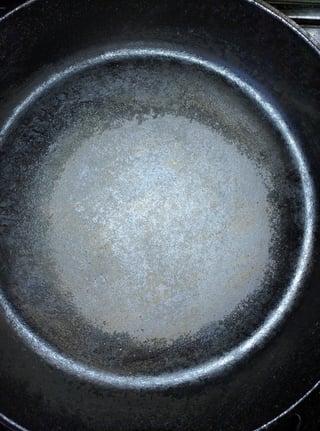
I cooked bacon this morning, then cleaned by scouring with a sponge. I dried with a paper towel, buffed some more canola oil on with a new paper towel, and turned my stove on high. After 15 minutes, the iron was up to 700F-800F. I turned it off, let it cool down and it looks like the seasoning has been stripped from where the pan was hottest, pictured below.

Is there a temperature at which the seasoning is destroyed? If so, what is it? If that's not what caused my problem, what did?

Cast Iron Seasoning Destroyed by Heat

Jolenealaska
  • 58,844
  • 32
  • 207
  • 325
Caleb
  • 2,818
  • 2
  • 13
  • 28

2 Answers2

6

As Jolene linked to in comments, one can certainly burn off cast iron seasoning at a high enough temperature. The exact temperature where it will begin to disintegrate depends on exactly what the seasoning layer is like (composition of oils etc. used to treat it, thickness and number of layers, how thoroughly the oils may have been polymerized, etc.).

Depending on the exact seasoning layer composition and thickness, you'll see a number of different possible scenarios -- the layer could effectively "evaporate off" mostly through smoke, it could flake and degrade, and/or it could turn into a layer of powdery ash (sort of like what one sees after a self-cleaning oven cycle).

There's a lot of kitchen "lore" surrounding cast iron seasoning, even on websites that claim to be based on "science." Everybody has their favorite seasoning methods and materials. So, I'm really not certain of all the chemical details here. But my personal experience is that a "young" seasoning that is rarely or never heated very hot is more likely to "smoke off." A very old seasoning that is quite thick will often leave ash residue (and will require a higher temperature to strip down to bare iron).

No matter how good your seasoning is, though, it will be destroyed by heat long before you get close to damaging the actual iron structure of the pan. There's an old traditional method of stripping seasoning off a cast iron pan that involves throwing the pan into a hot campfire. So this is a very old practice.
Athanasius
  • 33,328
  • 12
  • 103
  • 168
-1

In short : Yes.

More fully, it depends on the oil used. It depends not just on the smoke point of the oil or its fat content, but:

The oil used by artists and woodturners is linseed oil. The food-grade equivalent is called flaxseed oil. This oil is ideal for seasoning cast iron for the same reason it’s an ideal base for oil paint and wood finishes. It’s a “drying oil”, which means it can transform into a hard, tough film. This doesn’t happen through “drying” in the sense of losing moisture through evaporation. The term is actually a misnomer. The transformation is through a chemical process called “polymerization”.

The full explanation is at: http://sherylcanter.com/wordpress/2010/01/a-science-based-technique-for-seasoning-cast-iron/

This was tested in the labs at cooks illustrated (https://www.cooksillustrated.com/how_tos/5820-the-ultimate-way-to-season-cast-iron), so I put it in the category of highly reliable.

An aside: I have also gotten good results with grapeseed oil, when I didn't have flaxseed oil.