I scrub waxed citrus fruit under hot water with a little washing up liquid added as I have been advised. Can I clean up unwaxed citrus fruit coated with imazalil in a similar way please? I use a lot of citrus zest in my baking so this question is important to have an answer.
Asked
Active
Viewed 5.8k times


5 Answers
16
No, you can't wash it off. Part of it is probably that washing methods are not fully effective, another part is that there is diffusion into the fruit, and the diffusion is strongest in the uppermost cell layers. In oranges, this is the peel.
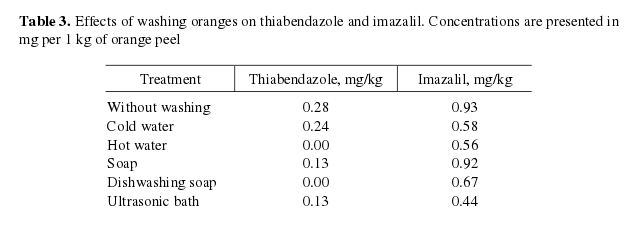 From Kruve, A., Lamos, A., Kirillova, J., & Herodes, K. (2007, September). Pesticide residues in commercially available oranges and evaluation of potential washing methods. In Proceedings of the Estonian Academy of Sciences. Chemistry (Vol. 56, No. 3, pp. 134-141).
The same paper found 0.64 mg/kg imazalil content in orange peel and 0.04 mg/kg in orange pulp before washing. The regulatory allowed limit is 5 mg/kg. So if your fruit starts out with more pesticide than theirs - and it can legally be sold with 8 times more - the residue will be even higher.
If you want to follow safe food preparation practices, you have to use organic citrus fruit for zest. Non organic fruit can have pesticide residue from the growing period and still be labelled as "untreated" because it was not treated post-harvest.
If you are eating only the zest, you can happen to stay under the WHO acceptable daily dose, which is 0.05 mg/kg (human weight, not fruit weight). So if you're a 75 kg man1, you can eat a bit over half a kilogram of orange peel (if it doesn't exceed regulatory limits) and stay under the limit. But 1) you're also taking in the pesticide from the pulp, and while there's less in it, you're eating much more pulp than zest, 2) regulatory limits might be laxer where you live than in the EU, and 3) you're still poisoning yourself, even if it's not enough to become alarmed about it. Why consume one more carcinogen when you can avoid it?
1 it's less for women of childbearing age and children


7
Imazalil is a systemic fungizide that surpresses mold and bacterial growth, for example on the skin of citrus fruits.
As it is a known carcinogen, the consumption of citrus peels treated with it is not advisable, as stated here (in German, sorry) for example by the German a.i.d. (Governement supported agency).
I could not (yet) find a reliable source giving good information on the solubility of imazalil and the effectiveness of washing, so I stick to the official warning of "do not consume".
Without contrary proof, a variation of the basic food safety rule applies:
When in doubt, throw it out - that is, do not use the zest of treated citrus fruits.

Stephie
- 61,426
- 8
- 175
- 226
6
Here in Germany, practically all Citrus fruit treated with any artificial coating (usually any combination of Thiabendazol, Orthophenylphenol, Imazalil) comes with a clear statement "Schale nicht zum Verzehr geeignet" - "Peel unsuitable for consumption". One should assume there is a reason behind that very unconditional statement.
Most supermarkets here will carry both treated and organic (I asked a clerk at an organic store about it, they definitely are not allowed to do wax or treat them in any way) varieties probably for exactly that reason; the interesting thing is that neither of them are immune to getting moldy, nor do any of them mold quickly when stored under normal pantry conditions. Also, citrus fruit that come without an organic label but with an explicit label of "Schale ist verzehrbar" - "Peel is edible","Unbehandelt - Schale nach der Ernte" - "Untreated (Peel, post-harvest)" are becoming common. Not 100% sure if there are waxed products around that state their peel is edible.

rackandboneman
- 15,337
- 3
- 39
- 56
2
Imazalil has a limited shelf life (after application) I guess one should keep the fruit (citrus) in the fridge for a while (maybe a week? considering that it has been already stored for a week before you got to buy it from the store...) please read "Degradation of imazalil, orthophenylphenol and pyrimethanil in Clementine mandarins under conventional postharvest industrial conditions at 4 °C" Washing will not help much but like any fruit/product to be consumed should be thoroughly cleaned; I use warm soapy water & baking soda for mine in hope I remove most of the wax as well as possible germs.

-2
How long do fungicides in wax on oranges take to degrade? That may solve a problem. Or just wash wax off hands after peeling. Our bodies are very good at getting rid of bad things.
