11

I've been told that I should be rinsing Chinese tea with the boiled water before the first full infusion intended for drinking.

I make the occasional very-expensive tea from Taiwan and I feel it is a waste to throw away a first pot simply for "rinsing". However, my mother-in-law insists it is correct to rinse the tea first :-)

Is this practice of rinsing always advisable, or are there specific cases or kinds of tea where rinsing is necessary? What are we trying to rinse away? Is the practice only for Chinese tea, or for other kinds of tea as well?

Looking for some enlightenment from some tea experts. Thank you!


Update:

Since I asked the question, my mother-in-law came across a newspaper article, in Chinese, describing pesticides found on some teas from China, and so it is advisable to rinse before consuming.

Here's a scan I made of the article:
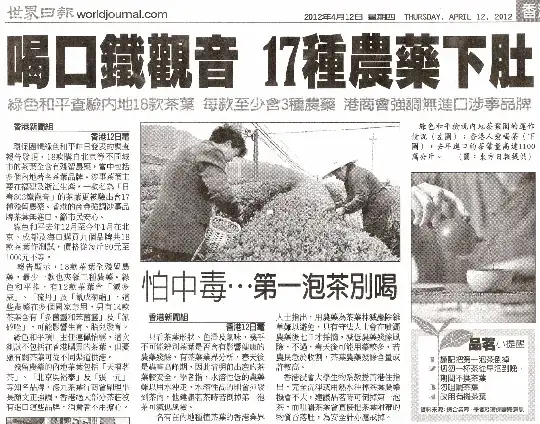
Scanned article about Chinese teas

Something in English...

Essentially, the article references a 2012 report by Greenpeace. You can read a press release about the report, and here's a link to the report itself: Pesticides: Hidden Ingredients in Chinese Tea Report (PDF). Press release summary:

A Greenpeace investigation has found pesticides banned for use on tea in the products marketed by some of China's top tea companies. Some of the firms, which include China Tea, Tenfu Tea and China Tea King, export tea products to Japan, the US and Europe.

For that reason, I accepted the answer below which suggests rinsing for reduction of pesticides.

Of course, I don't think I'd want to drink a tea with 17 kinds of pesticides present, even if rinsed! Caveat emptor ... I plan to ask more questions when I buy my tea.

Chris W. Rea
  • 527
  • 3
  • 7
  • 16

7 Answers7

8

Usually the first infusion is to remove pesticides and some dust that accumulates while aging the tea. Another reason is to let the dry leaves "breathe" to bring out their taste in subsequent infusions. You're supposed to drain out the water in seconds; so it shouldn't take away the taste.

thesquaregroot
  • 189
  • 1
  • 8
KMC
  • 1,984
  • 5
  • 19
  • 27
6

Yes, this is something you almost always want to do with fine Chinese (or Japanese) tea. It is not necessary, or useful, with inexpensive tea.

The purpose of the first rinse is to rinse away some of the bitter compounds which will be present on the outside of the tea leaves, so that more of the full flavor of the tea can shine through when you actually steep it. The lighter and more delicate the flavor of the tea, the more important rinsing is; on spring green teas, for example, the initial bitterness can completely overwhelm any other flavor if you don't rinse.

It's not necessary to do this with all teas; for example, teas which come in ball, flower, or other artistic forms have usually been rinsed before shaping and drying. If I get a chance to research later I'll give you some categorical advice on which other teas usually don't need rinsing.

EDITED TO ADD: I asked a friend of mine who's a tea buyer about this (Silk Road Teas). She said that rinsing is really only required with Oolong teas, and it's more to open the leaves than to wash away any bitterness. The reason I needed to rinse the Spring Tea, for example, is that it's an oolong and not a green as I'd thought.

FuzzyChef
  • 65,749
  • 19
  • 162
  • 246
4

When I was in China (July 2012), we visited a tea merchant. Our guide said that if we bought any tea we should throw out the first brew to get rid of the pesticides. Since I couldn't see how the government would benefit by giving out that info (and I think most professional guides are affiliated with the government), she seemed pretty credible. I've been looking on web sites for more precise directions, since I don't exactly remember the process she suggested. Given China's record for other environmental abuses (e.g. their coal pollution problem and the Three River Gorges dam), I'm not surprised about Greenpeace's findings regarding pesticides.

James
  • 41
  • 1
3

As far as rinsing of tea leaves goes, it does help remove the pesticides to a great extent. Teas made by fermenting, like the Darjeeling tea and Chinese teas are often rinsed to 'wake' the leaves. A quick rinsing is required preferably less ten seconds. Caffeine is removed to some extent because of rinsing but to remove the optimal level of caffeine one has to discard the tea got from more than 5minutes steeping. If the intent is to remove caffeine than one has to compromise a bit on tea flavor and aromas. To minimize the flavor and aroma loss one should always choose high quality tea leaves which produce consistent tea quality over multiple infusions.

SourDoh
  • 11,544
  • 1
  • 32
  • 48
3

You have to rinse pu-erh tea at least once. http://www.teavivre.com/info/brew-an-enjoyable-pu-erh-tea/

2

A recent Chinese study shows that rinsing tea can reduce pesticides but can't remove them completely:

The results showed that the 8 pesticides transferred into the rinse water at rates between 0.2% and 24% after 5, 10, 20, or 30 seconds. Rinsing tea before brewing reduced the pesticide risk levels by 5 to 59% in the tea infusion.

https://www.ncbi.nlm.nih.gov/pubmed/30350971

https://pubs.acs.org/doi/10.1021/acs.jafc.8b04908

-1

Washing your tea is useless in my opinion.

I get rid of impurities by using a strainer instead of throwing away the baby with the badwater. I wake up the tea by warming up the gaiwan (reusing the bottle water I use for it) and putting the tea in the empty pre-heated gaiwan for a while. I try to buy tea with little pesticides, but keep in mind that organic etc. also contain pesticides. They are not always easy to dissolve or wash away, and they are also not only on but also present inside the leaves.

Washing tea is like buying a good wine and spitting it out because it contains alcohol. Tons of people drink bad teabag tea every day and never rinse it.

Your good quality loose tea, that you spent hard earned money on, deserves to be consumed, not thrown away.

tvlooy
  • 107
  • 1